Vultures are good for potters and tanners, because these live away from the city and because the birds handle the dead.
Passage Book II, 20
9 readings from 4 sources.
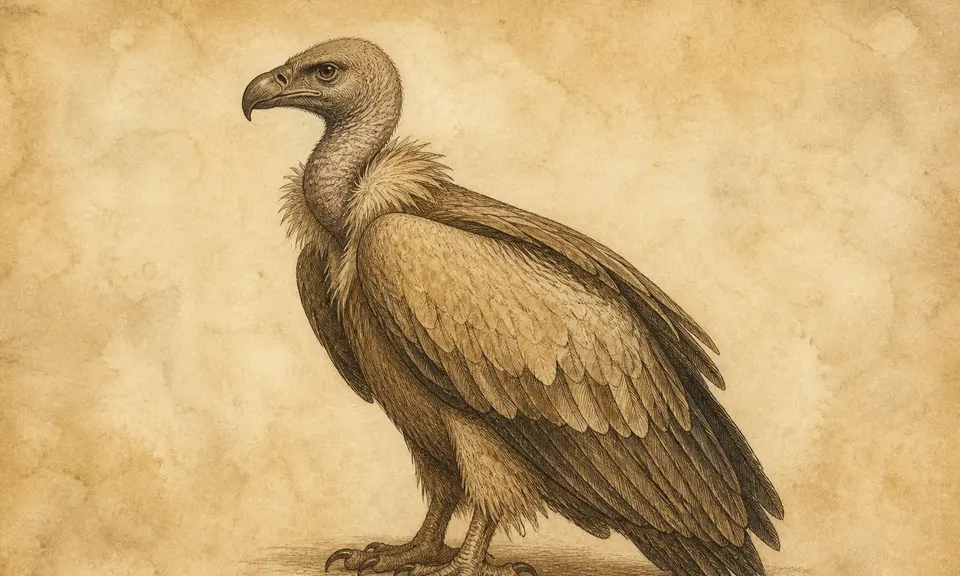
Jagaddeva does not read the bird but where it settles: when a vulture or a crow comes down on a person's head in a dream, or builds its nest there, it means misery as a rule. an-Nabulsi does not read the landing at all and gives the vulture the highest praise any bird gets in his book — the king of birds, the highest of them in flight and the longest-lived. The Indian reading watches what the bird does to a man; the Arabic one watches the bird, and they do not meet anywhere. Another Arabic reading takes a different bird, the carrion vulture and not the king of birds, and it is the longest of them: it is a foolish, filthy man by night and an illness by day, and many of them entering a town is an army of the lowest sort come down on its people. And then it does what the other books do not and sorts the trades, since for tanners and potters and anyone whose work is outside the town the bird is good and useful, while for physicians and the sick it is ill. Artemidorus does the same sorting by trade and gets there first: vultures are good for potters and tanners, because these live away from the city and because the birds handle the dead, but for physicians and for the sick they are bad, and for everything else they are bad. Miller keeps the one reading that makes the bird a plot rather than a man: a scheming person is bent on injuring the dreamer, and will not succeed unless the vulture is seen wounded or dead.
This paragraph was generated by a model. It sums up the sources above, comes from none of them and is attributed to no one.
Vultures are good for potters and tanners, because these live away from the city and because the birds handle the dead.
Passage Book II, 20
Those that lie in wait for the dead and hunt nothing mean idle and sluggish men, or layers-out of corpses, or sellers of burial goods, or tanners, or men driven out of the city, as vultures.
Passage Book IV
But for physicians and for the sick they are bad.
Passage Book II, 20
They also mean enemies who are accursed and foul and who do not live in the city.
Passage Book II, 20
And for everything else they are bad.
Passage Book II, 20
If birds such as the vulture or the crow settle on someone's head in a dream or build nests there, this as a rule means misery for men.
In a dream it is the king of birds, the highest of them in flight and the longest-lived. And whoever sees a vulture contending with him — then a ruler grows angry with him and sets an oppressive man over him, because Solomon, peace be upon him, set the vulture over the birds and they feared it. And whoever sees that he owned a vulture that is obeyed got a great kingdom and honour and might, and he gains power over a king or a great ruler. And whoever owned a vulture and flew with it and was not afraid — then his affair rises high and he becomes a great tyrant. And whoever got a vulture's chick, a son is born to him who will be great. And whoever sees that by day — then he falls ill; and if it scratched him, his illness grew long. And the slaughtered vulture points to the death of a king of the kings. And the woman with child, when she saw the vulture, then she sees the midwife and the wet nurse. And the vulture is read as the greatest of kings, and is read as the prophets and the righteous. And whoever sees the vulture and heard its voice quarrelled with a man. And whoever ate of the flesh of the vulture, or took something of its feathers or of its bone, then he gets money from a ruler. And whoever sees a vulture that carried him and flew with him — if it flew with him sideways, then he travels a journey in authority and elevation; and if it flew with him rising toward the sky, he died upon his journey. And the vulture points to length of life, and it points to abundant money and to war; and the sight of it may point to the new-fangled thing and to straying from guidance, by the word of God Most High: nor Yaghuth and Yauq and Nasr; and they led many astray. And the vulture may point to jealousy over the household. And whoever sees that a vulture plunged down with him from the sky to the earth — then his affair is not completed for him, and his authority and his kingdom pass away from him.
Section letter nun
It is in a dream a foolish, filthy man, if it was seen at night; and if it was seen by day, it is an illness. Whoever sees that he took a vulture falls into a war in which there is much blood; and perhaps he falls gravely ill. And it is said whoever saw it in his house, it is a help he sends. Whoever sees many vultures enter a town — an army of the lowest sort has come down on its people, men of what is forbidden. And if a sick man saw a vulture in his house, he dies, or his sickness comes close to the one entrusted with him. And the vulture, for the tanners and the potters and whoever has his trade outside the town, is a sign of good and of use; but for the physicians and the sick it is a sign of ill. And the vultures point to enemies, and to the coming of a low people, come down from elsewhere, who do not live in the city; and they point to idle men, and to men who wash the dead or who shelter in the graveyards. And the vultures point to the thieves between the walls, or to those who take what is forbidden in their earning. And they point to parting and to desolation and to the ruin of what was inhabited and to foul speech.
Section letter ra
To dream of vultures, signifies that some scheming person is bent on injuring you, and will not succeed unless you see the vulture wounded, or dead. For a woman to dream of a vulture, signifies that she will be overwhelmed with slander and gossip.