Vineyard

5 readings from 3 sources.

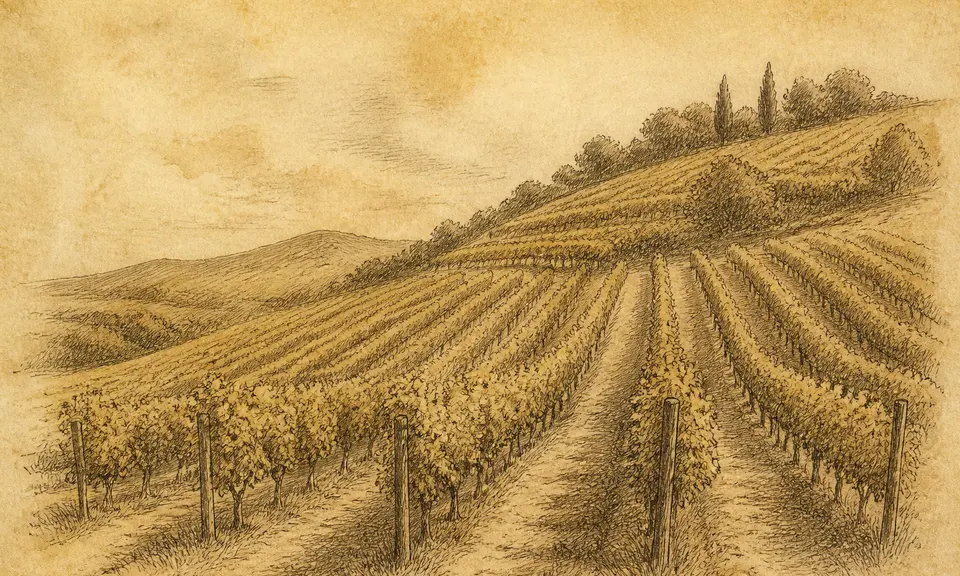
The image was generated by a model. It is not a period engraving and comes from none of the sources.

Miller reads the planting by its condition: a vineyard means favourable speculations and auspicious love-making, an ill-kept vineyard full of bad odours means disappointment overshadowing the best hopes, flowering vines good health, dead vines failure in a momentous enterprise, poisonous ones a plausible scheme that will cost the dreamer his health. an-Nabulsi reads the vine as standing and as a person: it is honour and nobility for whoever planted it, as every tree is, and the vine is a woman of means — so that taking cuttings from it means getting money from a noble woman, the trellised vine is a generous woman, and it is said the vine is a generous man. Artemidorus reads neither the vineyard nor the vine but a vine in the wrong place, and uses it for a rule about how much a dream can hurt: whatever a man sees that is like or akin to his own household is less bad when it is seen together with what belongs to it. A man who had a jar full of wine dreamed that a vine had grown out of the jar; there was a dead viper in that jar and the wine was spoiled, but nobody drank and nobody died, because they had resolved to strain the wine first, meaning to drink it again, and so learned what had happened and poured it away. It was fitting that these men should not die, he says, for since the vine belongs to the liquid in the jar, the dream turned out the less bad.

This paragraph was generated by a model. It sums up the sources above, comes from none of them and is attributed to no one.

Greek dream book

Whatever a man sees that is like or akin or of his own household, that thing, when it is seen together with what is his own and akin to it, would be less bad. For instance, a man who had a jar full of wine dreamed that a vine had grown out of the jar.

Passage Book IV

In the case of the vine that had likewise grown out of the jar: for this man too there was a dead viper in the jar and the wine was likewise spoiled, but no one drank nor died; for since they had resolved to strain the wine first, meaning to drink it again, they learned what had happened and poured the wine away. And it was fitting that these men should not die: for since the vine belongs to the liquid in the jar, the dream turned out the less bad.

Passage Book IV

Ὀνειροκριτικά (Oneirokritika)

Artemidorus of Daldis; edited by Rudolf Hercher

second century; Hercher’s edition 1864 · Greco-Roman

the source of the ancient tradition itself, which the others draw on

About this source

Five books of second-century Greek prose, not an alphabetical dictionary: the readings sit inside argued chapters and the author says of each one why it reads as it does. It is the source the other European and Arabic dream books draw on, including where they do not name it.

Rights: public domain

Where the text is from: https://archive.org/details/bub_gb_CRwTAAAAQAAJ

Arabic dream book

In a dream it is honour and nobility for the one who planted it, and so is every tree; and the vine is read as a woman of means, so that whoever saw that he took cuttings from the vine got money from a noble woman. The trellised vine is a generous woman, and it is said the vine is a generous man. And whoever sees a vine bearing in winter — it is read as a woman whose money has gone, while he thinks she is well off. And if he plucked something from the vine, his money went to the woman in the measure of what he plucked; and if he plucked nothing, he got clear of her even. And whoever sees the vine and its leaves has use of the quarter of a people in religion and obedience. And the vine stock is a sign of good for the man who wants to marry, for the way its parts tangle together and its roots wind about. And the vine's trellises are a fair, well-off woman with servants; and so too the vineyard garden is a woman. And whoever sees a vine that has grown above his head — sores come out on his head.

Section letter kaf
The Perfuming of Mankind in the Interpretation of Dreams

Abd al-Ghani al-Nabulsi

before 1731; first printed Cairo 1858 · Arab-Islamic

carries the ancient tradition after Artemidorus

About this source

An Arabic dream book by the Damascene scholar al-Nabulsi, an alphabetical dictionary of two and a half thousand headwords. It draws on the ancient tradition directly: Artemidorus was translated into Arabic by Hunayn ibn Ishaq in the ninth century. The readings here almost always address the dreamer’s standing, property and faith rather than their feelings.

Rights: public domain

Where the text is from: https://shamela.ws/book/1217

Miller

To dream of vines, is propitious of success and happiness. Good health is in store for those who see flowering vines. If they are dead, you will fail in some momentous enterprise. To see poisonous vines, foretells that you will be the victim of a plausible scheme and you will impair your health.

To dream of a vineyard, denotes favorable speculations and auspicious love-making. To visit a vineyard which is not well-kept and filled with bad odors, denotes disappointment will overshadow your most sanguine anticipations.

Ten Thousand Dreams Interpreted; Or, What's in a Dream

Gustavus Hindman Miller

1901 · American Victorian

carries fragments of the ancient tradition without its system

About this source

An American dream book, the only one here that knows the telephone, the railroad or the elevator. Doctrinally it is the most degraded: it keeps fragments of the ancient tradition without the system that once held them together.

Rights: public domain

Where the text is from: https://www.gutenberg.org/ebooks/926