Tragedy

3 readings from 2 sources.

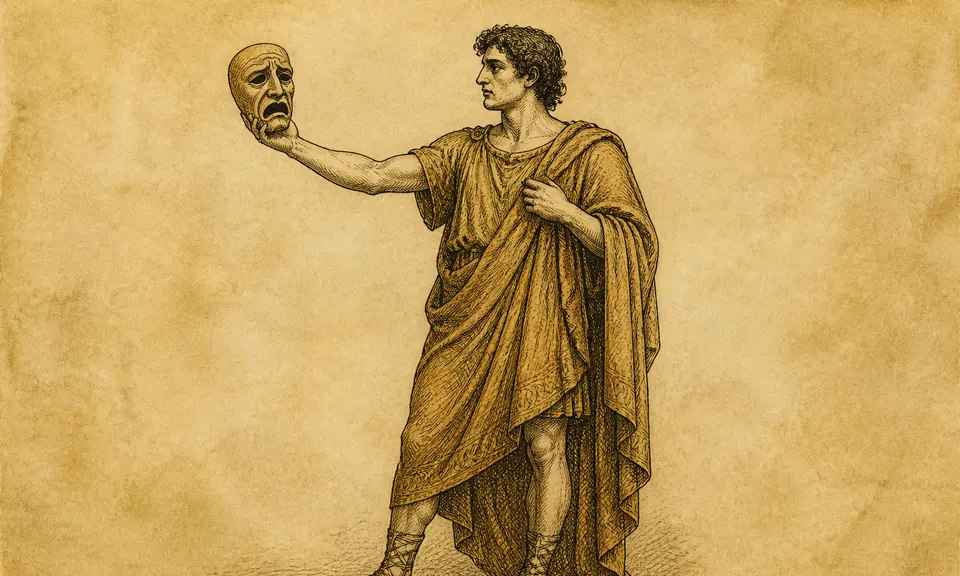
The image was generated by a model. It is not a period engraving and comes from none of the sources.

Artemidorus reads tragedy by the dreamer's memory, and that reading has no match in the whole corpus: to act in tragedy, to have tragic plays or figures, to hear tragic actors or to speak iambic verse — for the man who remembers what was said in the passage, the outcome follows what was said. For the man who does not remember, it means hardships and slavery and fights and outrages and dangers, and anything more dreadful or more savage than these, for tragedies are full of such things. The content of the dream decides only if the dreamer has kept hold of it; otherwise the genre decides. Miller has no such condition and gives two readings according to whether the dreamer only watches or is caught up in it: to dream of a tragedy foretells misunderstandings and grievous disappointments, and to dream that you are implicated in one portends a calamity that will plunge you into sorrow and peril.

This paragraph was generated by a model. It sums up the sources above, comes from none of them and is attributed to no one.

Greek dream book

To act in tragedy, or to have tragic plays or figures, or to hear tragic actors, or to speak iambic verse: for the man who remembers what was said in the passage, the outcome follows what was said; but for the man who does not remember, it means hardships and slavery and fights and outrages and dangers, and anything more dreadful or more savage than these, for tragedies are full of such things.

Passage Book I, 56

Further, one must attend to those histories that are much talked of and believed by the greatest number, such as the stories about Prometheus and Niobe and each of the subjects of tragedy: for even if these are not so, yet because they have been taken for granted by the greatest number they come out in the same way as their contents.

Passage Book IV

Ὀνειροκριτικά (Oneirokritika)

Artemidorus of Daldis; edited by Rudolf Hercher

second century; Hercher’s edition 1864 · Greco-Roman

the source of the ancient tradition itself, which the others draw on

About this source

Five books of second-century Greek prose, not an alphabetical dictionary: the readings sit inside argued chapters and the author says of each one why it reads as it does. It is the source the other European and Arabic dream books draw on, including where they do not name it.

Rights: public domain

Where the text is from: https://archive.org/details/bub_gb_CRwTAAAAQAAJ

Miller

To dream of a tragedy, foretells misunderstandings and grievious disappointments. To dream that you are implicated in a tragedy, portends that a calamity will plunge you into sorrow and peril.

Ten Thousand Dreams Interpreted; Or, What's in a Dream

Gustavus Hindman Miller

1901 · American Victorian

carries fragments of the ancient tradition without its system

About this source

An American dream book, the only one here that knows the telephone, the railroad or the elevator. Doctrinally it is the most degraded: it keeps fragments of the ancient tradition without the system that once held them together.

Rights: public domain

Where the text is from: https://www.gutenberg.org/ebooks/926