It is good also to bathe in springs and lakes and fountains and rivers that have clean and clear water, but not to swim, since swimming is bad for everyone and a token of danger and of illness.
Passage Book I, 64
5 readings from 3 sources.
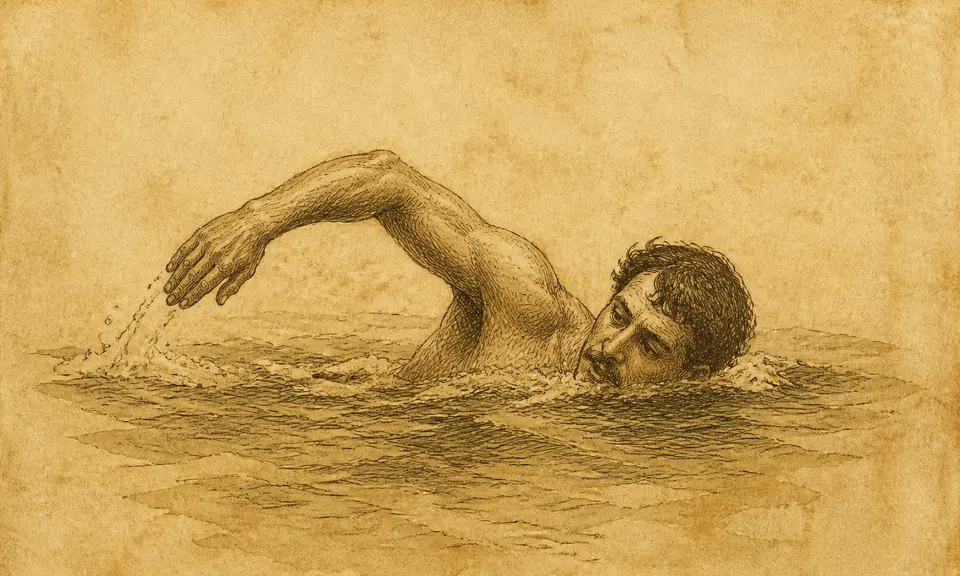
Miller asks how the swimming felt and an-Nabulsi asks where the water was. Miller's whole reading turns on comfort: swimming is an augury of success if you find no discomfort in the act, feeling yourself going down means much dissatisfaction will present itself, and swimming under water foretells struggles and anxieties. The body's sensation is the instrument. an-Nabulsi barely mentions how it feels and maps the water instead, and the reading is one of the longest in his book: swimming in the sea is knowledge attained if the dreamer was a scholar, and knowledge sought and then abandoned if he turns back to the shore, while swimming on dry land is imprisonment, and the length of the sentence is measured by how hard the swimming was and how near the land. A valley on level ground is service to a tyrannical sultan; the deep of the sea swum well is a mighty governance; still water is a king's anger; afraid, it is fear and imprisonment or sickness. The two agree only that going under is bad — and an-Nabulsi adds the rule Miller never thought to give, that it is better to see yourself saved from the water before you wake than to wake while you are still swimming. Artemidorus agrees with neither of them and condemns the act itself, since it is good to bathe in springs and lakes and rivers that have clean water, but not to swim, swimming being bad for everyone and a token of danger and of illness: whatever a fish suffers on land, a man may reasonably suffer in the water.
This paragraph was generated by a model. It sums up the sources above, comes from none of them and is attributed to no one.
It is good also to bathe in springs and lakes and fountains and rivers that have clean and clear water, but not to swim, since swimming is bad for everyone and a token of danger and of illness.
Passage Book I, 64
To dream of swimming in a river or a lake means being driven to the utmost danger, for whatever a fish suffers on land, a man may reasonably suffer in the water.
Passage Book II, 27
It is always better to swim across than to be woken in the middle of the swim.
Passage Book II, 27
Whoever saw in a dream that he swims in the sea: if he was a scholar, he reached his need in knowledge. And if he swims and then returned to the shore, he seeks knowledge and then leaves it. And it is said: swimming is imprisonment. So whoever saw that he swims upon dry land is imprisoned, and narrowness reaches him in his prison, and he stays in it to the measure of the hardness of the swimming or its ease, and to the measure of his nearness to the land. And if he saw that he swims in a valley upon level ground until he reaches a place he wants, he enters into the service of a tyrannical, oppressive sultan, and he asks of him a need of his and he fulfils it, and he gains a footing with him, and God the Most High makes him safe to the measure of his running in the valley. And if he was afraid, he fears such a sultan; and if he was saved, he is saved from him. And if he entered the deep of the sea and swam well in it, he enters into a great matter or a mighty governance, and he gains a footing with the king, and he attains might and strength. And if he swam upon his back, he repents and turns back from his disobedience. And if he swam in the sea and its water was still, he enters into the service of a king, and the work is troubled for him, and the king grows angry with him; and if he crossed the sea, he is saved. And if he swam while he was afraid, he attains fear and imprisonment or sickness, and that grows long upon him to the measure of his distance from the land. And if he thought that he would not be saved, he dies in that care. And if he was bold in his swimming, he comes safe out of that service. And if a sultan saw that he wants to swim in a sea tossing with its waves, he stands against a king among the kings; and if he cut across the sea by swimming, he killed that king. And every sea or valley that dried up is the going away of the fortune of whatever is ascribed to it; and if he saw that the water had come back, it is the return of the fortune of whatever is ascribed to it. And if he saw that he swims in a river or a lake and that he is choking, and that he was lifted from the river choking like a fish when it is thrown upon the ground, then there comes upon that man of hardship in the water the like of what comes upon the fish on land. And for a man to see that he has been saved from the water by swimming before he wakes from his sleep is better for him than to wake while he is in the water swimming.
Section letter sin
To dream of swimming, is an augury of success if you find no discomfort in the act. If you feel yourself going down, much dissatisfaction will present itself to you. For a young woman to dream that she is swimming with a girl friend who is an artist in swimming, foretells that she will be loved for her charming disposition, and her little love affairs will be condoned by her friends. To swim under water, foretells struggles and anxieties. See Diving and Bathing.