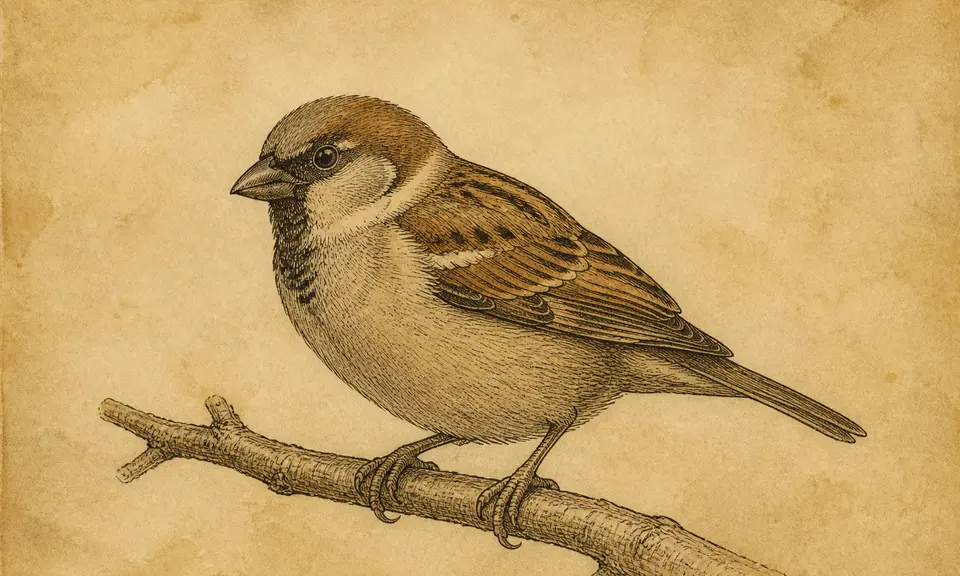
Sparrow

2 readings from 2 sources.

The image was generated by a model. It is not a period engraving and comes from none of the sources.

The smallest bird in the corpus gets a kind word in both books, and for different reasons. Miller surrounds the dreamer with love and comfort, makes him listen kindly to tales of woe, and has his benevolence win him popularity; sparrows wounded or distressed foretell sadness. an-Nabulsi reads the bird as a person — a man given to amusement and to tales, at whom people laugh — and then adds that it points to a male child. The chatter is in both readings; one book hears sympathy in it and the other a joke being told.

This paragraph was generated by a model. It sums up the sources above, comes from none of them and is attributed to no one.

Arabic dream book

In a dream he is a man given to amusement and to tales, at whom people laugh; and it points to a male child. And whoever sees that he slaughtered a sparrow — a weak son was born to him and death was feared for him. And it is said the sparrow points to a quarrelsome man of much money, possessed of leadership, full of devices in his affairs. And the sparrow points to a beautiful woman. And the voices of the sparrows point to fair speech or to the study of knowledge. And many sparrows are monies without toil for whoever gathered them in the dream. And the sparrows are read as boys. And whoever sees that in his hand is a sparrow attains ten dinars. And the sparrow is a man of great worth; so whoever sees that he got a sparrow or owned it gains power over a man of great worth, and likewise whoever saw that he hunted it. And whoever sees that he slaughtered it gets what he wanted of that man. And if he saw that he plucked some of its feathers or ate of its flesh, then he gets of his money. And if it was a female, then she is a woman. And whoever sees that he slaughtered a hen sparrow takes the maidenhead of a slave girl. And whoever sees that he got a sparrow's chick gets a son who reaches the rank of the great men. And whoever sees that in his hand or in his cage is a sparrow, and then it flew off and did not come back to him — then his sick child is dead. And whoever sees that he sews up the eyes of the sparrows deceives the boys and plots against them. And whoever sees that he got the chicks of the sparrows gets many children. And whoever sees that a sparrow went into his throat — if he has a small child, then it falls into a well. And whoever sees that he owned many sparrows grows wealthy and takes charge over a people of consequence. And the sparrows point to gathering and familiarity and love with the household and the kinsfolk at the feasts; and they may point to gathering in acts of disobedience, and to rout and to scattering.

Section letter ayn

The Perfuming of Mankind in the Interpretation of Dreams

Abd al-Ghani al-Nabulsi

before 1731; first printed Cairo 1858 · Arab-Islamic

carries the ancient tradition after Artemidorus

About this source

An Arabic dream book by the Damascene scholar al-Nabulsi, an alphabetical dictionary of two and a half thousand headwords. It draws on the ancient tradition directly: Artemidorus was translated into Arabic by Hunayn ibn Ishaq in the ninth century. The readings here almost always address the dreamer’s standing, property and faith rather than their feelings.

Rights: public domain

Where the text is from: https://shamela.ws/book/1217

Miller

To dream of sparrows, denotes that you will be surrounded with love and comfort, and this will cause you to listen with kindly interest to tales of woe, and your benevolence will gain you popularity. To see them distressed or wounded, foretells sadness.

Ten Thousand Dreams Interpreted; Or, What's in a Dream

Gustavus Hindman Miller

1901 · American Victorian

carries fragments of the ancient tradition without its system

About this source

An American dream book, the only one here that knows the telephone, the railroad or the elevator. Doctrinally it is the most degraded: it keeps fragments of the ancient tradition without the system that once held them together.

Rights: public domain

Where the text is from: https://www.gutenberg.org/ebooks/926