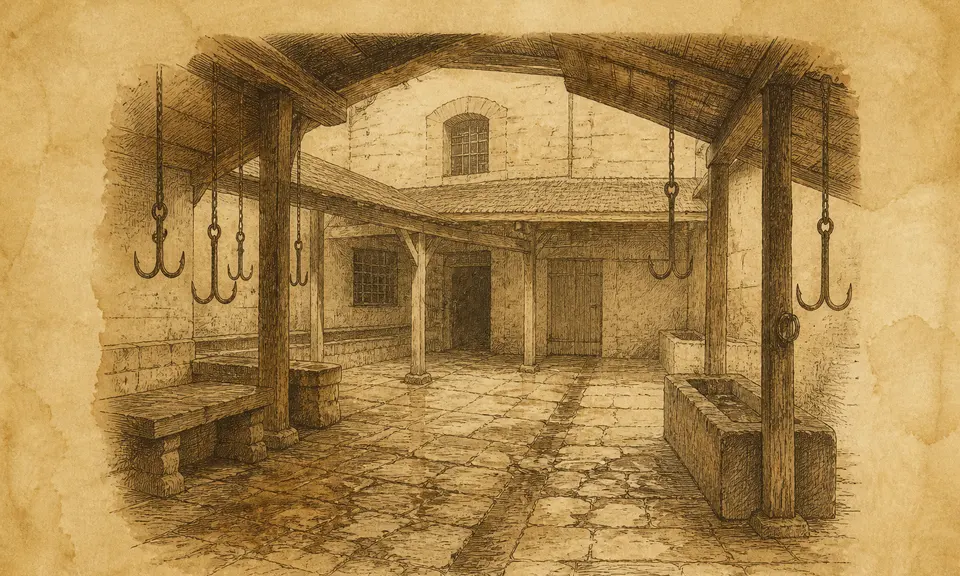
Slaughter-house

3 readings from 2 sources.

The image was generated by a model. It is not a period engraving and comes from none of the sources.

Miller reads the slaughter-house as reputation: it means you will be feared more than loved by the woman you love, your business will show a hidden drain, and unkind insinuations will follow. an-Nabulsi reads the act, not the place, and begins at the opposite end: slaughter is the crossing of parents and it is wrongdoing — but a people seen with their throats cut is a sign that the dreamer's affairs are being completed, and faster still if he cut the throat himself. Being slaughtered is release for a prisoner, safety for a frightened man, freedom for a slave, a wider office for a commander. Slaughtering what is not lawful to slaughter means wronging the one it is done to; slaughtering a close kinsman means breaking with him. The long middle passage is a worked example: a child slaughtered and roasted, with the roast left uncooked, means ugly talk against the parents — and the proof that the talk is false is precisely that the fire did not cook it through.

This paragraph was generated by a model. It sums up the sources above, comes from none of them and is attributed to no one.

Arabic dream book

In a dream it is the crossing of parents and it is wrongdoing. Whoever sees that he has had his throat cut, let him seek refuge with God. Whoever sees a people with their throats cut — that is a sign of good, that the affairs the dreamer wants are completed. Whoever sees in his dream that he cut another's throat, or that another cuts his, that too is a sign that affairs are completed, only faster. Whoever sees somebody having his throat cut by a slaughterer — the one slaughtered gets good from the slaughterer: if he was a prisoner, he gets release; if he was afraid, he gets safety; if he was a slave, he is freed; if a captive, he is ransomed; and if he was a commander, he gains in his office. Whoever sees that he cuts a man's throat — and so with everything whose slaughter is not lawful — then the doer wrongs the one it is done to. Whoever slaughters one of his close kin neglects his worth and breaks with him. A slave slaughtered in a dream is set free. And whoever was in care and saw that he had been slaughtered — his care is relieved. Slaughter is marriage: whoever slaughters what stands for women, such as doves and ewes, marries; and whoever slaughters something from the nape of its neck comes to it from behind. Whoever sees a slaughtered man and does not know who slaughtered him — that is a man who has brought in an innovation, or has put his name to false witness and to judgment and sentence. And whoever slaughters his father and his mother crosses them and transgresses against them. Whoever slaughters a woman lies with her, and likewise if he slaughtered a female animal he lies with his wife and takes a virgin. And if he sees that he slaughtered a small child, an infant, and roasted him and the roast did not cook through, then the wrong in it falls on the child's father and mother. If the child was in a place of being wronged, he is wronged in his right and ugly things are said of him, as much as the fire took of his flesh without cooking it through — and if what was said of him were true, the roast would have cooked. And if the child was not the one the talk and the wrong belonged to, then it falls on his parents: they are wronged and charged with a lie and people talk much about them, and all of it is void, so long as the fire did not cook the roast through. And if he sees the child slaughtered, that is the child reaching the stature of men; and if they ate of his flesh, they get of his good and his favour. And if he sees that a ruler slaughtered a man and laid him on the dreamer's neck, then the ruler wrongs a man and demands of him what he cannot do, and presses that demand on this carrier; and the weight of the money matches the weight of the slaughtered man. If he knew him, it is that man himself; and if he did not know him and he was an old man, he is seized on account of a friend who binds him to a fine in the measure of his weight or his lightness; and if he was a young man, he is seized on account of an enemy and is fined. And if the slaughtered man still had his head with him, he is seized for it but not fined, and the fine falls on its owner — though he gets a weight and a care out of it. Whoever sees that a man was slaughtered, or a people slaughtered, they are men gone astray, men of their own whims and innovations. Whoever sees that he cuts his own throat — his wife becomes forbidden to him. And when the blood of the slaughter comes out, it is wrongdoing and distance and the crossing of parents; and if no blood comes out, it is kinship kept and honour. And if a woman sees that the ruler slaughtered her, she will marry a man.

Section letter dhal

There is no good in his seeing it in a dream, because of the departing of the souls in it and the flaying of the hides from the bodies and the shedding of the blood and the foul smell. And perhaps his dream of it points to the fulfilling of needs and to joys and delights, because it is a help toward that. And perhaps it points to the houses of the people of injustice and of the fornicators. So if a sick man entered it, he died, and his heirs divided his estate and his spoil. And if the healthy man was soiled with something of its filth, it points to misery or to illness or to debt. So if he saw that swine are slaughtered in it, or what it is not lawful to eat, it points to the perishing of the oppressors and of the people of innovation. And if the people were fearing an enemy, they were given victory over him. And the slaughterhouse is a house of torment and of injustice and a prison; so whoever entered a slaughterhouse, let him beware of the prison or of standing before the police. And the slaughterhouse is a procuress woman, for what is in it of the bloods and the dungs and the ugly smell.

Section letter mim

The Perfuming of Mankind in the Interpretation of Dreams

Abd al-Ghani al-Nabulsi

before 1731; first printed Cairo 1858 · Arab-Islamic

carries the ancient tradition after Artemidorus

About this source

An Arabic dream book by the Damascene scholar al-Nabulsi, an alphabetical dictionary of two and a half thousand headwords. It draws on the ancient tradition directly: Artemidorus was translated into Arabic by Hunayn ibn Ishaq in the ninth century. The readings here almost always address the dreamer’s standing, property and faith rather than their feelings.

Rights: public domain

Where the text is from: https://shamela.ws/book/1217

Miller

To dream of a slaughter-house, denotes that you will be feared more than loved by your sweetheart or mistress. Your business will divulge a private drain, and there will be unkind insinuations. See Butcher.

Ten Thousand Dreams Interpreted; Or, What's in a Dream

Gustavus Hindman Miller

1901 · American Victorian

carries fragments of the ancient tradition without its system

About this source

An American dream book, the only one here that knows the telephone, the railroad or the elevator. Doctrinally it is the most degraded: it keeps fragments of the ancient tradition without the system that once held them together.

Rights: public domain

Where the text is from: https://www.gutenberg.org/ebooks/926