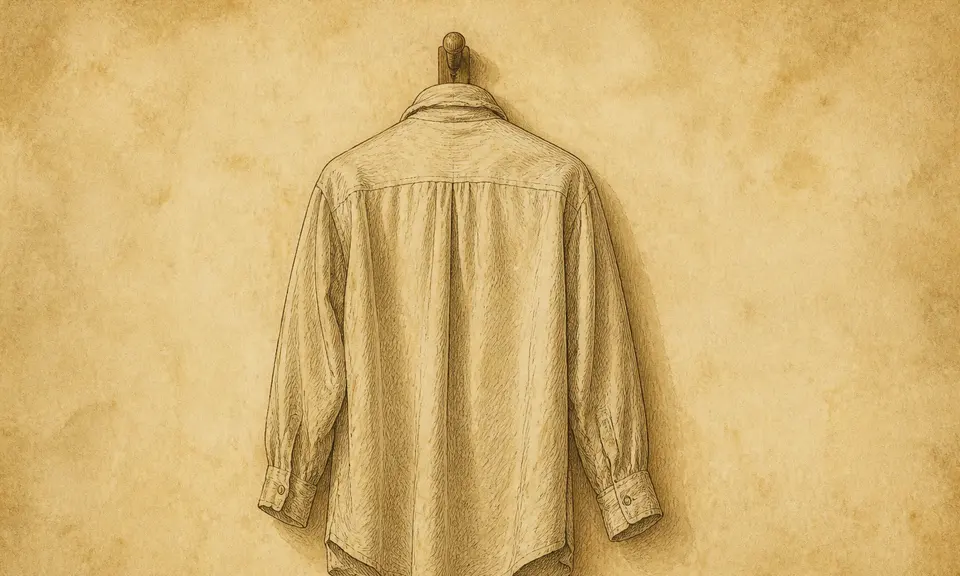
In a dream it is a man's religion, or his living, or his piety, or his knowledge, or good news, for the word of God: go with this shirt of mine. And if a man put it on, it is a woman he marries; and for a woman, a man she marries, for the word of God: they are a garment for you and you are a garment for them. And if a man put the shirt on and it tore, he does without his wife; and if it came apart at the seam, he parts from his wife or from his partner. And the shirt is a man's standing in his religion and in his world. And whoever saw that he put on a shirt without two sleeves — then it is the fineness of his beauty in his religion with no money for him, because money is what is in the hand, and he has nothing in hand, and that is the sleeve. And whoever saw that the opening of his shirt was torn — a door of poverty was opened upon him. And whoever saw that he has many shirts — then he has in the hereafter a great reward and many good deeds; and the white shirt is religion. And whoever saw that a shirt was given to him as a gift — then it is good news. And whoever saw that his shirt is torn and dirty — then it is poverty and care and hardship that reach him. And when a woman saw that she put on a new shirt, wide and ample, then it is the goodness of her state in her religion and in her world, or the goodness of her husband's state. And the wearing of the shirt is the condition of the one who wears it, and likewise its opening, and the soundness of the two and their corruption are in the condition of the one who wears them. And the green shirt points to religion, and the white likewise, and the blue is not praised; and the red shirt points to fame and the yellow to illness. And wetness in the garment points to a hindrance from travel; and if the wetness dried, the hindrance went away. And whoever saw that he put on a shirt with no opening and no collar and no tie at his head — it pointed to his death. And whoever of the women or the men saw that he put on a shirt with an embroidered band — then he makes the pilgrimage or travels. And whoever saw that he put on a short shirt that did not cover his private parts and his knee — then he falls short in his religion. And whoever saw that he put on a shirt of wood travels upon the sea and rides in the ship; and if he was sick, death is feared for him. And whoever saw a verse of the Quran written upon his shirt — then he holds fast to the Quran. And the shirt dyed black points to care and grief for the one who wore it. And whoever saw that he put on a shirt inside out — his state changed to the opposite of his habit; and sometimes it points to his lying with his wife in the backside. And sometimes the shirt is a man's house, because it covers a man as his shirt covers him, and it has four corners, and so does the house. And whoever saw the opening of his shirt torn — a door of poverty was opened upon him. And whoever saw his shirt split lengthwise — relief came to him; and if it split crosswise, then that is talk said against his honour. And whoever saw his shirt cut from behind — then he is accused by talk said against his honour and he is innocent of it; and if it was cut from the front, then the talk that is said about him is true, for the story of Joseph, peace be upon him. And whoever saw his shirt made of cloud — a favour covered him. And the sight of the shirt of Joseph, peace be upon him, is a messenger with news setting out from Egypt.
Section letter qaf