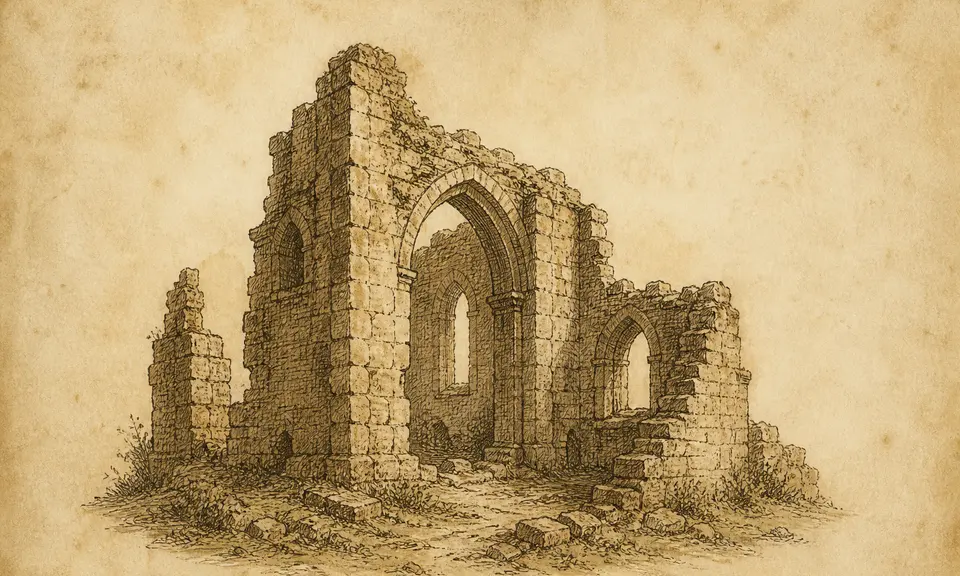
In a dream it points to the scattering of a family and to their death; and the ruin of a city points to the death of its king or to his injustice, and the death of the king points to the ruin of the city. And whoever saw himself in a ruin is afflicted with a people he has no strength against. And whoever saw that a city was ruined by earthquakes or by something else — then someone is sentenced to be killed, or the standing of the noble among the people is cut down. And whoever saw a thriving village ruined and its fields left idle — then it is a straying or a disobedience on the part of its masters; and if he saw it thriving, then it is the soundness of the religion of its people. And whoever saw the world ruined of its fields and its dwellings, and saw himself in a ruin in a fine show of clothing and of mount — then it is worldly goods he comes by in a straying. And whoever saw the walls of the house ruined by a torrent — then it is the death of his wife. And whoever saw that his house fell upon him and there was dust there — then it is the measles; and sometimes the falling of the roof upon him was a calamity. And whoever saw a ruin turn back into a sound built place — that is a soundness in the religion of its owner and his coming back from straying to guidance. And whoever saw something of his house or his palace or his dwelling fall inwards, and he had someone away from him, that one came to him; and if he had with him one who is asked for in marriage, his daughter or his sister or another is asked of him. And if the wind pulled a house down, then it is a death in that place at the hand of an unjust ruler. And whoever saw that he pulls down a house or an ancient building — care and evil reach him. And whoever saw that his house collapsed upon him, or a part of it — then a person dies in it, or a great calamity or a hideous happening reaches its owner. And if a woman saw that the roof of her house collapsed, then it is the death of her husband. And whoever saw a place of the built-up land ruined or falling down — then they are calamities that will be in that place. And whoever saw that a pillar of his house broke or fell down — then he dies, or someone of his household who is dear to him; and likewise every breaking or pulling down of a house or of a wall is a calamity. And if a ruler saw that his house collapsed, then that is his removal in any case.
Section letter kha