Ram

5 readings from 3 sources.

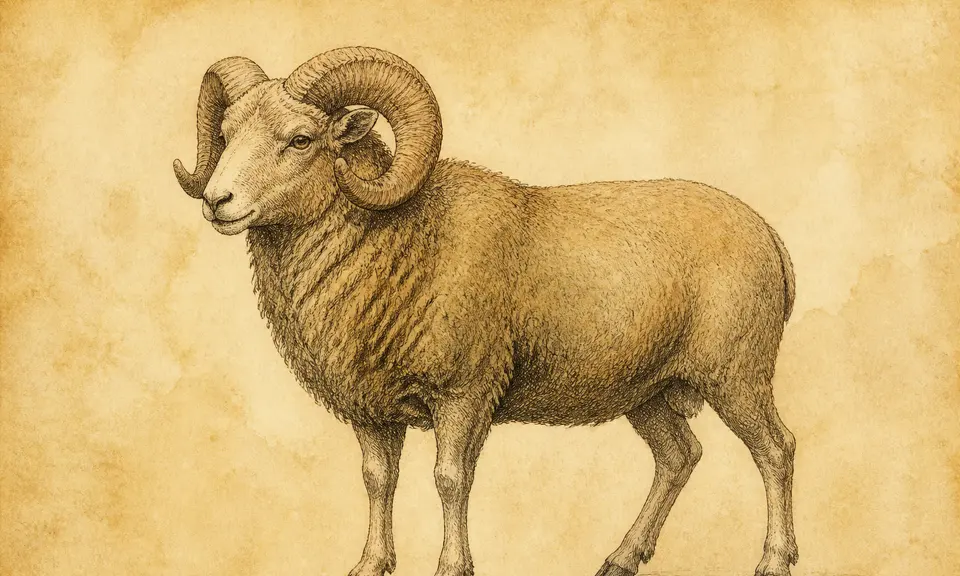
The image was generated by a model. It is not a period engraving and comes from none of the sources.

an-Nabulsi needs five words: in a dream it is a noble, unassailable man. Miller makes the same animal two different omens depending on what it is doing — a ram that pursues you foretells misfortune threatening, and one quietly grazing means powerful friends who will use their best efforts for your good. The powerful man is in both books; only Miller asks whether he is coming at you. Artemidorus has the powerful man as well — the ram is to be taken as a master, and as a magistrate and a king, for the ancients used the word kreiein for ruling — and he adds the one thing neither of the others asks, which is whether you stay on. It is good to dream of riding one safely and through level country, especially for men of letters and for those bent on growing rich, since the animal is swift and is held to be the mount of Hermes. And his case is about falling off: a man betrothed and about to be married dreamed that he was sitting on a ram and fell off it forwards, and was told that his wife would play the whore and put horns on him. He begged off that marriage, married the same woman later and watched her for a year, in which she stayed blameless — and then married another, thinking the dream had struck elsewhere, and that one turned out to the utmost of whoredom.

This paragraph was generated by a model. It sums up the sources above, comes from none of them and is attributed to no one.

Greek dream book

Someone said that to a man who had seen himself sitting on a ram and falling off it forwards, a man betrothed and about to hold his wedding in those very days, he had foretold: your wife will play the whore and will, as the saying goes, put horns on you. And so it turned out. Because of that prediction of the dream he begged off the marriage, and only after some time, hardly persuaded by his friends, he married the woman who had earlier been betrothed to him; but fearing the dream he kept watch over his wife and lived in complete wariness. She lived a year and remained blameless; but when he had married another wife after her, so that he even thought the dream had struck elsewhere, he fell into the misfortune: for that one turned out to the utmost of whoredom.

Passage Book II, 12

The ram, further, is to be taken as a master, and as a magistrate and a king; for the ancients used the word kreiein for ruling.

Passage Book II, 12

It is good also to dream of riding one safely and through level country, especially for men of letters and for those bent on growing rich; for the animal is swift and is held to be the mount of Hermes.

Passage Book II, 12

Ὀνειροκριτικά (Oneirokritika)

Artemidorus of Daldis; edited by Rudolf Hercher

second century; Hercher’s edition 1864 · Greco-Roman

the source of the ancient tradition itself, which the others draw on

About this source

Five books of second-century Greek prose, not an alphabetical dictionary: the readings sit inside argued chapters and the author says of each one why it reads as it does. It is the source the other European and Arabic dream books draw on, including where they do not name it.

Rights: public domain

Where the text is from: https://archive.org/details/bub_gb_CRwTAAAAQAAJ

Arabic dream book

In a dream it is a noble, unassailable man. And whoever sees that he took hold of a ram's horn — then a noble man protects him in a matter; and if he took it by its wool, then he grows wealthy from a noble man; and if he took its fat tail, then he comes to own the affair of a noble man and his money and his good, and he inherits from him at the end of his affair, or he marries his daughter; and if he took what is in its belly, then he takes charge of his treasury, or gets of what is in it. And the slaughtering of the ram not for eating is the killing of a great noble man or of an enemy; and if he was in a war, then it is his victory; and if he saw slaughtered rams in a place, then a people are killed there in a war or a fight. And if he bought a ram from a butcher, then a noble man is driven to him who speaks in his affair and saves him from destruction, or he is ailing and he treats him with a medicine by which he escapes an ailment in which he came to the brink of death. And if he slaughtered a ram, he got the better of a great enemy; and if he was sick, he recovered. And whoever sees that he carried a ram on his head takes on the keep of a big man. And whoever sees that he rides a ram and turns it where he wills and the ram obeys him — then he subdues a big man and turns him where he likes; and if the ram did not obey him and was hard upon him, then that man does not yield to what he wants; and if he saw that the ram mounted him, then a big man mounts him with a matter that he hates. And whoever sees that he broke the two horns of a ram, or one of them — then he wounds a great man and some of his strength and his defence goes. And whoever sees that he fights a ram contends with a big, unassailable man; and whichever of the two overcame, he is the overcomer. And whoever sees a ram that has died — then it is the death of a big, great man. And whoever sees that a ram was slaughtered and its flesh divided — then a great man dies and his money is divided. And whoever sees that he offered a sacrifice, or slaughtered a ram for eating — if he was a slave he was set free, and if he was a captive he was saved, and if he was afraid he was made safe, and if he was in debt he paid his debt, and if he had not made the pilgrimage he made it, and if he was sick God Most High healed him. And whoever sees that he slaughtered a ram and flayed it takes the money of his enemy; and if he ate of its flesh, then he eats of his money. And whoever sees that in his house is a flayed ram — then someone of his household and his kin dies; and if the flesh was a ram's thigh, the nearest of his people to him died. And whoever sees that he roasts a ram — then he falls ill, or punishment or prison from the ruler befalls him. And the ram may also be an office: so whoever sees that he was given a ram takes an office for a year; and if they were many rams, then for every ram an office of a year; and if he saw that while he is in a post, then the number of the rams is the years he will work in it. And whoever sees that the heads of rams were brought to him — then the heads of his enemies are brought to him. And the wool of rams is money. And the ram points to the caller to prayer and to the shepherd. And the ram is the leader of the army and the foremost in the troops. And the hornless ram points to the governor removed from office and stripped of his authority, or to a lowly man, or to a eunuch. And whoever sees a ram leaping at him, there reached him from his enemy what he hates; and if it butted him, harm befell him; and whoever had intercourse with a ram, a great man parted him from his money. And whoever sees a ewe that became a ram — then his wife does not conceive; and if he had no wife, he attained strength and might and victory over his enemy. And whoever sees two rams butting each other over his wife's private part — then his wife took the shears and cut the hair of her private part, because the razor was not to be had with her. And the black of the rams is reckoned to the Arabs and the white to the foreigners.

Section letter kaf
The Perfuming of Mankind in the Interpretation of Dreams

Abd al-Ghani al-Nabulsi

before 1731; first printed Cairo 1858 · Arab-Islamic

carries the ancient tradition after Artemidorus

About this source

An Arabic dream book by the Damascene scholar al-Nabulsi, an alphabetical dictionary of two and a half thousand headwords. It draws on the ancient tradition directly: Artemidorus was translated into Arabic by Hunayn ibn Ishaq in the ninth century. The readings here almost always address the dreamer’s standing, property and faith rather than their feelings.

Rights: public domain

Where the text is from: https://shamela.ws/book/1217

Miller

To dream that a ram pursues you, foretells that some misfortune threatens you. To see one quietly grazing denotes that you will have powerful friends, who will use their best efforts for your good. See Sheep and Lamb.

Ten Thousand Dreams Interpreted; Or, What's in a Dream

Gustavus Hindman Miller

1901 · American Victorian

carries fragments of the ancient tradition without its system

About this source

An American dream book, the only one here that knows the telephone, the railroad or the elevator. Doctrinally it is the most degraded: it keeps fragments of the ancient tradition without the system that once held them together.

Rights: public domain

Where the text is from: https://www.gutenberg.org/ebooks/926