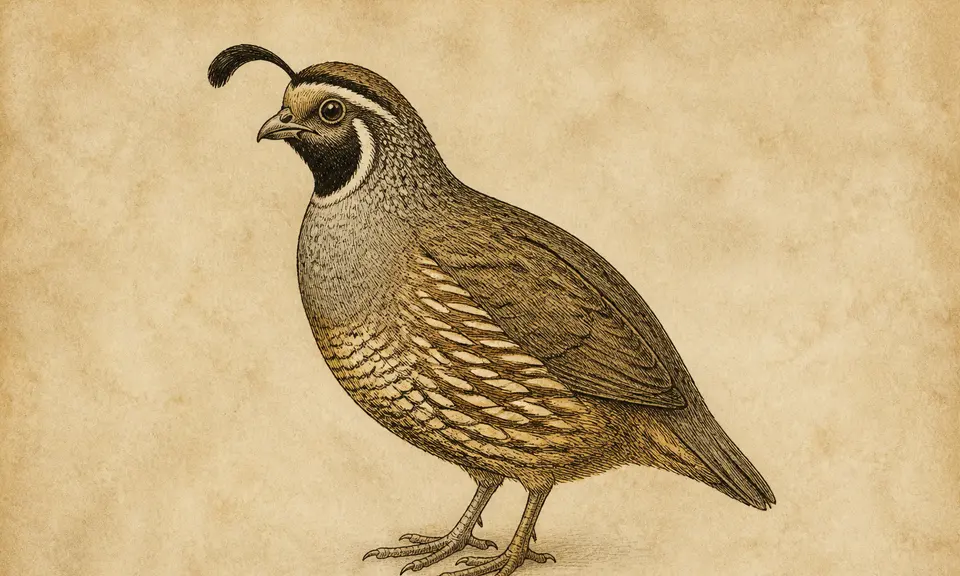
Quail

5 readings from 3 sources.

The image was generated by a model. It is not a period engraving and comes from none of the sources.

Miller settles the quail in four lines: alive it is a very favourable omen, dead it means serious ill luck, shooting them means ill feelings shown to the dreamer's best friends, and eating them means extravagance in his personal living. Artemidorus reads the bird by its nerve and by its travels. In partnerships and friendships and marriages and in all the contracts of daily life quails signify factions and quarrels; and as for the sick, if the birds are carried elsewhere they signify that they will die, because of the faintness of heart of these birds. For a journey abroad they are bad, for they foretell tricks and ambushes and robberies — and the reason is the bird's own history, that when quails move away from their own country, they too fall in with those who want to hunt them. The disagreement is not between the other two books but inside the Arabic one, which carries two readings that will not be reconciled. The quail is a goodly provision from God the Most High — and it is said that the quail is a two-faced man. It points to the driving away of care and of trouble and to the fulfilling of the promise; and perhaps to ingratitude for blessings and to straitness of living. Another reading adds benefits by reason of husbandry, then says that for the man who sets out to hear the bird it means provisions from doubtful things, and perhaps the crime that calls for imprisonment. One small bird carries manna from heaven and the gallows in the same book.

This paragraph was generated by a model. It sums up the sources above, comes from none of them and is attributed to no one.

Greek dream book

And in partnerships and friendships and marriages and in all the contracts of daily life they are significant of factions and quarrels; and as for the sick, if they are carried elsewhere they signify that they will die, because of the faintness of heart of these birds, but if they are not carried elsewhere, that they will be in less danger.

Passage Book III, 5

And for a journey abroad they are bad, for they foretell tricks and ambushes and robberies; for they too, when they move away from their own country, fall in with those who want to hunt them.

Passage Book III, 5

Ὀνειροκριτικά (Oneirokritika)

Artemidorus of Daldis; edited by Rudolf Hercher

second century; Hercher’s edition 1864 · Greco-Roman

the source of the ancient tradition itself, which the others draw on

About this source

Five books of second-century Greek prose, not an alphabetical dictionary: the readings sit inside argued chapters and the author says of each one why it reads as it does. It is the source the other European and Arabic dream books draw on, including where they do not name it.

Rights: public domain

Where the text is from: https://archive.org/details/bub_gb_CRwTAAAAQAAJ

Arabic dream book

It in a dream is a goodly provision from God the Most High. And it is said the quail is a two-faced man. And the quail points in a dream to the driving away of care and of trouble and of a sudden assault from the enemy, and to the fulfilling of the promise. And perhaps seeing it points to ingratitude for blessings and to the passing away of office and to straitness of living.

Section letter sin

Seeing it in a dream points to benefits and provisions by reason of sowing and husbandry; and for him who sets out to hear it, it is a sign of provisions from doubtful things and of discourses in diversion and play and squandering; and perhaps the seeing of the quail points to the crime that calls for imprisonment and crucifixion.

Section letter sin

The Perfuming of Mankind in the Interpretation of Dreams

Abd al-Ghani al-Nabulsi

before 1731; first printed Cairo 1858 · Arab-Islamic

carries the ancient tradition after Artemidorus

About this source

An Arabic dream book by the Damascene scholar al-Nabulsi, an alphabetical dictionary of two and a half thousand headwords. It draws on the ancient tradition directly: Artemidorus was translated into Arabic by Hunayn ibn Ishaq in the ninth century. The readings here almost always address the dreamer’s standing, property and faith rather than their feelings.

Rights: public domain

Where the text is from: https://shamela.ws/book/1217

Miller

To see quails in your dream, is a very favorable omen, if they are alive; if dead, you will undergo serious ill luck. To shoot quail, foretells that ill feelings will be shown by you to your best friends. To eat them, signifies extravagance in your personal living.

Ten Thousand Dreams Interpreted; Or, What's in a Dream

Gustavus Hindman Miller

1901 · American Victorian

carries fragments of the ancient tradition without its system

About this source

An American dream book, the only one here that knows the telephone, the railroad or the elevator. Doctrinally it is the most degraded: it keeps fragments of the ancient tradition without the system that once held them together.

Rights: public domain

Where the text is from: https://www.gutenberg.org/ebooks/926