Pomegranates are significant of wounds, because of their colour, and of tortures, because of their prickles, and of slavery and subjection, because of the story told at Eleusis.
Passage Book I, 73
3 readings from 3 sources.
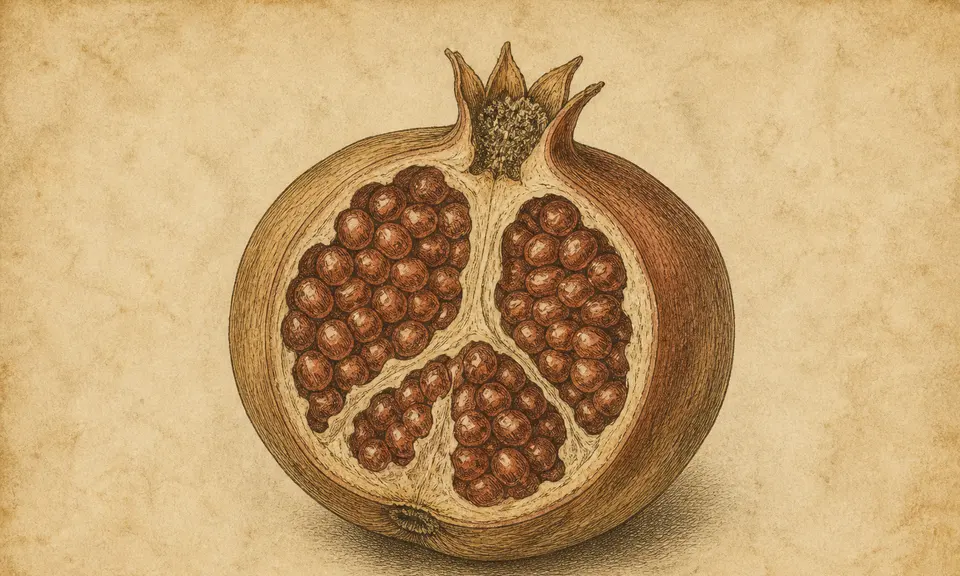
Miller reads the pomegranate as a test of appetite, and both his readings turn on resisting or yielding: the fruit means the dreamer will wisely use his talents for the enrichment of the mind rather than for pleasures that destroy morality and health, and to eat one is to yield himself a captive to the personal charms of another. an-Nabulsi takes the fruit apart and prices every part of it. Sweet, it is gathered wealth, and it is reckoned at a thousand dirhams or a hundred or ten according to the state of the man who saw it, with white seeds pointing to dirhams and red ones to dinars. For the sultan the pomegranate is the city — breaking it is conquering one, the rind is its wall, the seeds are its men, and the pith is its wealth. Read as a woman it is read by its condition: whole she is a virgin, broken she is already married, rotten she is a woman who is not chaste. The tree is a man of abundance possessed of religion and awe. And the reading provides for the doubtful case, which Miller's moral reading has no room for: a pomegranate of which it is not known whether it is sweet or sour stands in the rank of the sweet. Artemidorus takes the fruit apart as well, but reads every part as something done to a body, since pomegranates signify wounds, because of their colour, and tortures, because of their prickles, and slavery and subjection, because of the story told at Eleusis. Where the Arabic reading prices the seeds, he counts the punishments.
This paragraph was generated by a model. It sums up the sources above, comes from none of them and is attributed to no one.
Pomegranates are significant of wounds, because of their colour, and of tortures, because of their prickles, and of slavery and subjection, because of the story told at Eleusis.
Passage Book I, 73
It in a dream is gathered wealth if it was sweet. And perhaps the pomegranate pointed to the woman, and perhaps it was a flourishing district. And the pomegranate is wealth and a child. And the pomegranate is interpreted as a thousand dirhams or a hundred or ten, according to the state of the one who saw the vision. And the pomegranate is interpreted for the sultan as the city: if he broke it, he conquered a city; and its rind is its wall, and its seeds are its men, and its pith is its wealth. And whoever ate the rinds of a pomegranate in his sleep is freed from an illness. And the pomegranate is interpreted as the locked chest. And perhaps it pointed to the house of bees and the disc of the comb. And if the seeds of the pomegranate were white, it pointed to dirhams; and if they were red, it pointed to dinars. And it is said the pomegranate points to fright or to a journey. And when the pomegranate is interpreted as the woman, she is one of beauty; and if it was whole, she is a virgin; and if it was broken, she is one already married. And the pomegranate that is rotten is a woman who is not chaste. And the sour pomegranate is unlawful wealth, and it is said care and grief. And whoever sold a pomegranate is a man who has chosen this world over the hereafter. And the pressing of pomegranates and the drinking of their water is the man's spending upon himself. And the pomegranate that is uncertain, of which it is not known whether it is sweet or sour, is in the rank of the sweet. And the pomegranate tree is a man of abundance, possessed of religion and awe; and its thorns are what withhold him from acts of disobedience and from foul deeds. And if he was a sultan, he overcame the sultans; and if he was a merchant, his trade grew great. And the cutting of the pomegranate tree points to the cutting of kinship. And perhaps the pomegranate tree pointed to fright. And it is said the sweet pomegranate is lawful provision with toil, and the sour of it is care and vexation, and the mixed is provision in which there is doubt.
Section letter ra
Pomegranates, when dreamed of, denotes that you will wisely use your talents for the enrichment of the mind rather than seeking those pleasures which destroy morality and health. If your sweetheart gives you one, you will be lured by artful wiles to the verge of distraction by woman's charms, but inner forces will hold you safe from thralldom. To eat one, signifies that you will yield yourself a captive to the personal charms of another.