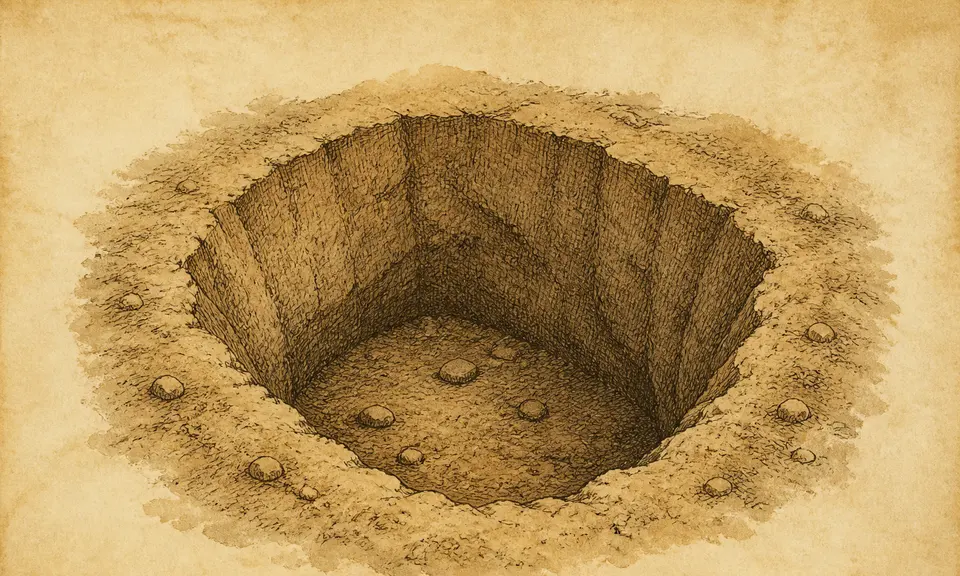
Pit

2 readings from 2 sources.

The image was generated by a model. It is not a period engraving and comes from none of the sources.

Miller reads the pit as depth and as risk taken knowingly. Looking into a deep one means running silly risks in business ventures and uneasiness about one's wooing; falling in denotes calamity and deep sorrow; descending into it on purpose signifies knowingly risking health and fortune for greater success; and to wake as the fall begins brings the dreamer out of distress in fairly good shape. an-Nabulsi begins by defining the thing — it is the well that is not lined — and then reads it as an entire life rather than a moment. It points to care and to trouble and to prison, and then: whoever was in anything of that had his care and his grief pass away from him, and he was joined to the great ones and attained might and elevation. If the dreamer was of the people of knowledge, people profited by his knowledge, and especially the knowledge of dreams; the messengers of the great ones came to him with what gladdens him; between him and his family there came trouble and envy, and they betray him, and then he sees through them; and he was charged with an accusation of which he is innocent. The last line is pure wordplay and the reading admits it in the same breath: the pit, al-jubb, points to castration, al-jabb, and to circumcision — and that, it says, is for the one who misreads it.

This paragraph was generated by a model. It sums up the sources above, comes from none of them and is attributed to no one.

Arabic dream book

It is the well that is not lined. And it points in a dream to care and to trouble and to prison. And whoever was in anything of that, his care and his grief passed away from him, and he was joined to the great ones and attained might and elevation. And if the seer was of the people of knowledge, people profited by his knowledge, and he was joined to the slave by what he had of knowledge, and especially the knowledge of dreams. And perhaps the messengers of the great ones came to him with what gladdens him. And perhaps there came about between him and his family trouble and envy, and they betray him, and then he sees through them. And perhaps the seer was charged with an accusation and he is innocent of it. And perhaps it points to the lifting of care and to the fulfilling of needs. And the pit points to travel, and it points to what the well points to. And perhaps the pit, al-jubb, points to castration, al-jabb, and to circumcision, and that is for the one who misreads it.

Section letter jim

The Perfuming of Mankind in the Interpretation of Dreams

Abd al-Ghani al-Nabulsi

before 1731; first printed Cairo 1858 · Arab-Islamic

carries the ancient tradition after Artemidorus

About this source

An Arabic dream book by the Damascene scholar al-Nabulsi, an alphabetical dictionary of two and a half thousand headwords. It draws on the ancient tradition directly: Artemidorus was translated into Arabic by Hunayn ibn Ishaq in the ninth century. The readings here almost always address the dreamer’s standing, property and faith rather than their feelings.

Rights: public domain

Where the text is from: https://shamela.ws/book/1217

Miller

If you are looking into a deep pit in your dream, you will run silly risks in business ventures and will draw uneasiness about your wooing. To fall into a pit denotes calamity and deep sorrow. To wake as you begin to feel yourself falling into the pit, brings you out of distress in fairly good shape. To dream that you are descending into one, signifies that you will knowingly risk health and fortune for greater success.

Ten Thousand Dreams Interpreted; Or, What's in a Dream

Gustavus Hindman Miller

1901 · American Victorian

carries fragments of the ancient tradition without its system

About this source

An American dream book, the only one here that knows the telephone, the railroad or the elevator. Doctrinally it is the most degraded: it keeps fragments of the ancient tradition without the system that once held them together.

Rights: public domain

Where the text is from: https://www.gutenberg.org/ebooks/926