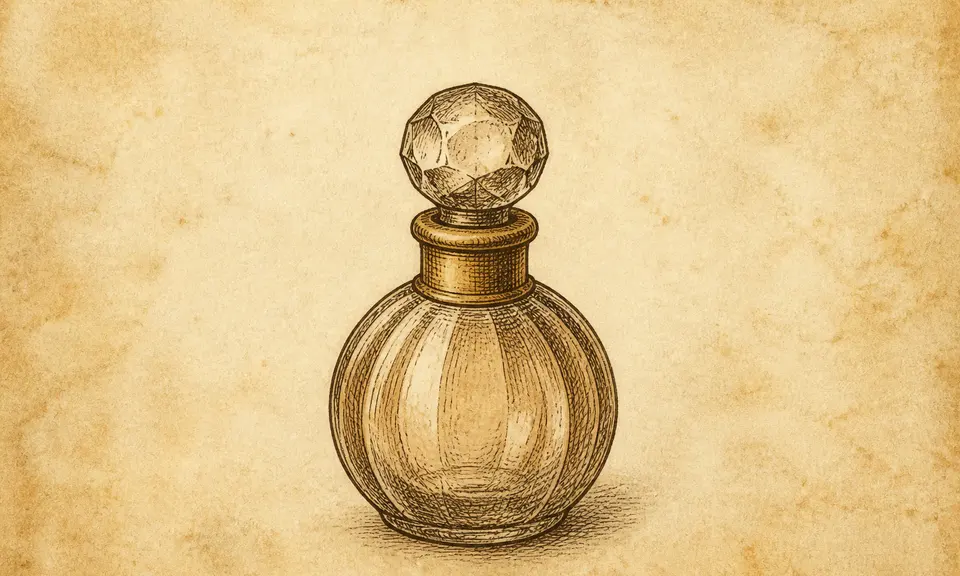
Perfume

3 readings from 3 sources.

The image was generated by a model. It is not a period engraving and comes from none of the sources.

Miller reads perfume as pleasure and counts its spillage. Inhaling it augurs happy incidents, perfuming one's garments and person means the dreamer will seek and obtain adulation, and being oppressed by it to intoxication means excesses in joy will impair his mental qualities; spilling perfume is the loss of something that gave pleasure, and breaking the bottle means that his most cherished wishes will end disastrously even while they promise a happy culmination. an-Nabulsi does not read the wearer's enjoyment but what other people smell on him, since perfume is fair praise and a beautiful renown, and burnt as incense it is praise together with terror and danger. Among the sick it points to their death. A woman who perfumed herself enters into a righteous work, and if she has no husband she marries. The last line is the one that stays: when the thief and the deceiver perfumes himself, he repents or he is seized, because the sweet scent tells on the one who bears it. Artemidorus says the same thing about the sick and gives it a case and a reason: a sick man dreamed that he saw a certain man called Piso, and somebody read it as much safety and deliverance from the first syllable of the name — but the man died none the less in that very illness, for Piso had seemed to him to be carrying perfumes, and perfumes are bad for a sick man, because they are carried out with the dead.

This paragraph was generated by a model. It sums up the sources above, comes from none of them and is attributed to no one.

Greek dream book

For instance, a sick man dreamed that he saw a certain man called Piso. Someone interpreted this as much safety and deliverance, and said besides that he would live ninety-five years, from the first syllable of Piso. But the man who had the dream died none the less in that very illness; for Piso had seemed to him to be carrying perfumes, and perfumes are bad for a sick man, because they are carried out with the dead.

Passage Book IV

Ὀνειροκριτικά (Oneirokritika)

Artemidorus of Daldis; edited by Rudolf Hercher

second century; Hercher’s edition 1864 · Greco-Roman

the source of the ancient tradition itself, which the others draw on

About this source

Five books of second-century Greek prose, not an alphabetical dictionary: the readings sit inside argued chapters and the author says of each one why it reads as it does. It is the source the other European and Arabic dream books draw on, including where they do not name it.

Rights: public domain

Where the text is from: https://archive.org/details/bub_gb_CRwTAAAAQAAJ

Arabic dream book

It in a dream is fair praise, and if it is burnt as incense it is praise together with terror and danger. And perfume among the sick points to their death. And the woman, if she saw that she had perfumed herself, enters into a righteous work; and if she was without a husband, she marries. And likewise perfume for men is fair praise and a beautiful renown. And when the thief and the deceiver perfumes himself, he repents or he is seized, because the sweet scent tells on the one who bears it.

Section letter ṭa

The Perfuming of Mankind in the Interpretation of Dreams

Abd al-Ghani al-Nabulsi

before 1731; first printed Cairo 1858 · Arab-Islamic

carries the ancient tradition after Artemidorus

About this source

An Arabic dream book by the Damascene scholar al-Nabulsi, an alphabetical dictionary of two and a half thousand headwords. It draws on the ancient tradition directly: Artemidorus was translated into Arabic by Hunayn ibn Ishaq in the ninth century. The readings here almost always address the dreamer’s standing, property and faith rather than their feelings.

Rights: public domain

Where the text is from: https://shamela.ws/book/1217

Miller

To dream of inhaling perfume, is an augury of happy incidents. For you to perfume your garments and person, denotes that you will seek and obtain adulation. Being oppressed by it to intoxication, denotes that excesses in joy will impair your mental qualities. To spill perfume, denotes that you will lose something which affords you pleasure. To break a bottle of perfume, foretells that your most cherished wishes and desires will end disastrously, even while they promise a happy culmination. To dream that you are distilling perfume, denotes that your employments and associations will be of the pleasantest character. For a young woman to dream of perfuming her bath, foretells ecstatic happenings. If she receives it as a gift from a man, she will experience fascinating, but dangerous pleasures.

Ten Thousand Dreams Interpreted; Or, What's in a Dream

Gustavus Hindman Miller

1901 · American Victorian

carries fragments of the ancient tradition without its system

About this source

An American dream book, the only one here that knows the telephone, the railroad or the elevator. Doctrinally it is the most degraded: it keeps fragments of the ancient tradition without the system that once held them together.

Rights: public domain

Where the text is from: https://www.gutenberg.org/ebooks/926