Pain

4 readings from 2 sources.

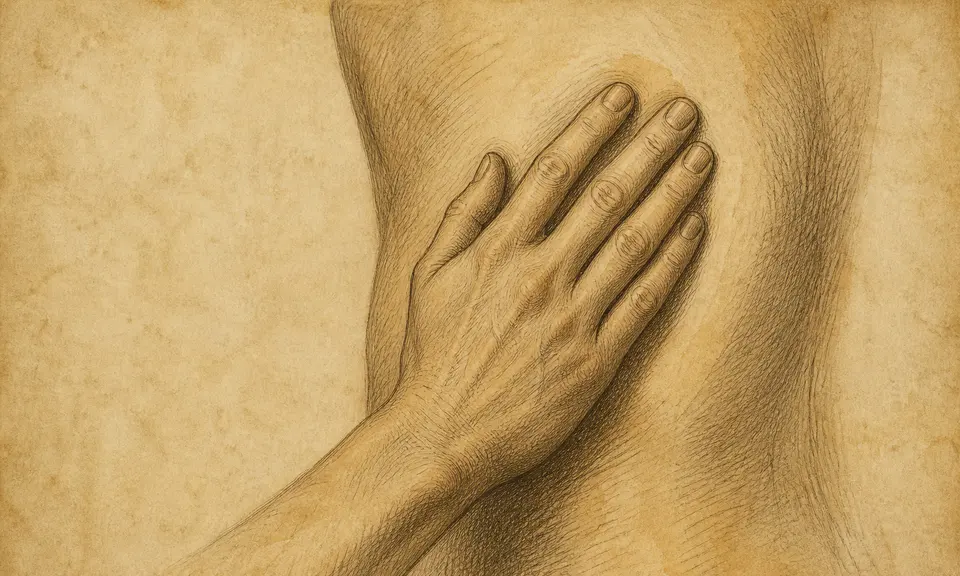
The image was generated by a model. It is not a period engraving and comes from none of the sources.

Two books, four readings, and they divide the same thing the same way: what the pain is, and what it is for. an-Nabulsi gives pain five words and they are all moral — in a dream it is remorse for a sin — and under the other word he narrows it to the head: whoever sees that he has a headache should repent, or give alms, or do good, or turn back from his sin, and the ache comes from whoever the head stands for, which is his chief. Miller keeps it inside the week ahead. The dreamer's own pain assures his unhappiness and foretells useless regrets over some trivial transaction, and seeing others in pain warns him that he is making mistakes in his life; and under the plural he reads the ache as a message from the body about the business — having aches means halting too much while somebody else profits from one's ideas, heartache in a young woman is distress at a laggardly suitor, backache illness from exposure, headache disquiet over a risk taken against a rival. Then he does the one thing no other reading does: he says the dream is usually due to physical causes and is of little significance. Both books read the ache as something the dreamer brought on himself. Only one of them allows that it may be nothing but the body.

This paragraph was generated by a model. It sums up the sources above, comes from none of them and is attributed to no one.

Arabic dream book

In a dream it is remorse for a sin. And whoever sees a pain in a molar of his molars or in a tooth of his teeth — then he hears something foul from the kinsman to whom that molar is ascribed in the reading, and he deals with him in a dealing that is hard upon him, in the measure of the pain he found. And the pain of the neck points to its owner having behaved ill in his keeping of company, until a complaint was born of it; and the pain of the neck may point to his having betrayed a trust and not rendered it, so that a punishment from God Most High came down upon him. And the pain of the shoulder points to ill-doing in his earning and in the toil of his right hand. And the pain of the belly points to his having spent his money in disobedience and that he regrets it; and it is said the pain of the belly points to the health of the kinsfolk and of the people of the house. And the pain of the navel points to his dealing ill with his wife. And the pain of the heart is a sign of the badness of what he hides within in the matters of religion. And the pain of the liver is a sign of ill-doing toward the child. And the pain of the spleen is a sign of the spoiling of a great wealth by which he and his household and his children were held up; and if his pain grew hard until death was feared for him, that pointed to the going away of religion. And the pain of the lung is a sign of the nearness of the appointed term, because the lung is the seat of the spirit. And the pain of the back points to the death of the brother; and it is said the reading of the pain of the back goes back to the one by whom the man is strengthened, of child and father and chief and friend; and if he saw in his back a bending from the pain, then it points to falling into poverty and to old age. And the pain of the thigh points to his doing ill to his clan. And the pain of the leg points to walking in what is not obedience to God Most High; and it is said the pain of the leg points to much money. And the pain of the penis points to ill-doing toward a people who speak of him with evil and call down curses upon him.

Section letter waw

Whoever sees in a dream that he has a headache should repent, or give alms, or do good, or turn back from the sin he is in, by His word, exalted be He: “or has an ailment of his head, then a ransom of fasting or alms or sacrifice”. And a headache is trouble coming from the one the head points to, who is his chief; and at root the reading of the headache goes back to the chief; and it is said it is a sin that must be repented of.

Section letter ṣad

The Perfuming of Mankind in the Interpretation of Dreams

Abd al-Ghani al-Nabulsi

before 1731; first printed Cairo 1858 · Arab-Islamic

carries the ancient tradition after Artemidorus

About this source

An Arabic dream book by the Damascene scholar al-Nabulsi, an alphabetical dictionary of two and a half thousand headwords. It draws on the ancient tradition directly: Artemidorus was translated into Arabic by Hunayn ibn Ishaq in the ninth century. The readings here almost always address the dreamer’s standing, property and faith rather than their feelings.

Rights: public domain

Where the text is from: https://shamela.ws/book/1217

Miller

To dream that you have aches, denotes that you are halting too much in your business, and that some other person is profiting by your ideas. For a young woman to dream that she has the heartache, foretells that she will be in sore distress over the laggardly way her lover prosecutes his suit. If it is the backache, she will encounter illness through careless exposure. If she has the headache, there will be much disquietude of mind for the risk she has taken to rid herself of rivalry. This dream is usually due to physical causes and is of little significance.

To dream that you are in pain, will make sure of your own unhappiness. This dream foretells useless regrets over some trivial transaction. To see others in pain, warns you that you are making mistakes in your life.

Ten Thousand Dreams Interpreted; Or, What's in a Dream

Gustavus Hindman Miller

1901 · American Victorian

carries fragments of the ancient tradition without its system

About this source

An American dream book, the only one here that knows the telephone, the railroad or the elevator. Doctrinally it is the most degraded: it keeps fragments of the ancient tradition without the system that once held them together.

Rights: public domain

Where the text is from: https://www.gutenberg.org/ebooks/926