Necklace

6 readings from 3 sources.

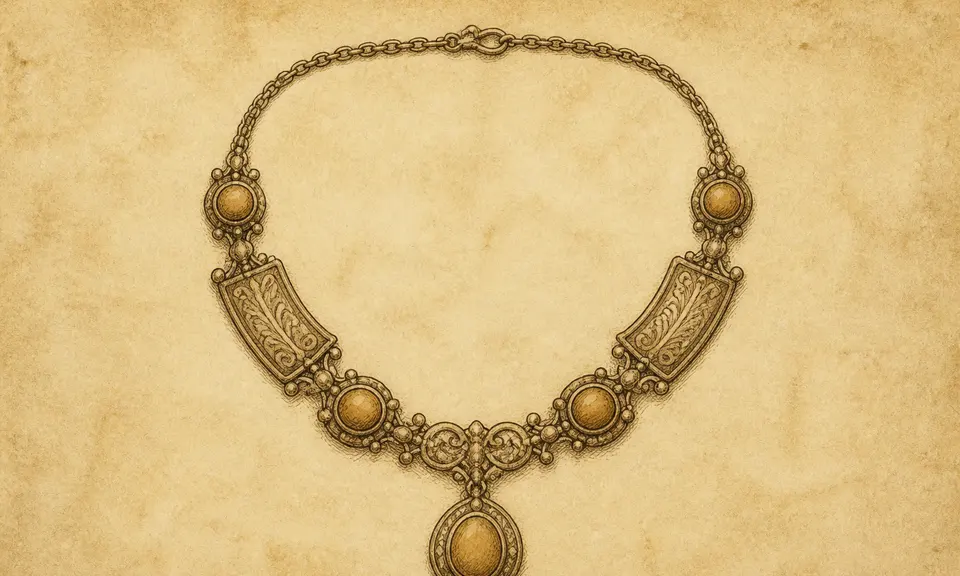
The image was generated by a model. It is not a period engraving and comes from none of the sources.

an-Nabulsi gives the necklace five words: for women it is their beauty and their adornment. Miller turns the same chain into a marriage and its loss into a death, since a woman who dreams of receiving a necklace is promised a loving husband and a beautiful home, and one who loses it will early feel the heavy hand of bereavement. The Arabic reading says what the thing is and the English one what happens to it, and only the second can go wrong. Another Arabic reading takes the choker and reads the husband off the stones: gems and pearls and chrysolite mean a man of high standing — and then the last line turns the chain round the way Miller's loss does, and harder, for to men the choker is a strangling. A further Arabic reading is the long one, and it reads the necklace as a thing held rather than worn, because the Arabic word is also the word for a bond: a necklace strung of pearl and coral is the Quran kept by heart and a covenant kept, while a thread that breaks is the covenant broken and the memorised text forgotten. Artemidorus reads the ornament by who is wearing it, and his reason is the Arabic book's in reverse: every kind of women's ornament worn about the neck is good for women, foretelling marriage to the unmarried and children to the childless, for just as women are adorned by these things, so they are adorned by husbands and by children — but for a man they mean tricks and ambushes.

This paragraph was generated by a model. It sums up the sources above, comes from none of them and is attributed to no one.

Greek dream book

Necklaces and chains and earrings and costly stones and every kind of women's ornament worn about the neck are good for women: for they foretell marriage to the unmarried, children to the childless, and to those who have both, gain and much abundance. For just as women are adorned by these things, so they are adorned also by husbands and by children and by wealth — for by nature they are lovers of wealth, as they are lovers of ornament — and further, these things are wound about the neck, just as a husband and children are.

Passage Book II, 5

But for a man they mean tricks and ambushes.

Passage Book II, 5

Ὀνειροκριτικά (Oneirokritika)

Artemidorus of Daldis; edited by Rudolf Hercher

second century; Hercher’s edition 1864 · Greco-Roman

the source of the ancient tradition itself, which the others draw on

About this source

Five books of second-century Greek prose, not an alphabetical dictionary: the readings sit inside argued chapters and the author says of each one why it reads as it does. It is the source the other European and Arabic dream books draw on, including where they do not name it.

Rights: public domain

Where the text is from: https://archive.org/details/bub_gb_CRwTAAAAQAAJ

Arabic dream book

For women it is their beauty and their adornment. And whoever sees that upon him is a necklace of gold and pearl and ruby is given charge of one of the offices of the Muslims, or is entrusted with a trust. And the necklace for the man, when silver coin is with it, points to marriage with a beautiful woman, and the ruby and the jewels in it are her beauty. And if it was of silver and jewels, then it is a gathering governorship with money and relief; and if it was of iron, then it is a governorship in strength; and if it was of brass, then the goods of the world; and if it was of beads, then a governorship in frailty and weakness. And the necklace for women is money her husband entrusted to her. And the necklace for the woman with child is a male child if what is on the neck is masculine in its name, and if it is feminine, then a female. And if the necklace came undone or was broken, the governor to whom the necklace is ascribed is put out of his office. And the red necklace for the woman is a red veil. And the necklace for the married woman is a child, and for the unmarried one a husband. And if he saw that upon him are necklaces and great strings and he is too weak to carry them, then he is too weak to act by his knowledge and to uphold it. And if the woman saw that upon her is a necklace, then whatever is in it of soundness or of corruption, the reading of that is in her husband, or in the one who keeps her, or in the trust she takes upon herself.

Section letter qaf

It is in a dream an adornment for the woman and for her children, sons and daughters, from a man who deals in gems. And if it was made up of gems and of pearls and of chrysolite, she marries a husband of high standing and bears him sons and finds what she wishes in him. And if it was of alum, he is a foreign man; and if of glass beads, he is a man of low standing. And the choker, for men, is a strangling.

Section letter mim

The pearl in a dream is, for women, their beauty and their adornment. And the necklace strung of pearl and coral is piety and the fear of God together with the keeping of the Quran by heart, in the measure of the pearl's clearness and beauty and number; and the gem is his work and its reach and its end. And a woman's necklace is her husband or her child. And a man's necklace on his neck: if he was a seeker of the Quran, he gathered it; and if he was a seeker of the law, he mastered it; and if there was a covenant or a bond upon him, he kept it. And if there was none of that and he was unmarried, he married a woman who knows the Quran well; and if his wife was with child, a son was born to him, a learned man or a judge — unless its thread breaks and its stringing scatters, and then, if there was a covenant on his neck, he broke it; and if he kept the Quran by heart, he forgot it and was heedless of it; and otherwise the knowledge ran away from him and was lost to him. And when several threads come together, the gems of them are the Quran and the pearls are the traditions, and the rest of the gems are judgement and pious speech and law. Whoever sees that he wears a necklace of pearls, or two necklaces — the strung pearl in the reading is the word of God out of pious speech, so he is one of those who carry the Quran, and trustworthiness and piety and goodness and devotion in religion go with him, in the measure of the necklace in its beauty and its brightness; or he is one on whose neck there is a trust and a covenant and a pact. Whoever sees that he wears many collars and necklaces and is too weak to carry them is too weak to act on his knowledge and to stand by it. And if a woman saw that she wore a necklace or a collar, then whatever was in it of soundness or of spoiling, the reading of that is in her husband, or in whoever stands over her, or in what she takes upon herself of a trust.

Section letter ayn
The Perfuming of Mankind in the Interpretation of Dreams

Abd al-Ghani al-Nabulsi

before 1731; first printed Cairo 1858 · Arab-Islamic

carries the ancient tradition after Artemidorus

About this source

An Arabic dream book by the Damascene scholar al-Nabulsi, an alphabetical dictionary of two and a half thousand headwords. It draws on the ancient tradition directly: Artemidorus was translated into Arabic by Hunayn ibn Ishaq in the ninth century. The readings here almost always address the dreamer’s standing, property and faith rather than their feelings.

Rights: public domain

Where the text is from: https://shamela.ws/book/1217

Miller

For a woman to dream of receiving a necklace, omens for her a loving husband and a beautiful home. To lose a necklace, she will early feel the heavy hand of bereavement.

Ten Thousand Dreams Interpreted; Or, What's in a Dream

Gustavus Hindman Miller

1901 · American Victorian

carries fragments of the ancient tradition without its system

About this source

An American dream book, the only one here that knows the telephone, the railroad or the elevator. Doctrinally it is the most degraded: it keeps fragments of the ancient tradition without the system that once held them together.

Rights: public domain

Where the text is from: https://www.gutenberg.org/ebooks/926