Neck

5 readings from 4 sources.

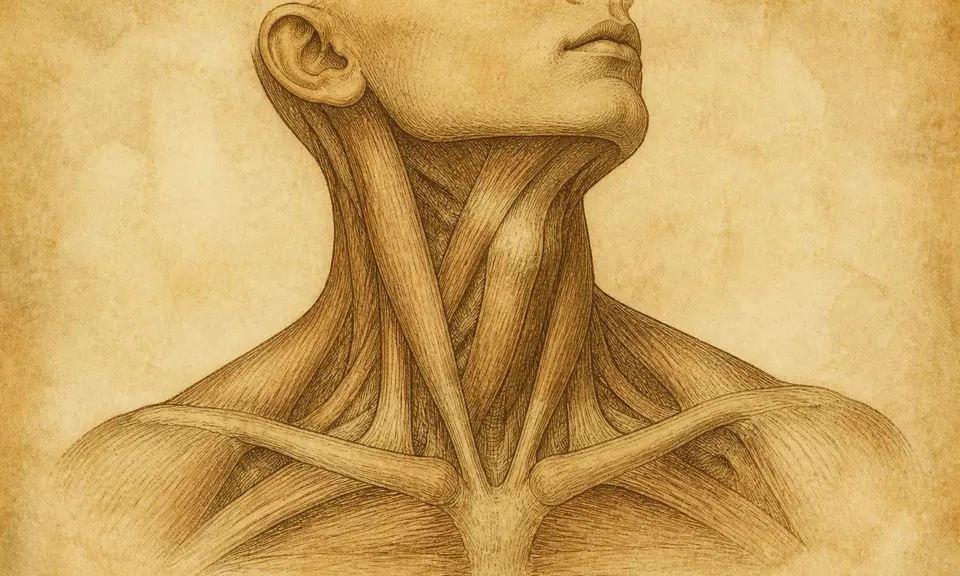
The image was generated by a model. It is not a period engraving and comes from none of the sources.

Three books and the neck does three different jobs. Miller reads it as household trouble: seeing your own neck means vexatious family relations interfering with business, admiring another's means broken domestic ties, and a woman who dreams her neck is thick is warned she will turn querulous. The Petersburg book keeps to the body's own signals — if the neck itches, we shall be invited to a feast. an-Nabulsi says six words and they carry the most: in a dream the neck is the place where a trust is carried. The part of the body a yoke sits on is read in the Arabic book as the part that holds what was entrusted to a man. Another Arabic reading hears the word rather than the body: the neck and a holding kept in expectancy are named from the same root, so the neck points to that holding, and from there to manumission and to ownership. A slave who sees a boy on his neck keeps what he owns; a neck loosed means he is set free. Artemidorus reads neither the trust nor the word but the hinge: whatever sore or affliction a man thinks in a dream that he has about his neck or his upper lip foretells illness for all alike, because in a way the whole body hangs from the head and the neck, and when these are in strength it is strong, while when they are in distress it is sick and not strong.

This paragraph was generated by a model. It sums up the sources above, comes from none of them and is attributed to no one.

Greek dream book

Whatever sore or affliction a man thinks in a dream that he has about his neck or his upper lip foretells illness for all alike; for in a way the whole body hangs from the head and the neck, and when these are in strength it is strong, while when they are in distress it is sick and not strong.

Passage Book I, 34

Ὀνειροκριτικά (Oneirokritika)

Artemidorus of Daldis; edited by Rudolf Hercher

second century; Hercher’s edition 1864 · Greco-Roman

the source of the ancient tradition itself, which the others draw on

About this source

Five books of second-century Greek prose, not an alphabetical dictionary: the readings sit inside argued chapters and the author says of each one why it reads as it does. It is the source the other European and Arabic dream books draw on, including where they do not name it.

Rights: public domain

Where the text is from: https://archive.org/details/bub_gb_CRwTAAAAQAAJ

Arabic dream book

In a dream it is the place where a trust is carried. And whoever sees that his neck is thick stands up to what he has carried of the trust; and if he saw it in thinness, then he is an oppressor unable for what he carried of the trust. And whoever sees on his neck a coiled snake does not pay the alms on his money. And if he saw thickness in the neck of the imam, then it is his strength in his justice and in his subduing of his enemies. And whoever sees a pain in his neck has done ill in keeping company or in giving back the trust; and whatever he sees on the neck of swellings or of knots, they are debts gathering upon him. And whoever sees his neck struck with the sword is healed if he was sick; and if a beardless boy struck his neck, then he dies, because the beardless boy is like the angel. And whoever's neck was struck while he is laden with care, God relieved his care; and if he was a slave, he was set free; and if a debt was upon him, he paid it and was rid of it; and likewise the prisoner comes out of the prison. And the neck is the place of office and of testimony and of bequest and of the alms and of the debt that hangs upon it. And whoever sees that his neck is comely, fat, fitting his body, it pointed to a lofty office in which he stretches his neck among the people; and if he was a witness, he was quit of the obligation in what he is about; and if a deposit was with him, it was loosed from his neck, or a bequest, or he paid the alms on his money, or he settled what was upon him of debt. And the contrary of that: if he saw on his neck boils or pus or flowing blood, then it points to his obligation being busied with what we have mentioned, and it hangs upon his neck. And if he saw a writing upon his neck, it pointed to his obligation being busied in what is between him and God Most High; and if he saw a fetter upon his neck, that pointed to the Fire and to what brings near to it. And the fineness of the dead man's neck points to his being quit of what we have mentioned, just as the fineness of the traveller's neck is a sign of his coming home safe. And the neck of the women points to what they put upon it, of a necklace or of other things, and likewise the neck of the small child. And whoever sees upon his neck a cord or a string of jewels or of pearls, it was a sign of merit and of knowledge and of standing by the truth. And if he saw the Prophet, God bless him and give him peace, pinch him on his neck, then he has rebuked him for the badness of what he has taken upon himself; and it may point to the settling of the debt and to healing from the illness. And whoever sees his neck neither long nor short: if he was of bad character, his character was made good; and if he was brave, his bravery increased; and if he was of base nature, he became generous. And the neck and the two shoulders are the place of the trust and of the debt: the two shoulders are of the trusts of the women and the neck of the trusts of the men. And whoever sees a bird upon his neck: if it was white, then it is a fine deed; and if it was black, then it is an ugly deed. And whoever sees upon his neck a copy of the Qur'an, then it is the standing by the covenant and by the truth, and the reading of knowledge, and the reciting of the Qur'an.

Section letter ayn

It is in a dream a holding kept in expectancy, which is named from the same root as the neck; and perhaps the neck points to manumission and to ownership. So if a slave sees a boy on his neck, his ownership lasts; and if his neck is loosed, it points to his being set free.

Section letter ra
The Perfuming of Mankind in the Interpretation of Dreams

Abd al-Ghani al-Nabulsi

before 1731; first printed Cairo 1858 · Arab-Islamic

carries the ancient tradition after Artemidorus

About this source

An Arabic dream book by the Damascene scholar al-Nabulsi, an alphabetical dictionary of two and a half thousand headwords. It draws on the ancient tradition directly: Artemidorus was translated into Arabic by Hunayn ibn Ishaq in the ninth century. The readings here almost always address the dreamer’s standing, property and faith rather than their feelings.

Rights: public domain

Where the text is from: https://shamela.ws/book/1217

Russian dream book, St Petersburg

If the neck itches, it means that we shall be invited to a feast.

A New, Complete and Detailed Dream Book

1811 · Russian

carries the ancient tradition after Artemidorus

About this source

A fuller Russian dream book from 1811. In places it carries Artemidorus’s doctrine verbatim, though it never names him.

Rights: public domain

Where the text is from: https://archive.org/details/novyjpolnyjipodrobnyjsonnikoznachajusc28

Miller

To dream that you see your own neck, foretells that vexatious family relations will interfere with your business. To admire the neck of another, signifies your worldly mindedness will cause broken domestic ties. For a woman to dream that her neck is thick, foretells that she will become querulous and something of a shrew if she fails to control her temper.

Ten Thousand Dreams Interpreted; Or, What's in a Dream

Gustavus Hindman Miller

1901 · American Victorian

carries fragments of the ancient tradition without its system

About this source

An American dream book, the only one here that knows the telephone, the railroad or the elevator. Doctrinally it is the most degraded: it keeps fragments of the ancient tradition without the system that once held them together.

Rights: public domain

Where the text is from: https://www.gutenberg.org/ebooks/926