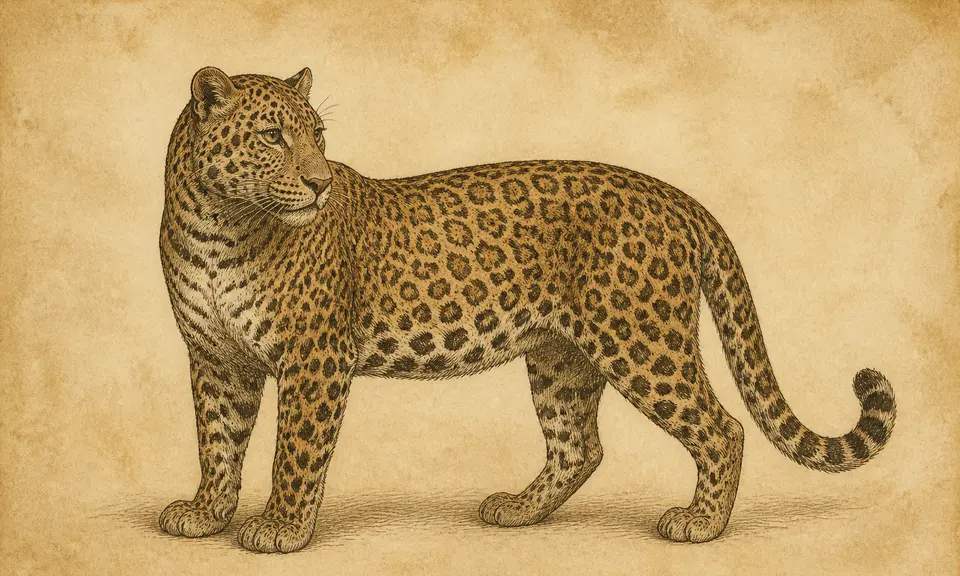
Leopard

2 readings from 2 sources.

The image was generated by a model. It is not a period engraving and comes from none of the sources.

Both books make the leopard an enemy, which is as near agreement as they get, and then part over what kind of enemy. Miller's danger is misplaced confidence: a leopard attacking means that while the future seemingly promises fair, success holds many difficulties, a caged one means enemies who surround but fail to injure, leopards trying to escape from the dreamer in their native place mean embarrassment in business or love that persistent effort overcomes, and the skin means interests endangered by a dishonest person who will win the dreamer's esteem. an-Nabulsi names the kind exactly: the leopard is a wavering enemy who shows neither enmity nor friendship, so that whoever disputed with it disputed with a person of that kind. And he leaves open a third possibility Miller never considers, who only kills or cages the animal — whoever had a leopard with which he hunts, that is provision and might. The Arabic reading also puts the whole contradiction into a single clause, which Miller's never does: the leopard is might and elevation and indulgence, together with anger and quarrel.

This paragraph was generated by a model. It sums up the sources above, comes from none of them and is attributed to no one.

Arabic dream book

It is in a dream: the seeing of it points to might and elevation and indulgence, together with anger and quarrel. And the leopard is a wavering enemy who shows neither enmity nor friendship; so whoever disputed with it disputed with a person of that kind. And whoever had a leopard with which he hunts, that is provision and might.

Section letter fa

The Perfuming of Mankind in the Interpretation of Dreams

Abd al-Ghani al-Nabulsi

before 1731; first printed Cairo 1858 · Arab-Islamic

carries the ancient tradition after Artemidorus

About this source

An Arabic dream book by the Damascene scholar al-Nabulsi, an alphabetical dictionary of two and a half thousand headwords. It draws on the ancient tradition directly: Artemidorus was translated into Arabic by Hunayn ibn Ishaq in the ninth century. The readings here almost always address the dreamer’s standing, property and faith rather than their feelings.

Rights: public domain

Where the text is from: https://shamela.ws/book/1217

Miller

To dream of a leopard attacking you, denotes that while the future seemingly promises fair, success holds many difficulties through misplaced confidence. To kill one, intimates victory in your affairs. To see one caged, denotes that enemies will surround but fail to injure you. To see leopards in their native place trying to escape from you, denotes that you will be embarrassed in business or love, but by persistent efforts you will overcome difficulties. To dream of a leopard's skin, denotes that your interests will be endangered by a dishonest person who will win your esteem.

Ten Thousand Dreams Interpreted; Or, What's in a Dream

Gustavus Hindman Miller

1901 · American Victorian

carries fragments of the ancient tradition without its system

About this source

An American dream book, the only one here that knows the telephone, the railroad or the elevator. Doctrinally it is the most degraded: it keeps fragments of the ancient tradition without the system that once held them together.

Rights: public domain

Where the text is from: https://www.gutenberg.org/ebooks/926