Borrowing and lending

5 readings from 2 sources.

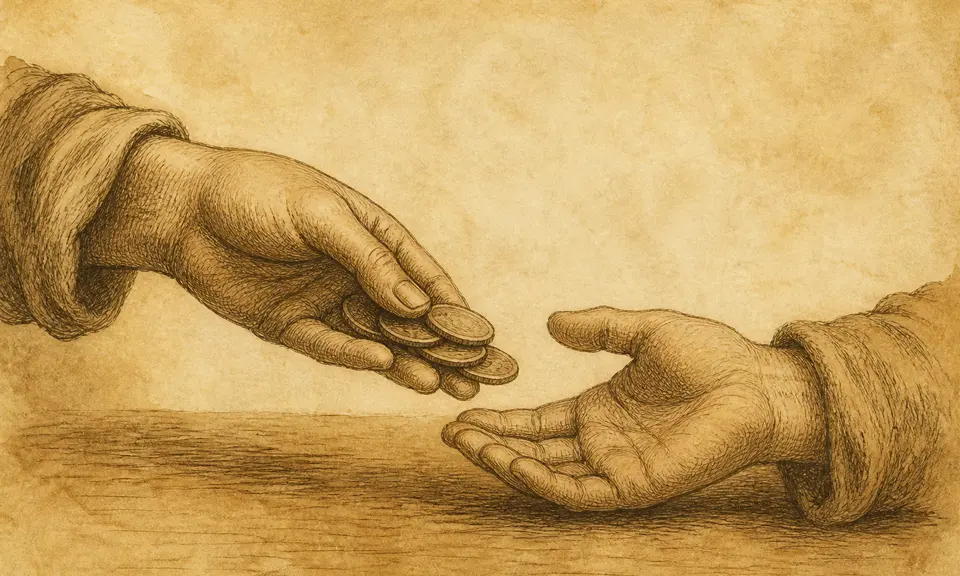
The image was generated by a model. It is not a period engraving and comes from none of the sources.

The two books put borrowing and lending in one place, because both of them read the transaction and not the side of it. Miller reads it by direction. Borrowing is a sign of loss and meagre support, and he gives one exact case — a banker who dreams of borrowing from another bank is being warned of a run on his own. Lending money means difficulty in meeting one’s own payments, lending other articles means impoverishment through generosity, refusing to lend keeps both one’s interests and the respect of friends, and being offered a loan means prosperity and close friendships. an-Nabulsi does not divide the two sides at all: whoever saw that he borrowed something, or lent it, is read in the same sentence, and what decides is the one property a loan always has, which is that it does not stay. A thing loved brings a good that does not last; a thing disliked brings a trouble that does not last either. Borrowing something of value is a debt of that size and lending something is a benefit of that size. A loan is an alms from the lender to the borrower and a sign of his need, and it points to repentance for the disobedient. He also hears the word itself: the Arabic for a loan sounds like the word for shame, so it may point to a scandal to be guarded against. And he settles the practical question the English book never raises — whoever borrows a beast, its keep is carried by the lender.

This paragraph was generated by a model. It sums up the sources above, comes from none of them and is attributed to no one.

Arabic dream book

Whoever saw in a dream that he borrowed something, or lent it: if that thing was loved, he comes by a good that favours him and does not last; and if it was disliked, he comes by something disagreeable that does not last — because a loan is a thing that does not stay. And it is said that whoever borrowed a beast, the lender carries the borrower's keep.

Section letter alif

Whoever sees in a dream that he borrowed something of value — it points to a debt in the measure of what he borrowed; and likewise if he lent something in a dream, perhaps a benefit comes to him in the measure of what he lent. And perhaps a loan, when the thing is unknown, points to the world coming to him; and perhaps the loan points to the shame a man should guard himself from, for fear of a scandal. And whoever sees that he borrowed a thing or lent it: if that thing was loved, he attains a good that does not last; and if it was disliked, a dislikeable thing reaches him that does not last — and that is because a borrowed thing has no permanence. And it is said whoever borrows a beast from a man, the lender carries the borrower's burden.

Section letter ayn

It in a dream is an alms from the lender to the borrower, and a need of him in what befalls him. And the loan points to repentance for the disobedient, and to the acceptance of Islam for the unbeliever, and to riches for the poor man. And if he lent something having value to one who asked him for it, it points to the goodness of his dealing with God the Most High. And the loan points to preferring others and to generosity for the sake of God the Most High.

Section letter qaf
The Perfuming of Mankind in the Interpretation of Dreams

Abd al-Ghani al-Nabulsi

before 1731; first printed Cairo 1858 · Arab-Islamic

carries the ancient tradition after Artemidorus

About this source

An Arabic dream book by the Damascene scholar al-Nabulsi, an alphabetical dictionary of two and a half thousand headwords. It draws on the ancient tradition directly: Artemidorus was translated into Arabic by Hunayn ibn Ishaq in the ninth century. The readings here almost always address the dreamer’s standing, property and faith rather than their feelings.

Rights: public domain

Where the text is from: https://shamela.ws/book/1217

Miller

Borrowing is a sign of loss and meagre support. For a banker to dream of borrowing from another bank, a run on his own will leave him in a state of collapse, unless he accepts this warning. If another borrows from you, help in time of need will be extended or offered you. True friends will attend you.

To dream that you are lending money, foretells difficulties in meeting payments of debts and unpleasant influence in private. To lend other articles, denotes impoverishment through generosity. To refuse to lend things, you will be awake to your interests and keep the respect of friends. For others to offer to lend you articles, or money, denotes prosperity and close friendships.

Ten Thousand Dreams Interpreted; Or, What's in a Dream

Gustavus Hindman Miller

1901 · American Victorian

carries fragments of the ancient tradition without its system

About this source

An American dream book, the only one here that knows the telephone, the railroad or the elevator. Doctrinally it is the most degraded: it keeps fragments of the ancient tradition without the system that once held them together.

Rights: public domain

Where the text is from: https://www.gutenberg.org/ebooks/926