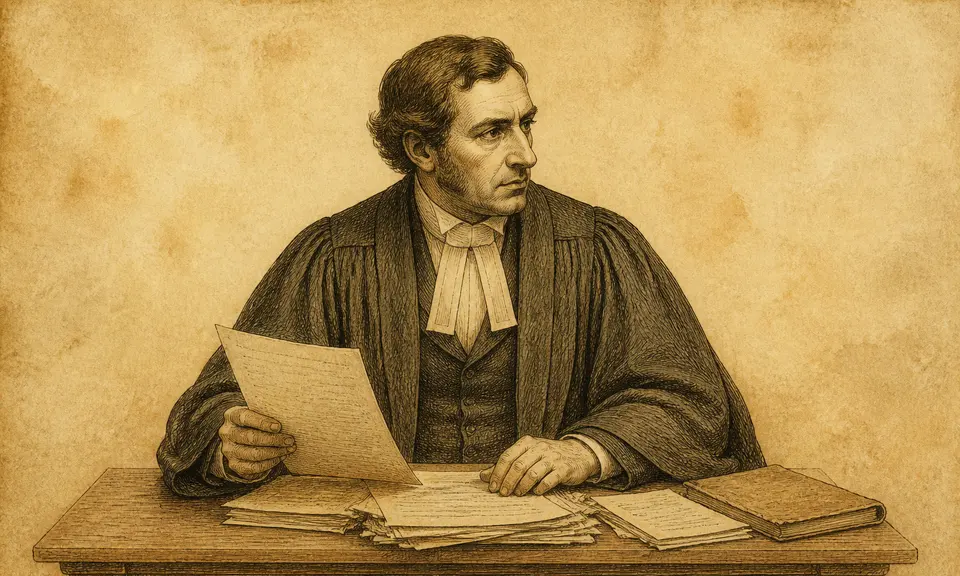
Lawyer

3 readings from 3 sources.

The image was generated by a model. It is not a period engraving and comes from none of the sources.

Miller gives the lawyer one line and it is about reputation: a young woman connected with one will unwittingly commit indiscretions that bring mortifying criticism. Artemidorus does not read the lawyer either, and uses one to warn against a way of reading: the etymologies of auspicious names are not to be trusted unless the things the names are set upon incline the same way. Paulus the lawyer, who had a case before the emperor, dreamed that a man called Nikon spoke for him — but this Nikon was the man who had long ago lost a case before the emperor. Paulus attended to the name alone, and the dream signified his condemnation, rightly and according to reason, because Nikon had been beaten. an-Nabulsi reads the jurist as the opposite kind of figure — cleverness, sharpness, knowledge, the man who heals the inward by what he knows. Seeing him turns the disobedient to repentance, the ignorant to guidance, the unbeliever to Islam. And then the detail only a jurist would write: a man who changes legal school in the dream is taking the easy way, or borrowing, or slackening — or moving from one wife to another.

This paragraph was generated by a model. It sums up the sources above, comes from none of them and is attributed to no one.

Greek dream book

But remember that the etymologies of auspicious names are not to be trusted unless the things the names are set upon incline the same way. For instance, Paulus the lawyer, who had a case before the emperor, dreamed that a certain man called Nikon spoke for him. But this Nikon was the man who had long ago lost a case before the emperor. Paulus attended to the name alone, but the dream signified his condemnation, rightly and according to reason, because Nikon had been beaten.

Passage Book IV

Ὀνειροκριτικά (Oneirokritika)

Artemidorus of Daldis; edited by Rudolf Hercher

second century; Hercher’s edition 1864 · Greco-Roman

the source of the ancient tradition itself, which the others draw on

About this source

Five books of second-century Greek prose, not an alphabetical dictionary: the readings sit inside argued chapters and the author says of each one why it reads as it does. It is the source the other European and Arabic dream books draw on, including where they do not name it.

Rights: public domain

Where the text is from: https://archive.org/details/bub_gb_CRwTAAAAQAAJ

Arabic dream book

Seeing him in a dream points to cleverness and sharpness and knowledge, and to spending on what one is engaged in; and perhaps the jurist points to the man who heals the inward by his knowledge and his conduct. And if the seer was disobedient he repents to God, or if he was ignorant he is guided, or if he was an unbeliever he enters Islam — the Prophet said: “whoever God wishes good for, He gives him understanding in religion”. And if he is of one school and in the dream moves to another, he takes the easy dispensations, or borrows, or slackens in his undertakings, or becomes a man of sedition, or of hypocrisy toward his teacher, or he moves from one place to another, or from one wife to another.

Section letter fa

The Perfuming of Mankind in the Interpretation of Dreams

Abd al-Ghani al-Nabulsi

before 1731; first printed Cairo 1858 · Arab-Islamic

carries the ancient tradition after Artemidorus

About this source

An Arabic dream book by the Damascene scholar al-Nabulsi, an alphabetical dictionary of two and a half thousand headwords. It draws on the ancient tradition directly: Artemidorus was translated into Arabic by Hunayn ibn Ishaq in the ninth century. The readings here almost always address the dreamer’s standing, property and faith rather than their feelings.

Rights: public domain

Where the text is from: https://shamela.ws/book/1217

Miller

For a young woman to dream that she is connected in any way with a lawyer, foretells that she will unwittingly commit indiscretions, which will subject her to unfavorable and mortifying criticism. See Attorney.

Ten Thousand Dreams Interpreted; Or, What's in a Dream

Gustavus Hindman Miller

1901 · American Victorian

carries fragments of the ancient tradition without its system

About this source

An American dream book, the only one here that knows the telephone, the railroad or the elevator. Doctrinally it is the most degraded: it keeps fragments of the ancient tradition without the system that once held them together.

Rights: public domain

Where the text is from: https://www.gutenberg.org/ebooks/926