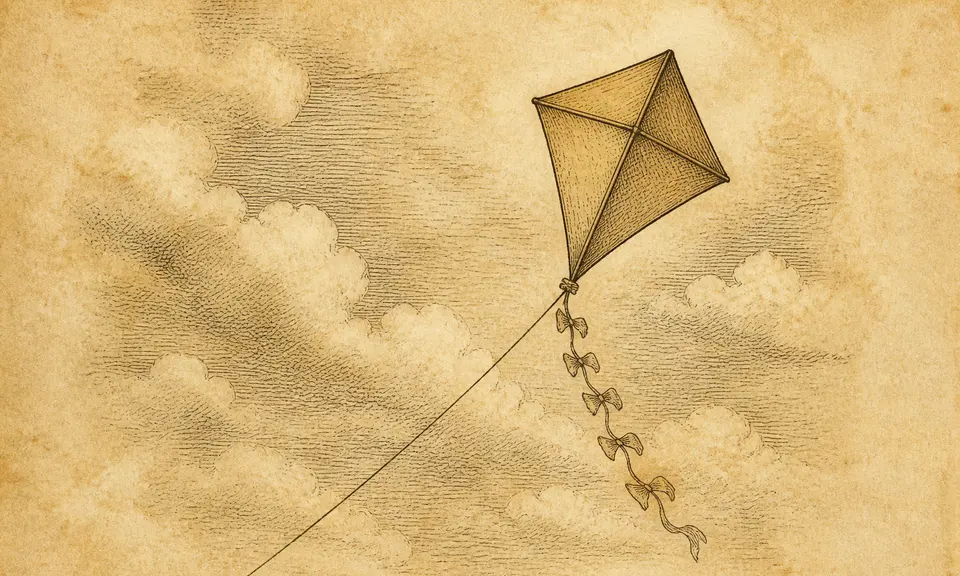
Kite

2 readings from 2 sources.

The image was generated by a model. It is not a period engraving and comes from none of the sources.

These two almost never agree, and here they arrive at the same word from opposite ends of the world. Miller: flying a kite denotes a great show of wealth, or business, but with little true soundness to it all; the kite thrown upon the ground foretells disappointment and failure; making one means you will speculate largely on small means and seek to win the one you love by misrepresentations; and if the kite ascends beyond the vision, high hopes resolve themselves into disappointment and loss. an-Nabulsi begins with the height — it points to height and to elevation and to loftiness — and then names what Miller only describes: the kite is like a false show, and the driving of it in the air by its strings is deceit and delusion. The same reading, with a strings-and-deceit image Miller leaves implicit in the words show and misrepresentation. Where they do part is in what the deceit belongs to. Miller keeps it commercial: speculation, overreaching, a courtship built on lies. an-Nabulsi takes it into sorcery — whoever saw that he plays with it has worked sorcery, or he is named among vanities, and it points to the charm and the incantation. And he closes on a clause with no counterpart at all: if it fell in his house, then it is cast into his house.

This paragraph was generated by a model. It sums up the sources above, comes from none of them and is attributed to no one.

Arabic dream book

It points in a dream to height and to elevation and to loftiness, and perhaps it points to being driven away from what is intended. And the kite points to sorcery; so whoever saw that he plays with it has worked sorcery, or he is named among vanities, because the kite is like a false show, and the driving of it in the air by its strings is deceit and delusion. And it points to sorcery or to the charm or to the incantation. And if it fell in his house, then it is cast into his house.

Section letter ṭa

The Perfuming of Mankind in the Interpretation of Dreams

Abd al-Ghani al-Nabulsi

before 1731; first printed Cairo 1858 · Arab-Islamic

carries the ancient tradition after Artemidorus

About this source

An Arabic dream book by the Damascene scholar al-Nabulsi, an alphabetical dictionary of two and a half thousand headwords. It draws on the ancient tradition directly: Artemidorus was translated into Arabic by Hunayn ibn Ishaq in the ninth century. The readings here almost always address the dreamer’s standing, property and faith rather than their feelings.

Rights: public domain

Where the text is from: https://shamela.ws/book/1217

Miller

To dream of flying a kite, denotes a great show of wealth, or business, but with little true soundness to it all. To see the kite thrown upon the ground, foretells disappointment and failure. To dream of making a kite, you will speculate largely on small means and seek to win the one you love by misrepresentations. To see children flying kites, denotes pleasant and light occupation. If the kite ascends beyond the vision high hopes and aspirations will resolve themselves into disappointments and loss.

Ten Thousand Dreams Interpreted; Or, What's in a Dream

Gustavus Hindman Miller

1901 · American Victorian

carries fragments of the ancient tradition without its system

About this source

An American dream book, the only one here that knows the telephone, the railroad or the elevator. Doctrinally it is the most degraded: it keeps fragments of the ancient tradition without the system that once held them together.

Rights: public domain

Where the text is from: https://www.gutenberg.org/ebooks/926