Jugs signify the attendants, amphoras the servants, side-tables the household managers, and the vessels that hold grain signify the stewards of the house; and the storeroom likewise.
Passage Book I, 74
8 readings from 3 sources.
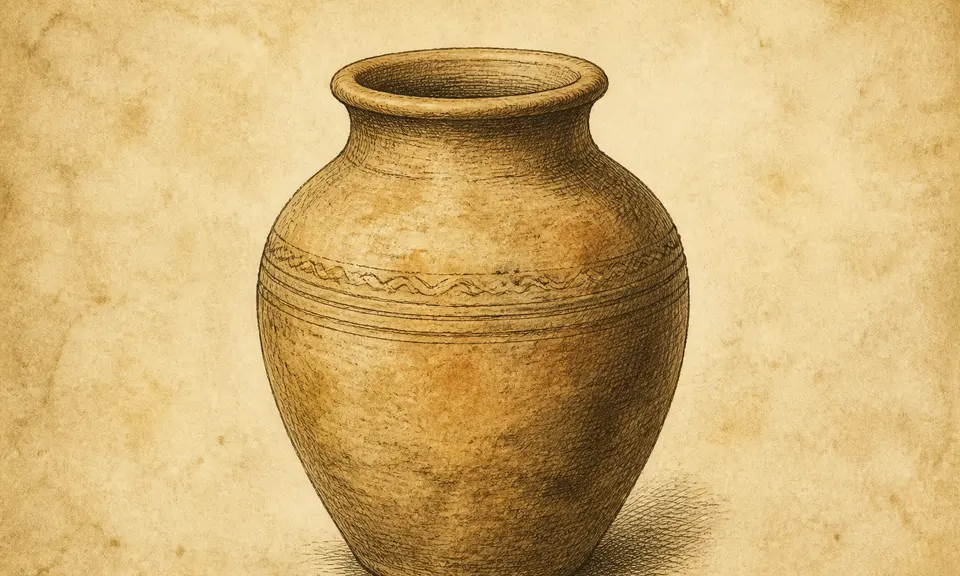
Miller reads the vessel by what is in it and by whether it is whole: empty jars mean impoverishment, full ones success, bought ones a precarious success and a heavy burden, broken ones sickness or deep disappointment, while jugs filled with clear liquid mean friends uniting to help. an-Nabulsi reads the jar as a person — a hired man and a hypocrite, through whose hands money passes and who is trusted with it — and then allows the one good thing, that drinking water from it is lawful gain and a good life. The same jar is a household's state in one book and a servant nobody should rely on in the other. The Arabic book has a second vessel, the ewer, and reads it the other way about: repentance for a sinner, a son for a woman with child, a boy who knows the household's secrets, and a gathering of them righteous deeds that bring a man into the garden. Another Arabic reading takes the large storage jar, and it is a woman again but a different one, an adulterous woman first and then a free woman, and what is inside decides the man instead — water in the house, a rich woman in grief; vinegar, a man of piety; butter, a man whose money is growing — while the jar that breaks in the dreamer's hand is a divorce. Artemidorus reads the vessels as the household staff, one rank to each: jugs are the attendants, amphoras the servants, and the vessels that hold grain the stewards of the house.
This paragraph was generated by a model. It sums up the sources above, comes from none of them and is attributed to no one.
Jugs signify the attendants, amphoras the servants, side-tables the household managers, and the vessels that hold grain signify the stewards of the house; and the storeroom likewise.
Passage Book I, 74
A man dreamed that he saw his mistress lying in an earthenware jar. His mistress died, with her throat cut by a public slave. For her being in an earthenware vessel fittingly signified death for the woman; and that it was by a public slave, since the jar too is public and serves everybody.
Passage Book V
In a dream it is a hired man and a hypocrite, through whose hand money passes and who is trusted with it; and drinking water from it is lawful gain and a good life. So whoever sees that he drank half of what is in it, half his life has run out; and if he drank less or more than that, its reading is what is left of his life or what has run out of it. And if he sees that he drank all that is in the jar, all his life has run out; and so with the rest of the vessels. And as if he drank from a jar narrow at the mouth, then he solicits a slave girl for herself. And whoever sees as if on his palm there is a jar of water, and it fell and broke and the water stayed, then his wife is with child, and she dies and the child stays. And it is said the jar is a woman and a servant or a slave. And it may point, when it was filled with oil or honey or milk, for the people of the world, to the storage pit and the storehouse and the purse; and likewise the rest of the earthenware vessels, the mugs and the pitchers and others, run the course of the jar. And the sight of the jar points to the beast or to the wife of much toil and striving, unless it be of copper, for then it points to the woman of high rank. And the wine jar points to a menstruating woman: whoever drank from it lay with a menstruating woman.
Section letter jim
Seeing it in a dream points to repentance for the sinner, and to a male child for the woman with child; and perhaps it points to the boy who is let in on secrets. And a gathering of ewers is righteous deeds that bring a man into the garden. And perhaps the ewer points to the sword, because that is one of its names, so that if its price went high in the dream, it points to the raising of the rank of the one it stood for. And the ewer points to play and laughter and loud laughter — and the same ruling holds for the vessels that are like it.
Section letter alif
In a dream it is an adulterous woman, and the reading of every large jar is according to its kind; and it is the storage jar and the water jar. And it points to the steward of the house and to his storeroom and his shop, and to his wife with child. And the waterskin points to much the same as the water jar. And the large jar is a free woman, and drinking from it is money gained through her. Whoever sees that he drew water and poured it into a large jar contrives to get money that a woman has left in deposit. And a jar of wine is the finding of a hoard. And the storage jar, if there was water in it and it was in a house, is a rich woman in grief; and if the water jar was in the irrigation channel, it is a man of much money who spends much in the path of God. And the storage jar, if there was vinegar in it, is a man of piety; and if there was butter in it, he is a man of growing money; and if there was a relish in it, he is a sick man. Whoever sees a large jar break in his hand divorces his wife.
Section letter kha
To dream of empty jars, denotes impoverishment and distress. To see them full, you will be successful. If you buy jars, your success will be precarious and your burden will be heavy. To see broken jars, distressing sickness or deep disappointment awaits you.
If you dream of jugs well filled with transparent liquids, your welfare is being considered by more than yourself. Many true friends will unite to please and profit you. If the jugs are empty, your conduct will estrange you from friends and station. Broken jugs, indicate sickness and failures in employment. If you drink wine from a jug, you will enjoy robust health and find pleasure in all circles. Optimistic views will possess you. To take an unpleasant drink from a jug, disappointment and disgust will follow pleasant anticipations.
To dream of a pitcher, denotes that you will be of a generous and congenial disposition. Success will attend your efforts. A broken pitcher, denotes loss of friends.