Herbs

2 readings from 2 sources.

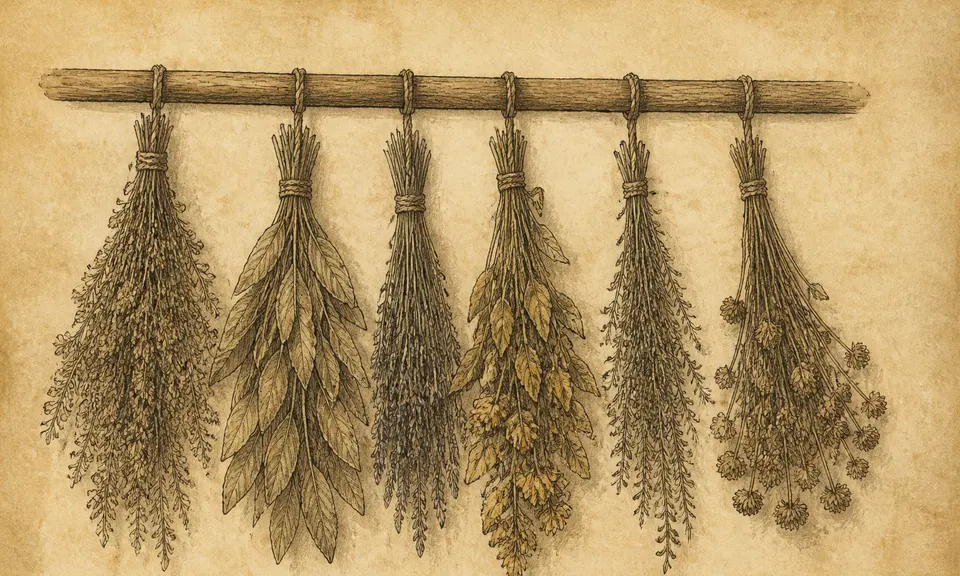
The image was generated by a model. It is not a period engraving and comes from none of the sources.

The two books open on the same note and then one of them stops being a single voice. Miller: herbs denote vexatious cares, though some pleasures will ensue; poisonous herbs warn of enemies; balm and other useful herbs mean satisfaction in business and warm friendships. Care first, then a sorting by whether the plant is any use. an-Nabulsi opens identically — in a dream they are care and sorrow — and then prints the disagreement instead of resolving it: some of them said all herbs are good, some said all herbs are disliked, and some said they point to trade and to men and to sorrow and to a child and to wealth. Three verdicts in three clauses, all left standing. What he does not leave open is the one thing that holds them together, and it is a clause Miller has no equivalent for: whatever herbs point to has no lasting. The trade has no lasting, the men are soldiers who have no lasting, the child and the wealth have no lasting — and the sorrow has no lasting either, which is the only comfort in the reading. He closes on the manna and the quails exchanged for herbs and garlic, which brings abasement and poverty, and on its reverse, herbs exchanged for something good, which is the escape from both.

This paragraph was generated by a model. It sums up the sources above, comes from none of them and is attributed to no one.

Arabic dream book

In a dream they are care and sorrow. And the herb is men who have in-laws. So whoever saw that he gathered from his garden a bunch of herbs — it is being contrived against him, so let him beware of evil; and if he knew its essence, then at that time it goes back to the natures. And the dry of herbs is wealth for which monies are set right. And the growing herb is a man, if its place was one held abominable for such a plant to grow in: then he is a man who has come in upon the people of that place by a marriage alliance or by a partnership. Some of them said: all herbs are good. And some of them said: all herbs are disliked. And some of them said: all herbs point to trade and to men and to sorrow and to a child and to wealth. So if they pointed to trade, it is a trade that has no lasting; and if they pointed to men, they are soldiers who have no lasting; and if they pointed to a child and to wealth, there is no lasting for the two of them; and if they pointed to sorrow, it is a sorrow that has no lasting. And whoever exchanged the manna and the quails for herbs and garlic, abasement and poverty come upon him. And if he saw that he exchanged herbs for something good, he escapes from poverty and abasement.

Section letter ba

The Perfuming of Mankind in the Interpretation of Dreams

Abd al-Ghani al-Nabulsi

before 1731; first printed Cairo 1858 · Arab-Islamic

carries the ancient tradition after Artemidorus

About this source

An Arabic dream book by the Damascene scholar al-Nabulsi, an alphabetical dictionary of two and a half thousand headwords. It draws on the ancient tradition directly: Artemidorus was translated into Arabic by Hunayn ibn Ishaq in the ninth century. The readings here almost always address the dreamer’s standing, property and faith rather than their feelings.

Rights: public domain

Where the text is from: https://shamela.ws/book/1217

Miller

To dream of herbs, denotes that you will have vexatious cares, though some pleasures will ensue. To dream of poisonous herbs, warns you of enemies. Balm and other useful herbs, denotes satisfaction in business and warm friendships.

Ten Thousand Dreams Interpreted; Or, What's in a Dream

Gustavus Hindman Miller

1901 · American Victorian

carries fragments of the ancient tradition without its system

About this source

An American dream book, the only one here that knows the telephone, the railroad or the elevator. Doctrinally it is the most degraded: it keeps fragments of the ancient tradition without the system that once held them together.

Rights: public domain

Where the text is from: https://www.gutenberg.org/ebooks/926