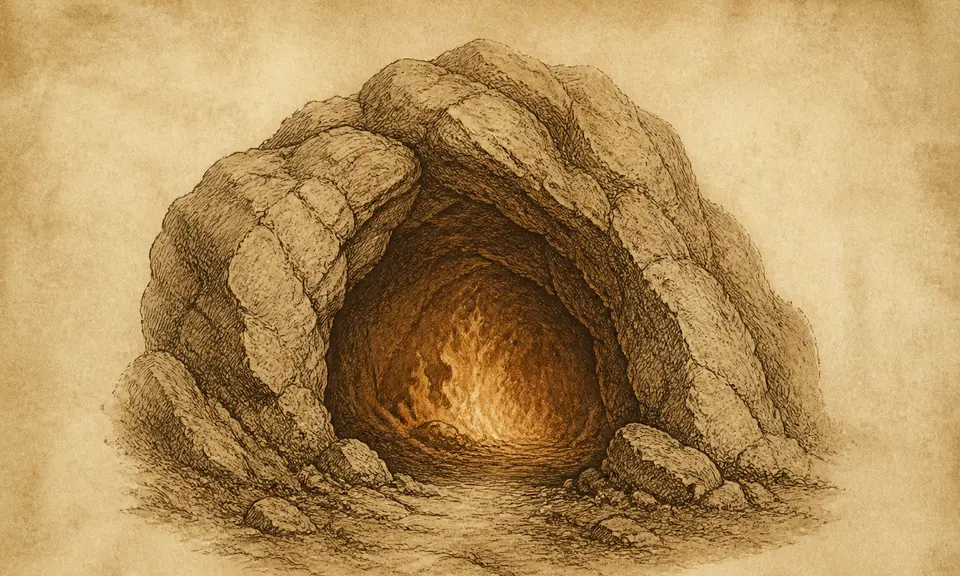
Whoever saw in a dream that he entered hell commits the grave sins; and if he came out of it without harm, he falls into the cares of this world. And whoever sees that the Fire has drawn near falls into a hardship and a trial from a ruler from which he is not saved, and a fine and a gross loss struck him; and it is a warning to him, that he may repent and turn back from what he is in. And if he entered it, then he commits the grave sins and the foul deeds for which God Most High has made the prescribed punishment due upon him, and he forgets his Lord; and if he entered it and drew a sword, then he speaks foulness and wrong. And if he saw that he entered it smiling, then he sins and disobeys God Most High and rejoices in the bliss of this world. And if he saw that he was brought into the Fire, then the one who brought him in leads him astray and urges him to commit a great sin, like a killing or a fornication. And if he saw that he never ceased to be shut up in Gehenna and does not know when he entered, then he does not cease to be in this world poor and sorrowing, and he does not pray and does not fast and does not call God Most High to mind. And if he saw that he passes over the live coals, then he deliberately steps over the necks of the people. And if he saw that he tasted of the zaqqum of Gehenna and of its boiling water and of its pus, or that something of its heat struck him, then he earns the sin and sheds blood and his affairs grow hard upon him. And whoever sees that he is black of face and blue of eye in Gehenna keeps company with the enemy of God Most High and is content with the hatefulness of his crime, so he is abased and his face is blackened before the people, and God Most High punishes him in the next world for his wrongdoing. And whoever sees Gehenna in his sleep plainly, let him beware of a ruler or of the anger of the Merciful. And whoever sees as though he entered Gehenna is disgraced for every sin he has not repented of; and if he saw as though he came out of Gehenna, then he repents of the acts of disobedience; and if he drank of its drink or tasted of its food, he does not cease to commit acts of disobedience, or he seeks a knowledge that becomes a bane upon him. And Gehenna in a dream points to the going away of the office in this world for the one who entered it; and perhaps it points to poverty after wealth, and to desolation after company, and to falling into hardships, and to lasting imprisonment, and to shame in this world. And if it pointed to the wife, she was a vexing wife; and if it pointed to the living, its earning was unlawful; and if it pointed to the dwelling, it neighboured the people of sin and heedlessness; and if it pointed to the illness, its end was death together with a bad ending; and if it pointed to the service, it was with one of unjust power; and if it pointed to knowledge, it was an innovation; and if it pointed to the deed, it was a deed not accepted; and if it pointed to the child, it was a child of fornication. And perhaps the entering of the Fire points to the one who begs after wealth; and it points to the house of innovation and of the sinners, and to the church and the synagogues and the houses of fire and the bath and the tannery and the slaughterhouse and the oven and whatever a fire is lit in for a purpose; and the entering of it points to the attaining of desires. And if he entered Laza, he was of those who gathered and hoarded, and likewise al-Hutama; and perhaps al-Hutama is for the one who slanders and backbites and gathers; and Gehenna is for the unbelievers and the hypocrites; and Saqar points to the leaving off of truthfulness and to plunging into what does not concern one and to niggardliness and to the calling of the Day of Judgement a lie; and as-Sa'ir is for the satans and for whoever takes on their characters; and al-Hawiya points to the giving short in the measure and the balance, or is for the one whose scales were light and who did not weigh them down with righteous deeds; and al-Jahim is for the one who transgressed and preferred the life of this world; and the lowest depth is for the masters of hypocrisy. And if he ate of its zaqqum, or drank of its foul water, or its scorpions stung him, or its snakes bit him, or his skin was changed for the skins of its people, or he was dragged upon his face, or he was thrown down from a climb upon his head, or he was struck with its maces, or its guards drove him off — all of that and what resembles it is a sign of innovations in religion and of partnership with the wrongdoers and of holding to the ways of the unbelievers and of taking on the characters of the idolaters and the mockers, and of going against the prophets and forsaking the godfearing, and of turning back from the religion, and of withholding the money of God from those who deserve it, and of disobedience to the Lord of the worlds, or of the denial of His lordship and His power and the likening of Him to His creation, be He praised and exalted. And the sight of Malik, the keeper of the Fire, points — for the one who changed in his quality, or whom he fed something good — to love for God Most High and for His messenger and for the believers, and to honour and power, and to being far from hypocrisy, and to leaving off sins and caprice after straying, and to zeal in religion. And if he saw the keeper, peace be upon him, turning toward him, it pointed to his safety and to his security from his Fire; and if he saw him turning away from him, or changed toward him in his face or in his bearing, it pointed to his falling into what makes his Fire due. And the keepers of Gehenna are the trustees and the guards and the troops and the helpers and the men of the guard and the household and the kinsfolk, for the one whom Malik pointed to. And whoever sees that Malik took him by his forelock and cast him into the Fire, then his vision makes abasement due for him. And if he saw that he entered the Fire and came out of it, then he enters the Garden, if God Most High wills, or he falls into an act of disobedience and repents of it. And if he saw his own limbs speaking to him, then it is a sign of being held back from the acts of disobedience and of awakening to the matter of the next world.
Section letter jim