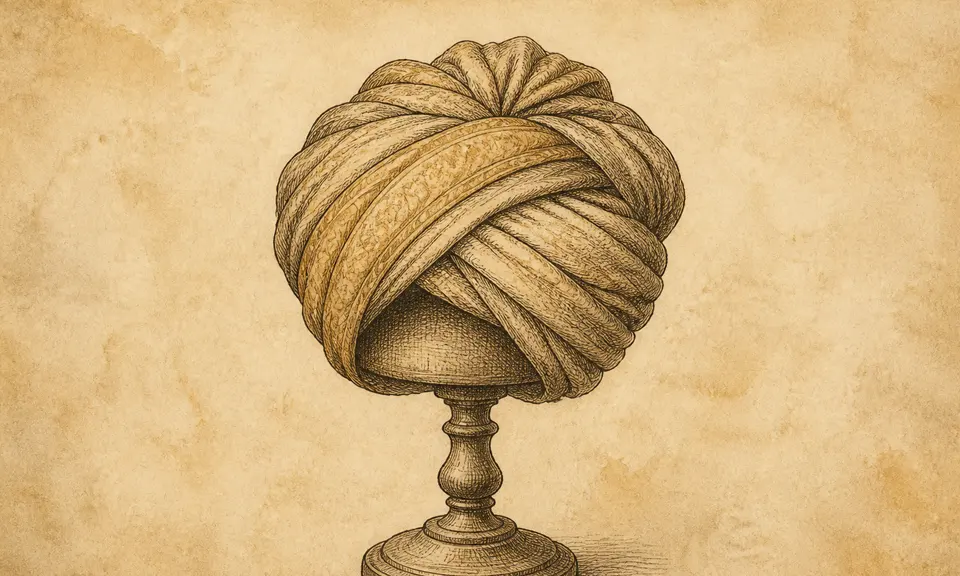
It is in a dream a man's crown and his standing and his strength and his office and his wife. Whoever of the officeholders sees that his turban came down around his neck in coils is removed from his office; and so it is if it was taken off the top of his head or snatched away. And if he is not an officeholder, he divorces his wife, or his money and his standing go. And so it is if he sees that his turban turned to gold: his office is going, or his wife, or his standing, or his money. Whoever sees that a governor put a turban on him takes an office or marries a God-fearing wife. Whoever sees that a prophet put a turban on him, or that a ruler, living or dead, handed him a turban, is given an office — and the turban is victory. Whoever sees that he put on a turban gains in headship and in craft; and if it was of silk brocade, he gains money; and if it was of wool, he gets an office and soundness in his religion; and if of cotton, it is as wool; and if of silk, it is an office in a spoiled religion and its money is unlawful. Whoever winds a turban over his turban grows in standing and is made firm in his office. Whoever sees that he winds a turban around his head travels as far as the length of the turban. A yellow turban is an illness in the head, and a black one is mastery. And if a king sees that his turban is like a house, or his ring like an anklet, he is removed from his kingship; and if he was a governor, he is removed from his office, because that has gone past all measure and will not hold. Turbans are the crowns of the Arabs. And perhaps the word for turban points to blindness, or to a care that is general. Whoever prays in a dream without a turban may have a doubt enter him about his washing, or a shortfall in his bowing and his prostration. Whoever of the idolaters sees a turban on his head takes Islam, by what has been handed down: nothing divides us from the idolaters but the turbans over the caps. And whoever was afraid of a man of power and saw him in a dream in a fair turban — that man will be mild with him and he will be safe from his evil; and so it is if a fair turban was on his own head: he will be mild with others and others will be safe from his evil. And a man said: I saw on my head a great fair turban, and the bier of a nun that they meant to pray over in the great mosque, with the callers to prayer chanting the praise before it; then they uncovered her and she had a black shroud, and I quarrelled with the callers over the chanting for her. And I said to him: you are a man with a wife who is content with you and loves you, and her father is enraged against you and has ordered some of the callers to part your wife from you — and you quarrelled with the callers over that. And he said to me: it is just as you have said. Then he said: and I saw glass over the eyes of that dead nun. And I said to him: that father is deluded by the world. And he said to me: yes, that too. And not many days passed before that father died.
Section letter ayn