To reap, to gather the vintage and to prune, seen out of season, puts off all one's doings and undertakings to that time and hour.
Passage Book I, 52
3 readings from 3 sources.
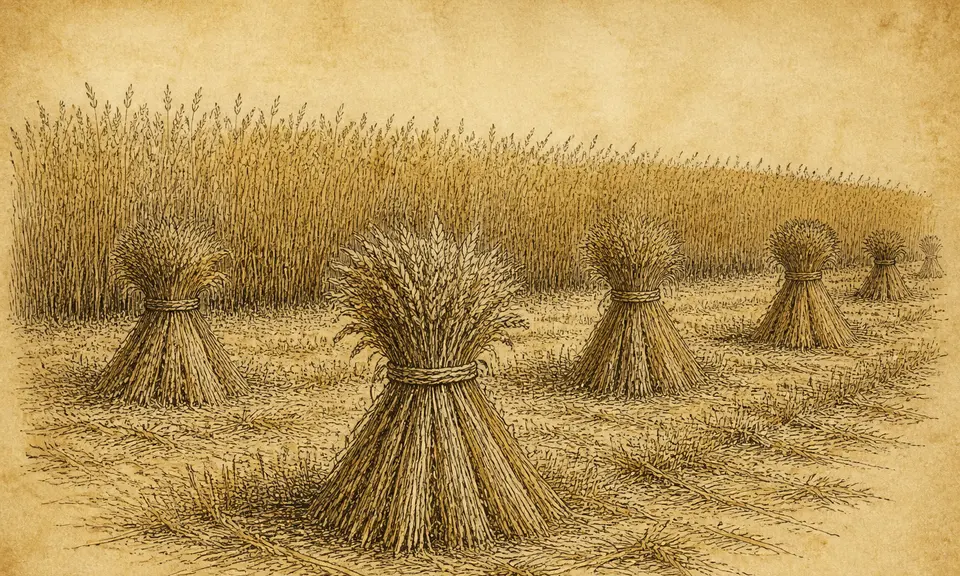
Miller reads the harvest as a public forecast: harvest time is a forerunner of prosperity and pleasure, an abundant yield is good for the country because the political machinery will grind to advance all conditions, and a poor harvest means small profits. an-Nabulsi reads the standing crop as a body of work and a body of people. Sowing is the wife's pregnancy; ploughing another man's land is war with its owner; the crop burning is hunger and drought; green means a long life and dry a near end. Walking in a green field is working at kindness without knowing whether it is accepted; walking among the standing crop is walking among the ranks of the fighters. And the field itself keeps turning: it is the woman, because it is ploughed and sown and conceives and bears and suckles until the harvest; it is the market, with the ear as its profits; it is the field of war, with the ear as the army and the harvest done by the sword. Artemidorus reads the harvest only when it is out of place, and makes the dream a postponement: to reap, to gather the vintage and to prune, seen out of season, puts off all one’s doings and undertakings to that time and hour.
This paragraph was generated by a model. It sums up the sources above, comes from none of them and is attributed to no one.
To reap, to gather the vintage and to prune, seen out of season, puts off all one's doings and undertakings to that time and hour.
Passage Book I, 52
Whoever sees in a dream that he sowed a crop — it is his wife's pregnancy. Whoever sees that he ploughs in land where another man has sown will have war between himself and the owner of that land. The burning of the crop is hunger and drought. Whoever sees that he walks about in a green field is working at deeds of kindness and devotion, and does not know whether they are accepted from him or not. Whoever sees that he has sown in a field: for the married man it is a child, for the unmarried a marriage, for the man of produce an increase in his income, for the ruler a widening of his kingdom. And if a Jew sees that he cast his seed in a field, he is killed and stoned. The crop, when green, points to a long life, and when dry, to a near end. Sowing wheat, giving it or taking it, is kindness or an alms with the reward doubled; and the ear of wheat may point to hardship, as its ear pointed to the doubling of the reward — and barley is the sensing of good. The crop points to work: whoever sees himself in land fit for sowing does a work by which he hopes for good tomorrow; and whoever sows where sowing does not belong commits sodomy or adultery. If he sees the crop reaped out of its season, it points to a death in that quarter, or to war. And whoever walks among the standing crop walks among the ranks of the fighters. Whoever sees that he has a crop that is known to him — that is his work in his religion. The field points to the woman, because it is ploughed and sown and conceives and bears and suckles until the harvest, when the plant no longer needs the earth; so its ear is her child or her money. And perhaps the field points to the market, and its ear to the market's provisions and profits and gains, because the crop has many profits and many blights, its yield and its loss. And the field points to the field of war, and its ear to the army, and its harvest is by the sword. And perhaps it points to the world, and its ear to the company of people, the small of them and the great, the old and the middle-aged. And perhaps the fields point to every place that is ploughed for the hereafter and where reward and merit are worked for: the mosques, the hostels, the circles of remembrance and the places of almsgiving.
Section letter zay
To dream of harvest time, is a forerunner of prosperity and pleasure. If the harvest yields are abundant, the indications are good for country and state, as political machinery will grind to advance all conditions. A poor harvest is a sign of small profits.