Giant

2 readings from 2 sources.

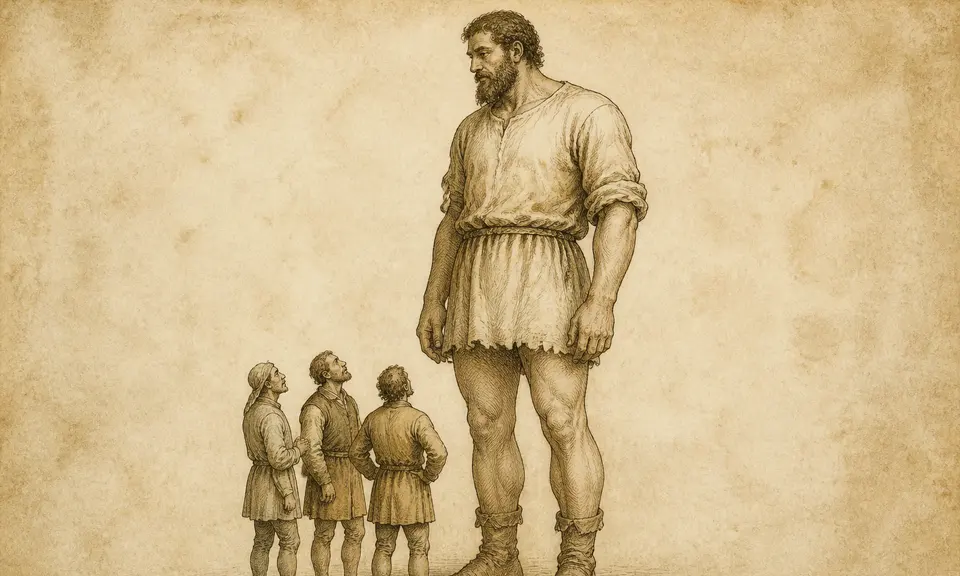
The image was generated by a model. It is not a period engraving and comes from none of the sources.

The two books are not reading the same thing, and saying so is the only way to read the Greek one honestly. Artemidorus does not interpret a giant met in a dream; he puts the battle of the giants among the dreams whose material is myth. All that is utterly faded and full of nonsense and idle talk, such as the stories about the battle of the giants and the Sown Men, both those at Thebes and those in Colchis and the like, either will not come out at all, or else it sets aside and cancels every expectation and announces that hopes are vain and empty — unless some one of these mythical things admits of a natural explanation. Miller takes the giant as an opponent and reads the encounter. A giant appearing suddenly before the dreamer denotes a great struggle between him and his opponents; if the giant succeeds in stopping his journey, he will be overcome by his enemy; and if the giant runs from him, prosperity and good health will be his. So one book makes the giant a thing to fight and gives the dream an outcome either way, while the other makes the giant evidence that the dream was made of old stories and will come to nothing at all.

This paragraph was generated by a model. It sums up the sources above, comes from none of them and is attributed to no one.

Greek dream book

But all that is utterly faded and full of nonsense and idle talk, such as the stories about the battle of the giants and the Sown Men, both those at Thebes and those in Colchis and the like, either will not come out at all, or, according to what was said before, it sets aside and cancels every expectation and announces that hopes are vain and empty — unless some one of these mythical things admits of a natural explanation.

Passage Book IV

Ὀνειροκριτικά (Oneirokritika)

Artemidorus of Daldis; edited by Rudolf Hercher

second century; Hercher’s edition 1864 · Greco-Roman

the source of the ancient tradition itself, which the others draw on

About this source

Five books of second-century Greek prose, not an alphabetical dictionary: the readings sit inside argued chapters and the author says of each one why it reads as it does. It is the source the other European and Arabic dream books draw on, including where they do not name it.

Rights: public domain

Where the text is from: https://archive.org/details/bub_gb_CRwTAAAAQAAJ

Miller

To dream of a giant appearing suddenly before you, denotes that there will be a great struggle between you and your opponents. If the giant succeeds in stopping your journey, you will be overcome by your enemy. If he runs from you, prosperity and good health will be yours.

Ten Thousand Dreams Interpreted; Or, What's in a Dream

Gustavus Hindman Miller

1901 · American Victorian

carries fragments of the ancient tradition without its system

About this source

An American dream book, the only one here that knows the telephone, the railroad or the elevator. Doctrinally it is the most degraded: it keeps fragments of the ancient tradition without the system that once held them together.

Rights: public domain

Where the text is from: https://www.gutenberg.org/ebooks/926