Finger-nails

3 readings from 3 sources.

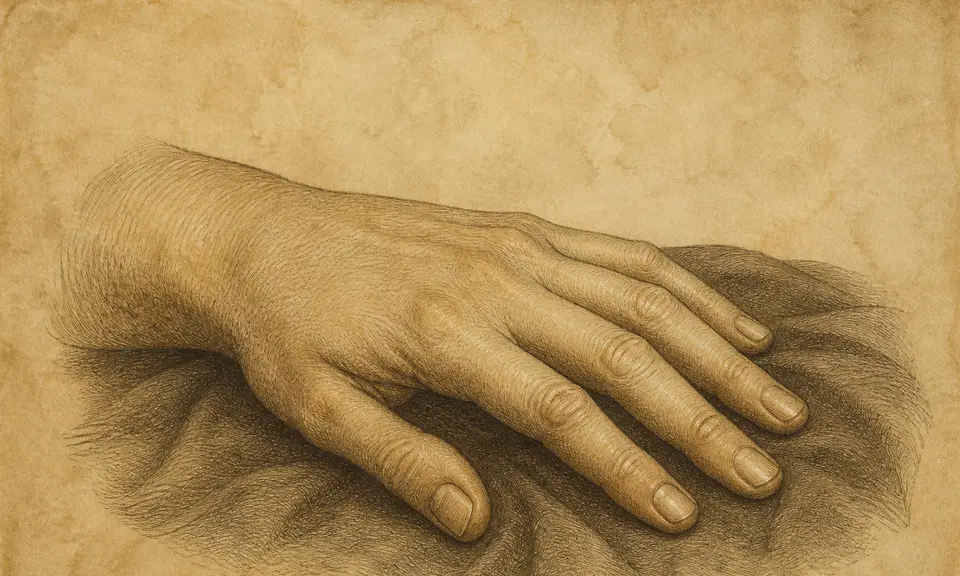
The image was generated by a model. It is not a period engraving and comes from none of the sources.

Miller grooms the nail and an-Nabulsi arms it. For Miller the reading is hygiene read as character: soiled finger-nails forebode disgrace in the family through the wild escapades of the young, and well-kept nails indicate scholarly tastes, some literary attainment, and thrift. Two states, two verdicts, and the whole reading fits in two sentences. an-Nabulsi makes the nail a weapon, since it points to victory over enemies, the nail is the man's strength, and nails grown to a length at which he is safe from their breaking are an increase in his strength and his wealth, a weapon against his enemies and a protection from them, so that whoever's nails went away, his power went away. But the same length then turns on itself, because a long nail is contrary to the Prophet's custom, so it can also point to rejectionism, and past the known bound it is a blemish; the one who pares his nails and does not pass that bound is the man who follows the custom. And he makes room for a case Miller's scale cannot hold, since length is breadth of provision for the man who needs it in his trade and for the men of arms it is an increase in their arms. Artemidorus reads neither the dirt nor the length but the cutting, and he reads it as a word: to have one's nails trimmed means, for a debtor, paying the interest, and for everyone else harm from those who trimmed them, for in common speech we say that a man is trimmed who has been cheated by somebody to his harm.

This paragraph was generated by a model. It sums up the sources above, comes from none of them and is attributed to no one.

Greek dream book

To have one's nails trimmed means, for a debtor, paying the interest, and for the rest harm from those who trimmed them, provided they see themselves trimmed by some others; for in common speech we say that a man is trimmed who has been cheated by someone to his harm.

Passage Book I, 20

Ὀνειροκριτικά (Oneirokritika)

Artemidorus of Daldis; edited by Rudolf Hercher

second century; Hercher’s edition 1864 · Greco-Roman

the source of the ancient tradition itself, which the others draw on

About this source

Five books of second-century Greek prose, not an alphabetical dictionary: the readings sit inside argued chapters and the author says of each one why it reads as it does. It is the source the other European and Arabic dream books draw on, including where they do not name it.

Rights: public domain

Where the text is from: https://archive.org/details/bub_gb_CRwTAAAAQAAJ

Arabic dream book

It in a dream points to victory over enemies. And perhaps the length of the nail, for one who has need of it, such as the circumciser and others, points to breadth in provision, unlike when he sees it clipped. And perhaps the length of the nail points to rejectionism, because the length of the nail is contrary to the Prophet's custom, and rejectionism is contrary to that custom. And the nail is the man's strength. So whoever saw that his nails have grown to a length at which he is safe from their breaking, that is an increase in his strength and his wealth, and it is a weapon against his enemies and a protection for him from them. And whoever's nails went away, his power went away. And whoever pared his nails and did not pass the known bound is a man who follows the Prophet's custom. And the length of the nail, for the men of arms, is an increase in their arms and their strength; and when it passes the bound in its length, it is a blemish.

Section letter ẓa
The Perfuming of Mankind in the Interpretation of Dreams

Abd al-Ghani al-Nabulsi

before 1731; first printed Cairo 1858 · Arab-Islamic

carries the ancient tradition after Artemidorus

About this source

An Arabic dream book by the Damascene scholar al-Nabulsi, an alphabetical dictionary of two and a half thousand headwords. It draws on the ancient tradition directly: Artemidorus was translated into Arabic by Hunayn ibn Ishaq in the ninth century. The readings here almost always address the dreamer’s standing, property and faith rather than their feelings.

Rights: public domain

Where the text is from: https://shamela.ws/book/1217

Miller

To dream of soiled finger-nails, forbodes disgrace in your family by the wild escapades of the young. To see well-kept nails, indicates scholarly tastes and some literary attainments; also, thrift.

Ten Thousand Dreams Interpreted; Or, What's in a Dream

Gustavus Hindman Miller

1901 · American Victorian

carries fragments of the ancient tradition without its system

About this source

An American dream book, the only one here that knows the telephone, the railroad or the elevator. Doctrinally it is the most degraded: it keeps fragments of the ancient tradition without the system that once held them together.

Rights: public domain

Where the text is from: https://www.gutenberg.org/ebooks/926