Figs in their own season are good, but appearing out of season they foretell slander and abuse; for the ancients used the word for gathering figs of abusing a man as well.
Passage Book I, 73
6 readings from 3 sources.
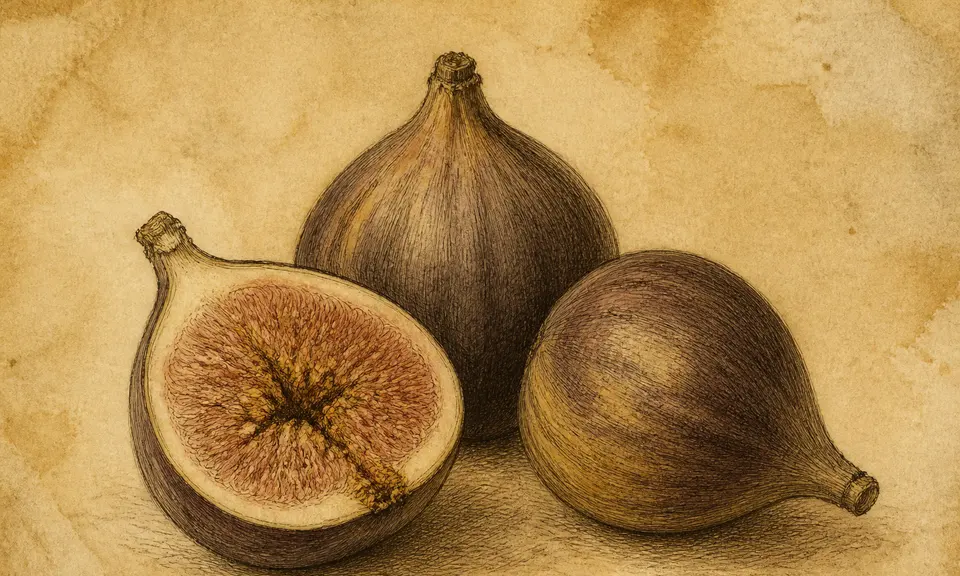
Both books make the fig money, and both put a condition on what the dreamer does with it. Miller divides eating from seeing: eating figs signifies a malarious condition of the system, while seeing them growing is favourable to health and profit. an-Nabulsi has no such division — the fruit is money and great abundance for whoever gets some of it — and then reads the tree as a man: rich, of much money and much benefit, and sheltering the enemies of Islam, because snakes shelter in it. He closes with a claim no other fruit gets anywhere in his book, that among fruits there is nothing that equals it. Another Arabic reading takes the sycamore fig instead, and the tree stops sheltering snakes, since it is a man of much use, steady in good, of great force and much money, and the fruit is lawful money of much profit; the fig itself becomes a woman of lineage and of money. Artemidorus reads the fig by its season and by its colour, and makes the fig out of season a matter of words: figs in their own season are good, but appearing out of season they foretell slander and abuse, for the ancients used the word for gathering figs of abusing a man as well. White figs mean fair weather and black ones storm and rain — but only for those who work in the open, since to anybody else the fig tree would prophesy nothing about the weather.
This paragraph was generated by a model. It sums up the sources above, comes from none of them and is attributed to no one.
Figs in their own season are good, but appearing out of season they foretell slander and abuse; for the ancients used the word for gathering figs of abusing a man as well.
Passage Book I, 73
Only for those who work in the open do white figs signify fair weather and black ones storm and rain, since to anyone else the fig tree would prophesy nothing about the state the weather will be in.
Passage Book I, 73
A man who had a sister at once rich and sick dreamed that a fig tree had grown up before his sister's house, and that he plucked from it and ate black figs, seven in number. His sister died, leaving the dreamer her heir, having lived seven days longer.
Passage Book V
In a dream they are money and great abundance for whoever gets some of them, and the fig tree is a rich man of much money and much benefit, in whom the enemies of Islam find shelter, because snakes shelter in it, and among fruits there is nothing that equals it. And whoever sees that he eats of it — then his offspring grow many. And it is said the fig is provision from the side of Iraq, and gathered money by which its owner grows fat without toil, and its trace shows upon him and is not hidden, because of the fig's benefit. And eating a little of it is provision without hardship. And every fig that is eaten or taken is a thousand dinars, or ten thousand dirhams that falls into his hand. And it is said the fig is ready money. And it is said the fruit of the fig and its leaves are care and sorrow and regret, so whoever ate them, care befell him over a matter that has come to him or will come to him. And it is said the fig is read as the righteous and the best of men, and as provision, and ease, and complete gladness, and ample bounty. And the black fig in its season is good, and the white fig is good; and if he saw the fig out of its season, then it points to an envy that comes upon the man of the vision. And the fig may point to an oath; and if it was black, the oath may be a lying one. And it may point to vexation and sorrow and to going out from the higher place to the lower. And it may point to remorse, just as remorse pointed to the eating of the fig.
Section letter ta
They point in a dream to lawful money of much profit for whoever got some; and whoever ate something of them came into an easy provision. And the sycamore tree is a man of much use, steady in good, of great force, of much money. And the sycamore fig is a woman of lineage and of money. And perhaps seeing it points to a weakness of the heart or of the sight.
Section letter jim
Figs, signifies a malarious condition of the system, if you are eating them, but usually favorable to health and profit if you see them growing. For a young woman to see figs growing, signifies that she will soon wed a wealthy and prominent man.