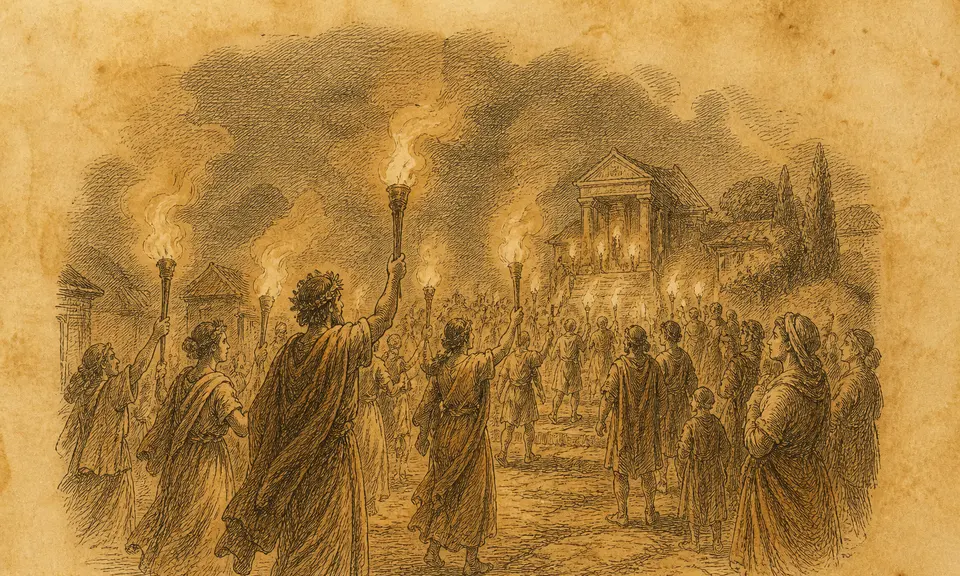
Festival

4 readings from 2 sources.

The image was generated by a model. It is not a period engraving and comes from none of the sources.

Artemidorus grades the festival by who is keeping it. All-night festivals and night-time feasts, and the merrymaking that goes with staying awake, are good for marriages and partnerships, and for the poor they are a sign of plenty and of gain, inasmuch as for the grieving and the fearful they have been found to bring neither fear nor grief — for a man cannot keep an all-night feast unless he is in great good cheer. On those who are well off and whose life is brilliant the same feasts lay disturbances and loud talk, the end of which would turn out to be free of grief. And one reading is about other people entirely: the feasts make adulterers and adulteresses plain to see, but they do not punish them at all. Miller reads the festival as a trait of the dreamer rather than as his station: to dream of being at one denotes indifference to the cold realities of life, and a love for those pleasures that make one old before his time, so that he will never want but will be largely dependent on others. The two books meet only at the top of the Greek scale. What the poor man gains in Artemidorus, Miller allows nobody; and where Artemidorus leaves even the disturbances of the rich ending without grief, Miller makes the whole dream the price of the pleasure.

This paragraph was generated by a model. It sums up the sources above, comes from none of them and is attributed to no one.

Greek dream book

All-night festivals and night-time feasts and the merrymaking that goes with staying awake are good for marriages and partnerships, and for the poor they are a sign of plenty and of gain, inasmuch as for the grieving and the fearful they have been found to bring neither fear nor grief; for a man cannot keep an all-night feast unless he is in great good cheer.

Passage Book III, 61

They make adulterers and adulteresses plain to see, but they do not punish them at all.

Passage Book III, 61

But on those who are well off and whose life is brilliant they lay disturbances and loud talk, the end of which would turn out to be free of grief.

Passage Book III, 61

Ὀνειροκριτικά (Oneirokritika)

Artemidorus of Daldis; edited by Rudolf Hercher

second century; Hercher’s edition 1864 · Greco-Roman

the source of the ancient tradition itself, which the others draw on

About this source

Five books of second-century Greek prose, not an alphabetical dictionary: the readings sit inside argued chapters and the author says of each one why it reads as it does. It is the source the other European and Arabic dream books draw on, including where they do not name it.

Rights: public domain

Where the text is from: https://archive.org/details/bub_gb_CRwTAAAAQAAJ

Miller

To dream of being at a festival, denotes indifference to the cold realities of life, and a love for those pleasures that make one old before his time. You will never want, but will be largely dependent on others.

Ten Thousand Dreams Interpreted; Or, What's in a Dream

Gustavus Hindman Miller

1901 · American Victorian

carries fragments of the ancient tradition without its system

About this source

An American dream book, the only one here that knows the telephone, the railroad or the elevator. Doctrinally it is the most degraded: it keeps fragments of the ancient tradition without the system that once held them together.

Rights: public domain

Where the text is from: https://www.gutenberg.org/ebooks/926