Eagles

3 readings from 3 sources.

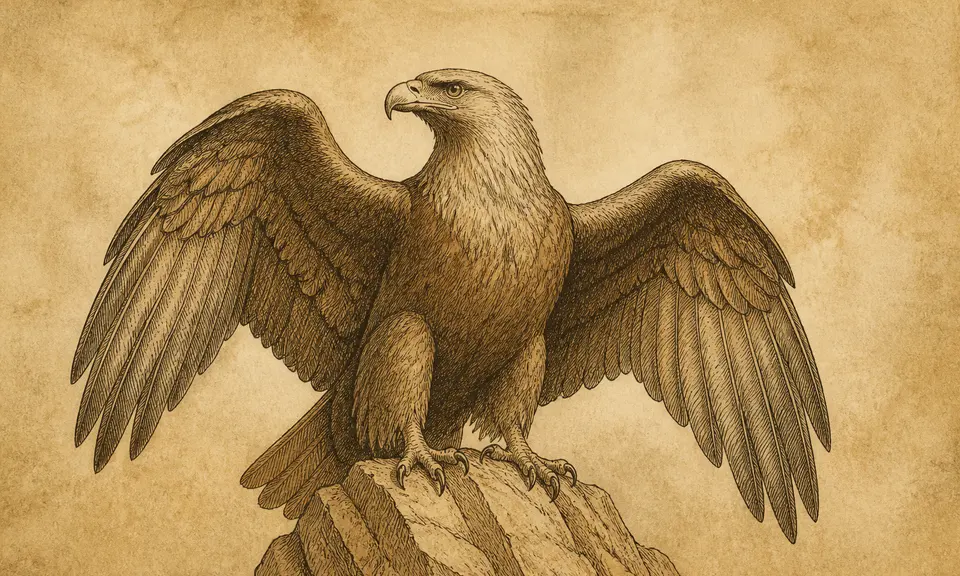
The image was generated by a model. It is not a period engraving and comes from none of the sources.

Miller's eagle is an ambition and an-Nabulsi's is a danger. Miller runs through the positions: one soaring above the dreamer means lofty ambitions fiercely struggled for and eventually gained; one perched on distant heights means fame, wealth and the highest position attainable in his country; young eagles in the eyrie mean association with people of high standing and in time a rich legacy; eating its flesh means a will that would not turn aside even for death; and to ride on its back is a long voyage into almost unexplored countries after knowledge and wealth. Only one case turns bad, and it is the one he does not do himself, since a dead eagle killed by others means high rank and fortune wrested from him ruthlessly. an-Nabulsi reads the bird as what it is to everything beneath it: a strong man possessed of sovereignty and hard violence, awe-inspiring, a man of war whom neither the near nor the far one is safe from — and then he puts it on a roof, for if the eagle alighted on the roof of a man's house, or he saw it in his courtyard, it is the angel of death. In one book the dreamer is the eagle; in the other he is what it has landed on. Artemidorus has one case and in it the bird is a calendar and a birth: a man dreamed that an eagle tore open his entrails with its talons and carried them into the theatre and showed them to the spectators, and he was childless, and after the dream a son was born to him who was notable in the city.

This paragraph was generated by a model. It sums up the sources above, comes from none of them and is attributed to no one.

Greek dream book

A man dreamed that an eagle tore open his entrails with its talons and carried them through the city into the theatre, which was full of a crowd, and showed them to the spectators. He was childless, and after this dream a son was born to him who was notable and brilliant in the city; for the eagle meant the year in which the son was to be born to him, the entrails meant the son, and the carrying into the theatre meant the brilliance and distinction of the son.

Passage Book V

Ὀνειροκριτικά (Oneirokritika)

Artemidorus of Daldis; edited by Rudolf Hercher

second century; Hercher’s edition 1864 · Greco-Roman

the source of the ancient tradition itself, which the others draw on

About this source

Five books of second-century Greek prose, not an alphabetical dictionary: the readings sit inside argued chapters and the author says of each one why it reads as it does. It is the source the other European and Arabic dream books draw on, including where they do not name it.

Rights: public domain

Where the text is from: https://archive.org/details/bub_gb_CRwTAAAAQAAJ

Arabic dream book

It in a dream is a strong man, possessed of sovereignty and of hard violence, awe-inspiring, a man of war whom neither the near nor the far one is safe from. And if the eagle alighted upon the roof of a man's house, or he saw it in its courtyard, then it is the angel of death.

Section letter ayn

The Perfuming of Mankind in the Interpretation of Dreams

Abd al-Ghani al-Nabulsi

before 1731; first printed Cairo 1858 · Arab-Islamic

carries the ancient tradition after Artemidorus

About this source

An Arabic dream book by the Damascene scholar al-Nabulsi, an alphabetical dictionary of two and a half thousand headwords. It draws on the ancient tradition directly: Artemidorus was translated into Arabic by Hunayn ibn Ishaq in the ninth century. The readings here almost always address the dreamer’s standing, property and faith rather than their feelings.

Rights: public domain

Where the text is from: https://shamela.ws/book/1217

Miller

To see one soaring above you, denotes lofty ambitions which you will struggle fiercely to realize, nevertheless you will gain your desires. To see one perched on distant heights, denotes that you will possess fame, wealth and the highest position attainable in your country. To see young eagles in their eyrie, signifies your association with people of high standing, and that you will profit from wise counsel from them. You will in time come into a rich legacy. To dream that you kill an eagle, portends that no obstacles whatever would be allowed to stand before you and the utmost heights of your ambition. You will overcome your enemies and be possessed of untold wealth. Eating the flesh of one, denotes the possession of a powerful will that would not turn aside in ambitious struggles even for death. You will come immediately into rich possessions. To see a dead eagle killed by others than yourself, signifies high rank and fortune will be wrested from you ruthlessly. To ride on an eagle's back, denotes that you will make a long voyage into almost unexplored countries in your search for knowledge and wealth which you will eventually gain.
Ten Thousand Dreams Interpreted; Or, What's in a Dream

Gustavus Hindman Miller

1901 · American Victorian

carries fragments of the ancient tradition without its system

About this source

An American dream book, the only one here that knows the telephone, the railroad or the elevator. Doctrinally it is the most degraded: it keeps fragments of the ancient tradition without the system that once held them together.

Rights: public domain

Where the text is from: https://www.gutenberg.org/ebooks/926