Devil and Satan

4 readings from 2 sources.

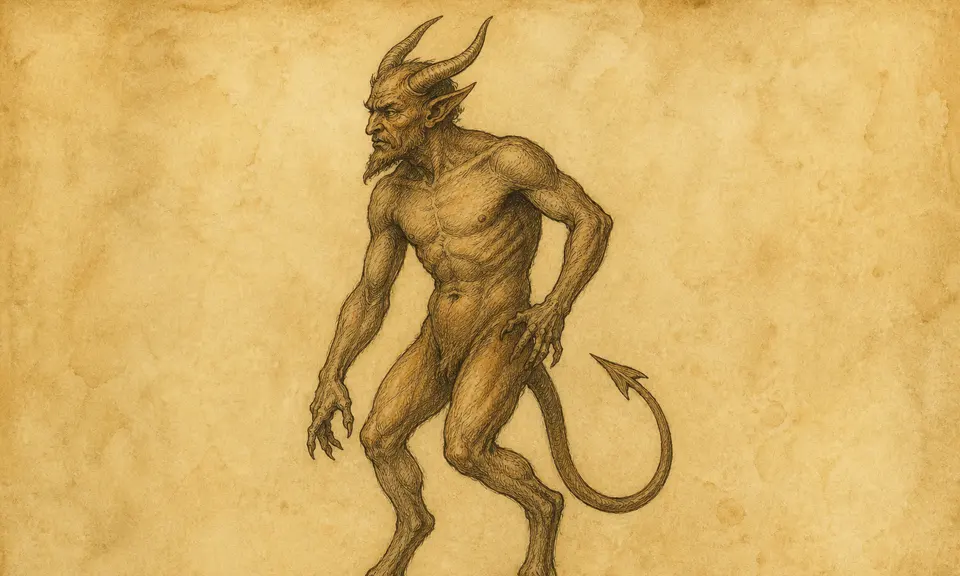
The image was generated by a model. It is not a period engraving and comes from none of the sources.

Both books read the same being under two names, and neither means a different being by the second one. Miller's devil is a social predator: to farmers he means a scorched harvest, cattle dying and illness in the family; and in the main picture he is a large, richly dressed man covered in glittering jewels who urges the dreamer to come inside with him — that is, ruthless people working at his ruin by the most ingenious flattery. Satan in the same book is that figure dressed up in the things a man would be glad to take: literature, wealth, power, music, a beautiful woman, each disguise turning into the dreamer's own failing, while to kill him means leaving bad company and living on a higher plane. an-Nabulsi's Iblis is a theological figure and opens with a joke, since al-Hasan, asked whether Iblis sleeps, smiled and said that if he slept we should have some peace. He stands for heedlessness, for the scholar who brings in innovations, for abandoning prayer, for lying and embezzlement — and for a long life. The difference between the two books is clearest in what happens when a man puts him on: whoever sees that he has become Iblis will be struck in his sight, or fall away from his religion, or die sorrowing, but he will be given offspring and money, he will beat his enemies by cunning, and if he was fit to rule, he will rule. Miller's devil can only cost the dreamer something; the Arabic one can be worn, and it pays.

This paragraph was generated by a model. It sums up the sources above, comes from none of them and is attributed to no one.

Arabic dream book

It in a dream is an enemy in religion and in this world, cunning, deceiving, greedy, overbearing, who neither cares nor heeds. And perhaps he was an emir or a vizier or a judge or a policeman or a jurist or a preacher or an unbeliever or a hypocrite or an envier. And perhaps he was the family and the household. And the seeing of Satan is joy and excess and lust, just as lust is excess and a satan.

Section letter shin

In a dream he points to heedlessness. A man said to al-Hasan: O Abu Said, does Iblis sleep? He said: and he smiled and said: if he slept, we would find rest. And the seeing of him in a dream points to the scholar who brings in innovations, and he points to the leaving of prayer and to lying and to embezzlement and to the earning of sins and of their traces, and to length of life. And the seeing of him points to guile and deceit and sorcery and to the parting between the two spouses, by analogy with his story with Adam, upon him be peace. And perhaps the seeing of him points to turning back from religion, because he was a worshipper of God the Most High, and then by his opposing he returned driven off and set far away. Then he is, in interpretation, a sign of the unbelieving king who dwells by the sea and equips the troops and the horse and the foot. God the Most High said: {and rally against them your horse and your foot}. And if he saw that he became Iblis, he is stricken in his sight, or he turns back from his religion, or he lives set far away and dies in grief, and he is granted offspring and wealth, and he gains victory over his enemies by guile. And if he was fit for kingship, he reigns, and in his time he commands what is reprehensible and forbids what is right.

Section letter alif
The Perfuming of Mankind in the Interpretation of Dreams

Abd al-Ghani al-Nabulsi

before 1731; first printed Cairo 1858 · Arab-Islamic

carries the ancient tradition after Artemidorus

About this source

An Arabic dream book by the Damascene scholar al-Nabulsi, an alphabetical dictionary of two and a half thousand headwords. It draws on the ancient tradition directly: Artemidorus was translated into Arabic by Hunayn ibn Ishaq in the ninth century. The readings here almost always address the dreamer’s standing, property and faith rather than their feelings.

Rights: public domain

Where the text is from: https://shamela.ws/book/1217

Miller

For farmers to dream of the devil, denotes blasted crops and death among stock, also family sickness. Sporting people should heed this dream as a warning to be careful of their affairs, as they are likely to venture beyond the laws of their State. For a preacher, this dream is undeniable proof that he is over-zealous, and should forebear worshiping God by tongue-lashing his neighbor. To dream of the devil as being a large, imposingly dressed person, wearing many sparkling jewels on his body and hands, trying to persuade you to enter his abode, warns you that unscrupulous persons are seeking your ruin by the most ingenious flattery. Young and innocent women, should seek the stronghold of friends after this dream, and avoid strange attentions, especially from married men. Women of low character, are likely to be robbed of jewels and money by seeming strangers. Beware of associating with the devil, even in dreams. He is always the forerunner of despair. If you dream of being pursued by his majesty, you will fall into snares set for you by enemies in the guise of friends. To a lover, this denotes that he will be won away from his allegiance by a wanton.

To dream of Satan, foretells that you will have some dangerous adventures, and you will be forced to use strategy to keep up honorable appearances. To dream that you kill him, foretells that you will desert wicked or immoral companions to live upon a higher plane. If he comes to you under the guise of literature, it should be heeded as a warning against promiscuous friendships, and especially flatterers. If he comes in the shape of wealth or power, you will fail to use your influence for harmony, or the elevation of others. If he takes the form of music, you are likely to go down before his wiles. If in the form of a fair woman, you will probably crush every kindly feeling you may have for the caresses of this moral monstrosity. To feel that you are trying to shield yourself from satan, denotes that you will endeavor to throw off the bondage of selfish pleasure, and seek to give others their best deserts. See Devil.

Ten Thousand Dreams Interpreted; Or, What's in a Dream

Gustavus Hindman Miller

1901 · American Victorian

carries fragments of the ancient tradition without its system

About this source

An American dream book, the only one here that knows the telephone, the railroad or the elevator. Doctrinally it is the most degraded: it keeps fragments of the ancient tradition without the system that once held them together.

Rights: public domain

Where the text is from: https://www.gutenberg.org/ebooks/926