Eating dates: you will beget a noble son.
Section Food and drink, wine, meat, melons and vegetables
4 readings from 4 sources.
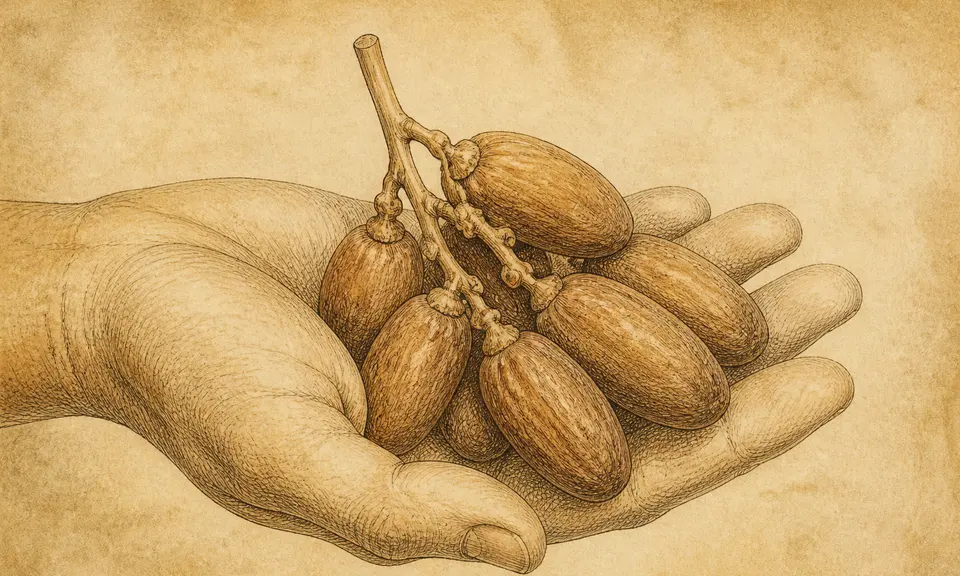
The Duke of Zhou is the shortest: eating dates, and you will beget a noble son. Miller divides them by where they are: dates on their palms mean prosperity and a happy union, dates eaten as the trade prepares them are omens of want and distress. an-Nabulsi has the longest reading and sorts the fruit by what has been done with it — dates seen are rain, dates eaten a whole year's pure provision that nobody shares in, buried dates money laid away, dates spread out coins that will not stay — and he adds that the dream may mean the dreamer will read the Qur'an to the profit of his faith, and that whoever ate the poorest kind is of the protected peoples. Artemidorus has neither the tree nor the trade, but a cure: a man ill in the stomach and needing a prescription from Asclepius dreamed that he went into the god’s temple, and that the god stretched out the fingers of his own right hand and gave them to him to eat. Eating five dates he was cured — for the good fruits of the date palm are called fingers.
This paragraph was generated by a model. It sums up the sources above, comes from none of them and is attributed to no one.
Eating dates: you will beget a noble son.
Section Food and drink, wine, meat, melons and vegetables
A man ill in the stomach and needing a prescription from Asclepius dreamed that he went into the god's temple, and that the god stretched out the fingers of his own right hand and gave them to him to eat. Eating five dates he was cured: for the good fruits of the date palm are called fingers.
Passage Book V
In a dream it is rain for the one who saw it, and for the one who ate it a provision for the whole year, pure, which comes to him and in which nobody shares with him; and its reading may be that he will read the Qur'an and that it will profit him in his religion. Buried dates are money laid away, and so is the sugar cane; dates spread out are coins that will not stay; and whoever ate the poorest kind is of the protected peoples. And whoever sees it, money comes to him from men of consequence who hold office. And a bundle of dates is spoil. And whoever gathered dates in their season from a palm married a wealthy and noble woman with sharpness in her, of much good and blessing; or he attains money from noble men without toil; and perhaps he attains knowledge. And if it was out of their season, he hears knowledge and does not act by it. And if he shook fresh ripe dates down upon himself from a dry palm, he learns useful knowledge from a hypocrite; and if he was in grief or in care, it is relieved from him, by the story of Mary, peace be upon her: and shake towards you the trunk of the palm, it will drop upon you fresh ripe dates, the verse. And if she saw that she eats dates with tar, she takes an inheritance from her husband while she is secretly divorced from him, and the inheritance is unlawful; and if the man saw that, then his wife is secretly divorced from him. And if a person saw that he took a date and split it and brought its stone out of it, a child is born to him. And whoever sees that he plucked a black grape from a palm, his wife bears a child by a black slave; or the dates are read as lawful and good provision. And whoever sees that he eats good dates hears good speech and gains a great benefit. And whoever sees as if he buries dates gained money from the treasuries or from the money of orphans, or he lays money away. And whoever sees as if he eats forty dates at the ruler's door, and it was not the season when the dates come out nor the time of their ripening, he was given forty strokes. And whoever sees as if he ate forty dates, and it was in the time of their ripening, attained forty thousand dirhams. And whoever sees baskets of barni dates falling from the bellies of swine, and he lifts them and carries them to his house, then they are spoils from the money of the unbelievers. And whoever sees as if he sucks a date and gives it to another, who sucks it, shares with him in a small kindness. And whoever sees as if he ate dates finds the sweetness of faith. And whoever sees as if he split a date and set its stone apart from it is granted a child.
Section letter ta
To dream of seeing them on their parent trees, signifies prosperity and happy union; but to eat them as prepared for commerce, they are omens of want and distress.