And for other men too the prizes bring both the good things and the bad to their end, whenever a man comes as far as the crown.
Passage Book I, 62
14 readings from 3 sources.
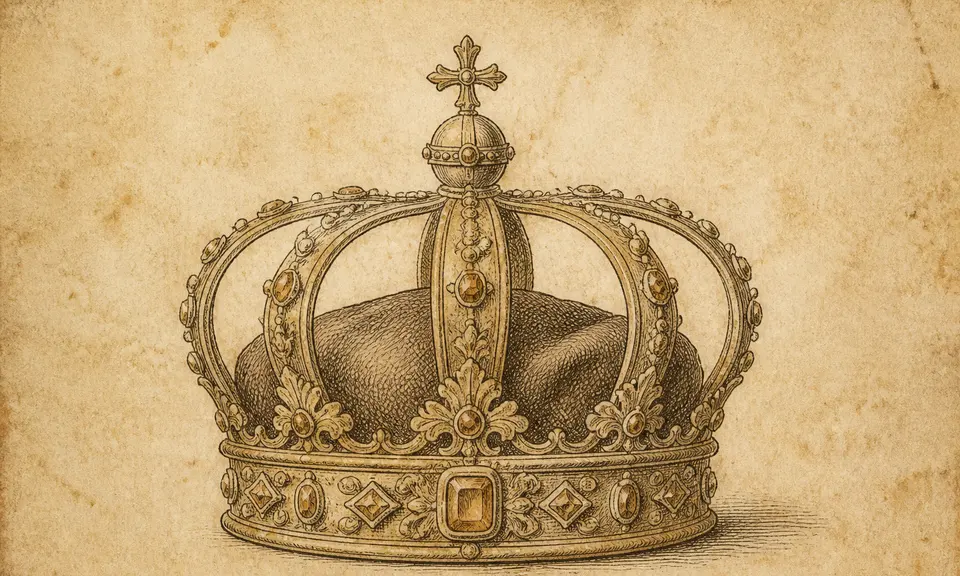
Miller reads the crown as a change of life rather than a rank: a change in the habit of living, a long journey from home, new relations — and wearing one is the loss of personal property, the only reading here where wearing it costs the wearer something. an-Nabulsi reads it as knowledge, the Qur’an and kingship, and then the metal: on a woman a husband of authority and wealth, on a man a foreign authority — but gold is disapproved for men in the Law, so a crown of plain gold can be the very thing that corrupts his religion, while jewelled gold brings a wealthy foreigner of lineage. A prisoner who dreams it is brought out and honoured as Joseph was, unless he has an absent son, for then the son is his crown and he does not die until he sees him. And the ruler who wears gold and disbelieves loses his sight, by an argument the reading spells out: the eye is the religion, so when the religion went the sight went with it. Artemidorus reads it the same way and has far more materials: wax is bad for all and worst for the sick, since the poets call death kér too; wool poisonings and binding spells; salt and sulphur being weighed down by men set above you; gold is wretched for a slave and for a poor man, swift death for the sick — pale, heavy, cold — and good for the rich and for leaders. Then the place decides: a garland that means something good goes bad worn anywhere but the head, which he proves from Zoilos, who saw his sons’ ankles garlanded and buried them before the contest.
This paragraph was generated by a model. It sums up the sources above, comes from none of them and is attributed to no one.
And for other men too the prizes bring both the good things and the bad to their end, whenever a man comes as far as the crown.
Passage Book I, 62
But the crown made him marry a maiden, because of its binding and because the olive belongs to a maiden goddess; and it came about in Egypt as well, for the story is that the plant was brought over from Egypt to Athens.
Passage Book IV
Garlands of wax are bad for all, and most of all for the sick, since the poets also call death kêr.
Passage Book I, 77
Those made of wool signify, by reason of their motley, poisonings and binding spells.
Passage Book I, 77
Those of salt or of sulphur mean that the dreamer will be weighed down by men set above him, for they are heavy by nature and have nothing pleasant about them.
Passage Book I, 77
To dream of wearing a golden crown is wretched for a slave, unless he has with it the things that go with such a crown, I mean purple and an escort; and it is wretched for a poor man too, because it is beyond his station. The one of them, therefore, will be put to the torture, and the other will be caught out in great crimes — and it is likely that he too will be tortured.
Passage Book I, 77
To a sick man it foretells a swift death, for gold is pale and heavy and cold, and for that reason it has been likened to death. It also brings hidden things to light, because the man who wears gold is looked at by everyone.
Passage Book I, 77
For rich men, for leaders of the people and for those who have set out to rule the crowd, I have observed the crown to be good.
Passage Book I, 77
Those garlands which mean something good, when they are not about the head but about some other part of the body, not only mean nothing good but turn out bad as well.
Passage Book IV
Zoilos, who had brought his own sons up to Olympia to compete, the one in wrestling, the other in the pancration, dreamed that their ankles were garlanded with olive and with wild olive. He was in very good heart, since the garlands were sacred and were victors' garlands and were given at Olympia; but his sons died before the contest, for the garlands about their ankles were not far from the ground.
Passage Book IV
A runner who had been crowned at Olympia in the boys' stadion dreamt, as he was to compete in another contest, that he was washing his feet in the Olympic crown as though in a basin. He was beaten in that contest.
Passage Book V
The royal gear signifies the same thing, that is, the diadem, the sceptre and the purple robe.
Passage Book II, 30
It points in a dream to knowledge and to the Qur'an and to kingship. And perhaps the wearing of the crown points to the renewing of a child or of a town, or to the humbling of an enemy. And a woman, if she saw the crown upon her head, marries a lofty man possessed of authority or of wealth; and if she was pregnant, she gave birth to a boy. And if a man saw it upon his head, he attains a foreign authority; and if there came upon him what sets him right, his religion is safe, and otherwise there is in it what corrupts, because the wearing of gold is disapproved in the Law for men. And the crown may be a wife of lofty rank, rich and well-to-do, whom he marries. And if he who is imprisoned in the prison of the ruler saw that, then he brings him out and makes his affair honoured, as the affair of Joseph, peace be upon him, was made honoured with the king, unless he has an absent son, for then he does not die until he sees him, and he is his crown. And the crown studded with jewels is better than the crown of gold alone. And the crown is the kingship of the foreigners, or authority, and the awe of the man. And if a woman saw that upon her head there was a crown of gold studded with jewels, and she was without a husband, she married a husband who is a man of this world and of wealth and of standing and of lineage, little in sickness, a foreigner. And if it was of gold alone, then he is an old husband from whom she inherits wealth. And if she had a husband, then she gives birth to a son who will be the master of the people of his house. And if it was a crown of gold, then the woman dies quickly. And if a ruler saw that he wore a crown of gold and he disbelieved or transgressed, then his sight goes, because the eye is the religion; so when he disbelieved, his religion went, and the religion is the sight, so when his religion went, his sight has gone. And if he wore a crown of gold and jewels, then he obtains a foreign authority and loses his religion and its laws and plays the hypocrite because of the place of the gold.
Section letter ta
To dream of a crown, prognosticates change of mode in the habit of one's life. The dreamer will travel a long distance from home and form new relations. Fatal illness may also be the sad omen of this dream. To dream that you wear a crown, signifies loss of personal property. To dream of crowning a person, denotes your own worthiness. To dream of talking with the President of the United States, denotes that you are interested in affairs of state, and sometimes show a great longing to be a politician.