Conjurer and conjuring

5 readings from 3 sources.

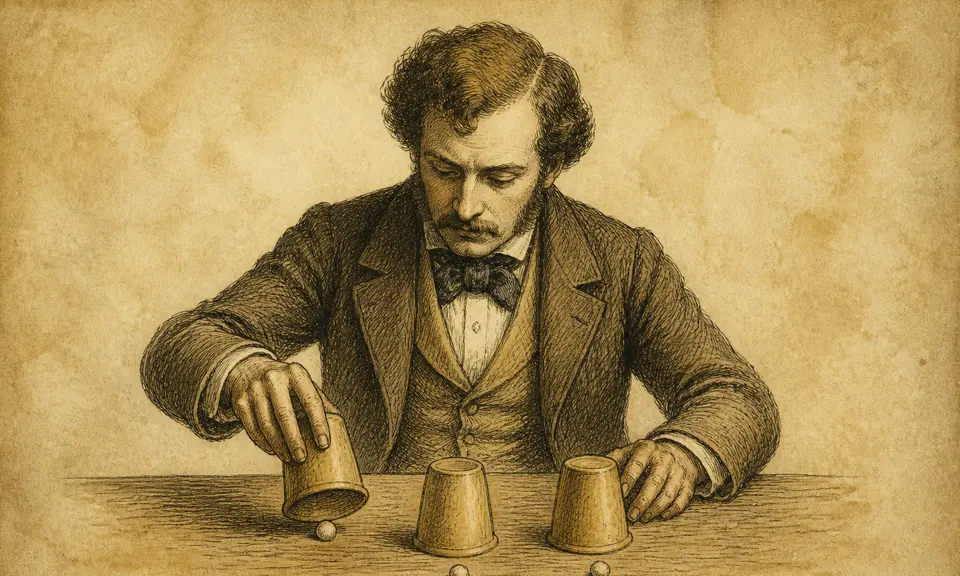
The image was generated by a model. It is not a period engraving and comes from none of the sources.

Both books divide the dream the same way — by whether the dreamer is the one doing it — and both make the doer the winner. Artemidorus reads tricks with pebbles: to dream of doing them without knowing how means that a man will gain much by miscounting and by lying, because the conjurer palms many pebbles and shows them now one way, now another, while to see someone else doing tricks with pebbles means that one will be miscounted and deceived. Miller reads the same split through the stage hypnotist of his own century, since to be in a hypnotic state or under the power of others portends disastrous results, for the dreamer's enemies will enthrall him, while holding others under a spell means he will assert decided will power in governing his surroundings. Where he parts from the Greek book is the audience: seeing hypnotic and sleight-of-hand performances signifies worries and perplexities in business and domestic circles — the watcher is not cheated of anything in particular, as he is in Artemidorus, but merely unsettled. an-Nabulsi reads the juggler as the company he keeps, a man of idleness and play and mockery and lying, and then names, without softening it, the three people the trade stands for: a fornicating woman, a procuress, or a servant. So the books agree about the man and divide about the act: whoever works the trick gains by it, and whoever only watches is cheated, unsettled, or beset.

This paragraph was generated by a model. It sums up the sources above, comes from none of them and is attributed to no one.

Greek dream book

To dream of doing tricks with pebbles without knowing how means that a man will gain much by miscounting and by lying, because the conjurer palms many pebbles and shows them now one way, now another, not in any straightforward manner but cunningly.

Passage Book III, 54

But to see someone else doing tricks with pebbles means that one will be miscounted and deceived, and so harmed.

Passage Book III, 54

Ὀνειροκριτικά (Oneirokritika)

Artemidorus of Daldis; edited by Rudolf Hercher

second century; Hercher’s edition 1864 · Greco-Roman

the source of the ancient tradition itself, which the others draw on

About this source

Five books of second-century Greek prose, not an alphabetical dictionary: the readings sit inside argued chapters and the author says of each one why it reads as it does. It is the source the other European and Arabic dream books draw on, including where they do not name it.

Rights: public domain

Where the text is from: https://archive.org/details/bub_gb_CRwTAAAAQAAJ

Arabic dream book

Seeing him in a dream points to the man of idleness and play and mockery and lying; and the juggler points to a fornicating woman, or a procuress, or a servant.

Section letter mim

The Perfuming of Mankind in the Interpretation of Dreams

Abd al-Ghani al-Nabulsi

before 1731; first printed Cairo 1858 · Arab-Islamic

carries the ancient tradition after Artemidorus

About this source

An Arabic dream book by the Damascene scholar al-Nabulsi, an alphabetical dictionary of two and a half thousand headwords. It draws on the ancient tradition directly: Artemidorus was translated into Arabic by Hunayn ibn Ishaq in the ninth century. The readings here almost always address the dreamer’s standing, property and faith rather than their feelings.

Rights: public domain

Where the text is from: https://shamela.ws/book/1217

Miller

To dream of a conjuror, denotes unpleasant experience will beset you in your search for wealth and happiness.

To dream that you are in a hypnotic state or under the power of others, portends disastrous results, for your enemies will enthrall you; but if you hold others under a spell you will assert decided will power in governing your surroundings. For a young woman to dream that she is under strange influences, denotes her immediate exposure to danger, and she should beware. To dream of seeing hypnotic and slight-of-hand performances, signifies worries and perplexities in business and domestic circles, and unhealthy conditions of state.
Ten Thousand Dreams Interpreted; Or, What's in a Dream

Gustavus Hindman Miller

1901 · American Victorian

carries fragments of the ancient tradition without its system

About this source

An American dream book, the only one here that knows the telephone, the railroad or the elevator. Doctrinally it is the most degraded: it keeps fragments of the ancient tradition without the system that once held them together.

Rights: public domain

Where the text is from: https://www.gutenberg.org/ebooks/926