Cauldrons: you will gain great wealth.
Section Clothes, curtains, blankets, mattresses, spoons and chopsticks
5 readings from 2 sources.
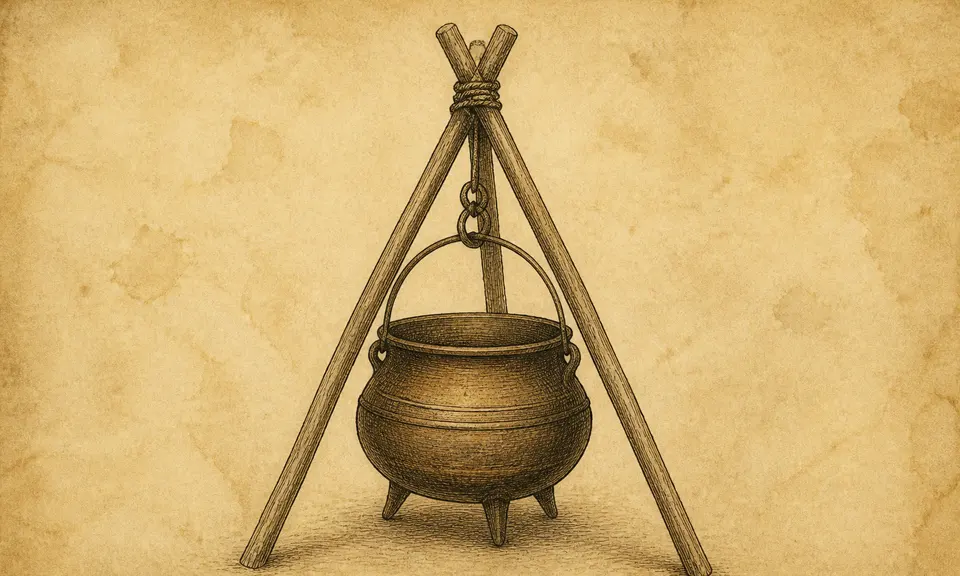
Two short lines and no quarrel between them. The Duke of Zhou says cauldrons bring great wealth; an-Nabulsi says the cauldron is a noble office. Both read the vessel as what it feeds rather than what it is — a household kept in plenty on one side, a man set over others on the other — and neither has anything to say about cooking. Another Arabic reading breaks the agreement, and it does it with an image: the frying pan means drowning for a man travelling at sea, because whoever is in it is forever drowning or swimming, with shouting and clamour. The rest is the office again, but a harder set of them — the steward of the house, and then the judge, the overseer, the tax-farmer, the tither and the exciseman. Another Arabic reading takes the cauldron as a household and names whose: the steward of a house of the line of the Christians, and if the cauldron was of copper, of the line of the Jews, the richest of them — with his riches measured by what is cooking in it. And then the office again, but a particular one: the go-between between the king and his subjects, or the chief of police.
This paragraph was generated by a model. It sums up the sources above, comes from none of them and is attributed to no one.
Cauldrons: you will gain great wealth.
Section Clothes, curtains, blankets, mattresses, spoons and chopsticks
A pot boiling over: you will gain great wealth.
Section Clothes, curtains, blankets, mattresses, spoons and chopsticks
In a dream it is a noble office.
Section letter dal
And it is the tajin: seeing it points in a dream, for a man travelling at sea, to drowning, because whoever is in it is forever drowning or swimming, with shouting and clamour. And the pan, the tajin, may point to the steward of the house, and may point to the judge and the overseer and the tax-farmer and the tither and the exciseman.
Section letter ṭa
It is in a dream the steward of a house, of the line of the Christians; and if it was of copper, then of the line of the Jews, the strongest and richest of them, and his riches are in the measure of that cooking which is in it and of its kind. And the cauldron is an officeholder at whose hands hard matters are carried through, like the go-between between the king and his subjects, or the chief of police.
Section letter mim