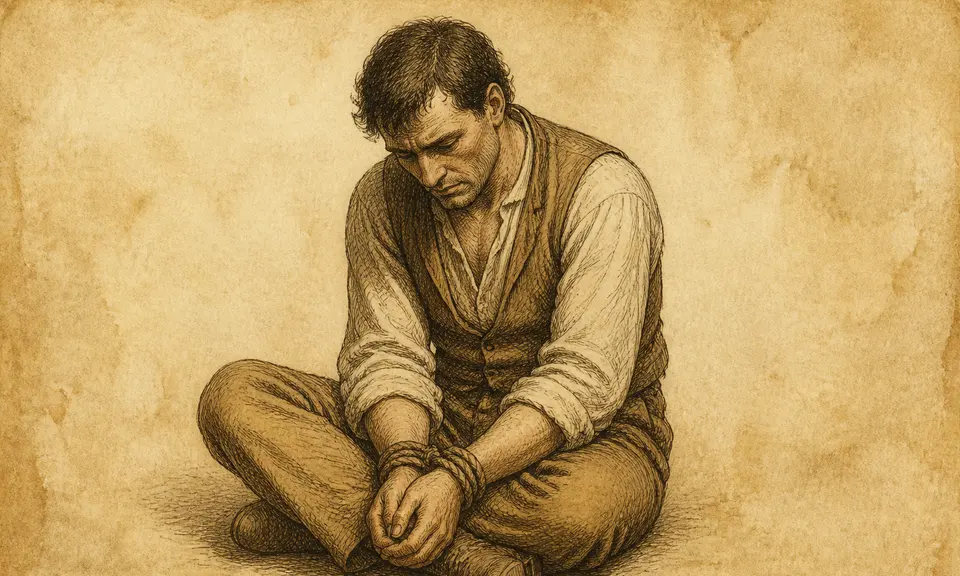
Captive

3 readings from 3 sources.

The image was generated by a model. It is not a period engraving and comes from none of the sources.

Miller reads captivity as a thing that happens to the dreamer and an-Nabulsi, remarkably, calls it good. For Miller to be a captive means treachery to deal with, and injury and misfortune if there is no escape; to take somebody captive means joining oneself to pursuits and persons of the lowest status; and for a young woman the dream means a husband jealous of her confidence in others, or censure for her indiscretion. Artemidorus reads being held and makes the reading turn on how badly off the dreamer already is: to be kept under guard, held by force by others, foretells hindrances in one’s business and detentions and delays in appointed terms and a worsening in illnesses — but to those at the last extremity it foretells safety, for we call life a guarding and a watching and a staying of the things that are, and the opposite of these a loosing and a destruction, that is, death. To be held, then, is to be still held among the living. an-Nabulsi gives one clause on the subject and it goes the other way: the captivity of a man in a dream is a proof of good and of provision. The rest of his reading is about something else — concealment, which he reads as the retention of urine, and then as being given sight of secrets, and ends with the loss that is replaced by something better. The two subjects sit in one reading in the printed book because the Arabic words differ by a vowel, and the reading is published as it stands.

This paragraph was generated by a model. It sums up the sources above, comes from none of them and is attributed to no one.

Greek dream book

To be kept under guard, held by force by others, foretells hindrances in one’s business and detentions and delays in appointed terms and a worsening in illnesses, but to those at the last extremity it foretells safety: for we call life a guarding and a watching and a staying of the things that are, and the opposite of these a loosing and a destruction, that is, death.

Passage Book III, 60

Ὀνειροκριτικά (Oneirokritika)

Artemidorus of Daldis; edited by Rudolf Hercher

second century; Hercher’s edition 1864 · Greco-Roman

the source of the ancient tradition itself, which the others draw on

About this source

Five books of second-century Greek prose, not an alphabetical dictionary: the readings sit inside argued chapters and the author says of each one why it reads as it does. It is the source the other European and Arabic dream books draw on, including where they do not name it.

Rights: public domain

Where the text is from: https://archive.org/details/bub_gb_CRwTAAAAQAAJ

Arabic dream book

In a dream it is a proof of good and of provision. And concealment in a dream is the retention of urine, and in the language it is likewise. And concealment in a dream is being given sight of secrets. And if he had lost something, he is granted what is better than it.

Section letter alif

The Perfuming of Mankind in the Interpretation of Dreams

Abd al-Ghani al-Nabulsi

before 1731; first printed Cairo 1858 · Arab-Islamic

carries the ancient tradition after Artemidorus

About this source

An Arabic dream book by the Damascene scholar al-Nabulsi, an alphabetical dictionary of two and a half thousand headwords. It draws on the ancient tradition directly: Artemidorus was translated into Arabic by Hunayn ibn Ishaq in the ninth century. The readings here almost always address the dreamer’s standing, property and faith rather than their feelings.

Rights: public domain

Where the text is from: https://shamela.ws/book/1217

Miller

To dream that you are a captive, denotes that you may have treachery to deal with, and if you cannot escape, that injury and misfortune will befall you. To dream of taking any one captive, you will join yourself to pursuits and persons of lowest status. For a young woman to dream that she is a captive, denotes that she will have a husband who will be jealous of her confidence in others; or she may be censured for her indiscretion.

Ten Thousand Dreams Interpreted; Or, What's in a Dream

Gustavus Hindman Miller

1901 · American Victorian

carries fragments of the ancient tradition without its system

About this source

An American dream book, the only one here that knows the telephone, the railroad or the elevator. Doctrinally it is the most degraded: it keeps fragments of the ancient tradition without the system that once held them together.

Rights: public domain

Where the text is from: https://www.gutenberg.org/ebooks/926