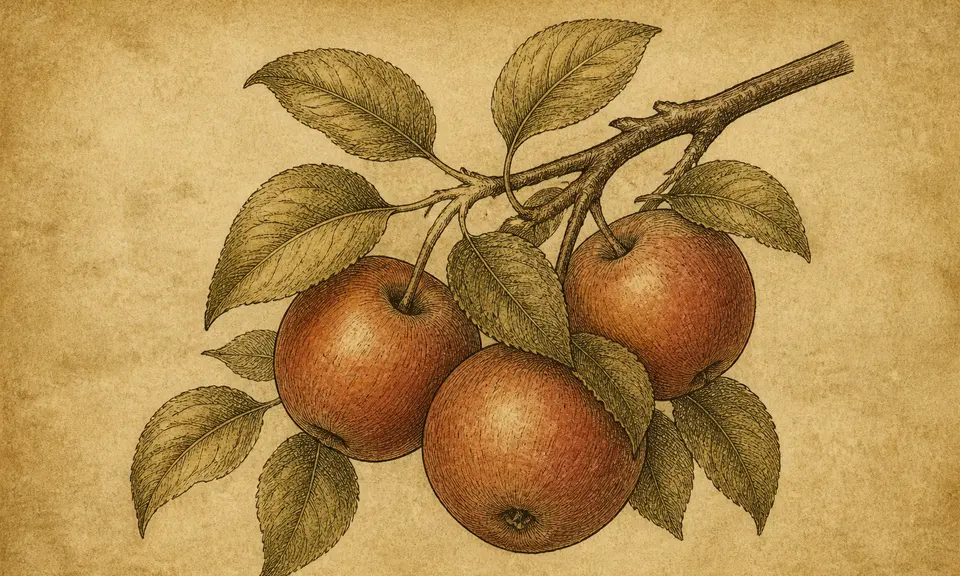
Apples

2 readings from 2 sources.

The image was generated by a model. It is not a period engraving and comes from none of the sources.

Miller reads the apple and an-Nabulsi reads the sleeper. Miller grades the fruit: red apples on trees with green foliage are exceedingly propitious, eating them is less good unless they are faultless, and then he hands the rest of the reading to a friend who interprets dreams — ripe on the tree means the time has come to act fearlessly, ripe at the top warns against aiming too high, apples on the ground mean flatterers are at work, decayed ones mean hopeless effort. It is a scale of ripeness, and the dreamer's own position in it is fixed. an-Nabulsi refuses the scale. The apple is the man's aspiration and what he attempts, and it is according to the aspiration of whoever sees it: to the sultan it is his kingdom, to the merchant his trade, to the tiller his tillage. The same apple means something different in each bed. Only at the end does he grade anything — the sweet apple is lawful provision and the sour unlawful — and he adds two readings Miller has no room for: an apple thrown by the sultan is a message carrying his wish, and planting an apple tree is raising an orphan.

This paragraph was generated by a model. It sums up the sources above, comes from none of them and is attributed to no one.

Arabic dream book

And it points in a dream to children and to those of fair faces. And the apple is the man's aspiration and what he attempts, and it is according to the aspiration of him who sees it. So if he was a sultan, the seeing of the apple is his kingdom; and if he was a merchant, the apple is his trade; and if he was a tiller, the seeing of the apple is his tillage; and likewise the apple, for whoever sees it, is his aspiration. So if he saw that he got apples or ate them, he attains of that aspiration according to the measure I have described. And it is said: the sweet apple is lawful provision and the sour one unlawful. And whoever the sultan threw at with an apple — it is a message in which is his wish and his desire. And the apple tree is a believing man who is close to the people; so whoever saw that he plants an apple tree raises an orphan.

Section letter ta

The Perfuming of Mankind in the Interpretation of Dreams

Abd al-Ghani al-Nabulsi

before 1731; first printed Cairo 1858 · Arab-Islamic

carries the ancient tradition after Artemidorus

About this source

An Arabic dream book by the Damascene scholar al-Nabulsi, an alphabetical dictionary of two and a half thousand headwords. It draws on the ancient tradition directly: Artemidorus was translated into Arabic by Hunayn ibn Ishaq in the ninth century. The readings here almost always address the dreamer’s standing, property and faith rather than their feelings.

Rights: public domain

Where the text is from: https://shamela.ws/book/1217

Miller

This is a very good dream to the majority of people. To see red apples on trees with green foliage is exceedingly propitious to the dreamer. To eat them is not as good, unless they be faultless. A friend who interprets dreams says: “Ripe apples on a tree, denotes that the time has arrived for you to realize your hopes; think over what you intend to do, and go fearlessly ahead. Ripe on the top of the tree, warns you not to aim too high. Apples on the ground imply that false friends, and flatterers are working you harm. Decayed apples typify hopeless efforts.”

Ten Thousand Dreams Interpreted; Or, What's in a Dream

Gustavus Hindman Miller

1901 · American Victorian

carries fragments of the ancient tradition without its system

About this source

An American dream book, the only one here that knows the telephone, the railroad or the elevator. Doctrinally it is the most degraded: it keeps fragments of the ancient tradition without the system that once held them together.

Rights: public domain

Where the text is from: https://www.gutenberg.org/ebooks/926