To see winged ants is in no way good: they foretell ruin and dangerous journeys. The other sort are good for farmers, for they prophesy a good harvest, since where there is no grain nobody would see ants.
Passage Book III, 6
5 readings from 3 sources.
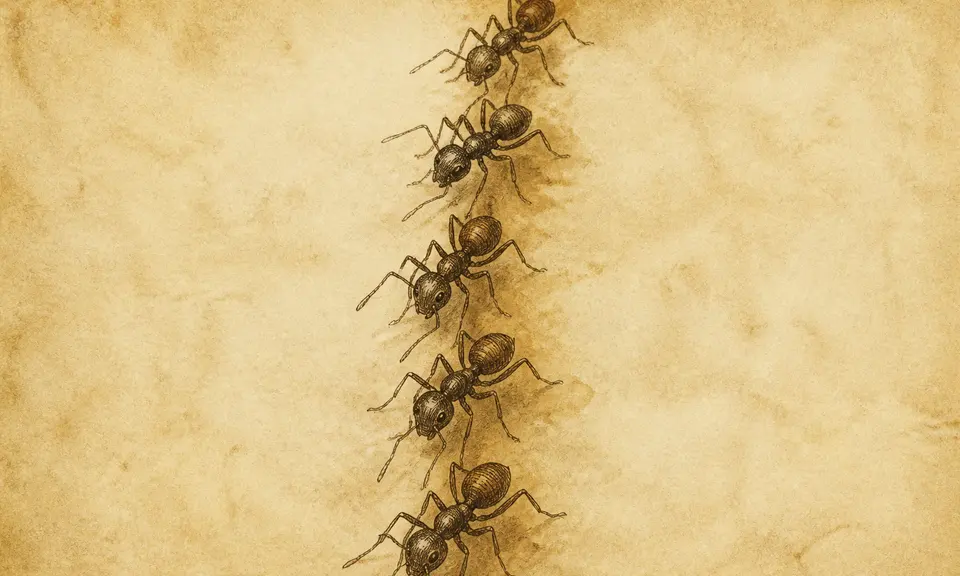
Both readings start from the same picture — many small creatures, all busy — and end up in different places. Miller keeps it on the scale of a single day: petty annoyances, little worries chased about, general dissatisfaction in everything. an-Nabulsi reads the column of ants as a column of men: a weak people holding to their greed, and then soldiery, household and long life, so that ants entering a village mean soldiers entering it. The nuisance and the invading army are the same dream seen from a house and from a country. Another Arabic reading takes the smallest of them, the motes, and spreads them across a life rather than a day: offspring, the army, money, a long life — and the weak among people, who are, the reading says, an army of the armies of God. Counting them or taking them is wrongdoing and a strife being walked into. And the one condition is where they came from: ants that come in from a place where they are not usual are knowledge and money beyond counting.
This paragraph was generated by a model. It sums up the sources above, comes from none of them and is attributed to no one.
To see winged ants is in no way good: they foretell ruin and dangerous journeys. The other sort are good for farmers, for they prophesy a good harvest, since where there is no grain nobody would see ants.
Passage Book III, 6
For they are called workers, and they never leave off their labour, which is proper to the living. But when they move about the dreamer's body, they foretell destruction, because they are children of the earth, and cold, and black.
Passage Book III, 6
In a dream they are a weak people, holders of greed, and they are read as soldiery, as household and as a long life. Whoever saw ants enter a village, soldiers will enter it. And whoever sees that the ants are upon his bed, his children grew many; and whoever they went out of his house from, the number of his household lessened. And whoever sees them flying from a place in which there is a sick man, then he dies, or a people travel from that place who meet hardship. And it points to plenty and to provision, because they are only in a place in which there is provision. And when the sick man sees that the ants creep over his body, then he dies. And it is said whoever sees the ants coming out of their place and their nest, care reached him. And whoever sees many ants in a house or in his quarter, the number of the people of that place and their offspring grow many; and whoever sees them going out of his house or his quarter, his people grow few by death or by moving away. And the small ants are likewise, except that they are the weak among people. And when the ants get a wing, it points to the perishing of a great soldiery of a great number. And the sight of the ants points to the dreamer's own self and points to his kin; and the knowing of the speech of the ants is an office, from the story of Solomon, peace be upon him. And whoever sees the ants entering his house with food, the good of his house grows much; and whoever sees the ants going out of his house with the food grew poor. And the going out of the ants from the nose and the ear or from others of the limbs, while he is glad at that, points to the dreamer's dying a martyr; and if he was grieved, he died without repentance. And if he saw that the ants fled from a town and a house, then the thieves carry something off from that place, or there is building there, because the ants and building do not come together. And the abundance of ants in a town without harm to anyone points to the abundance of the people of the town. And whoever sees that he killed ants committed a sin on account of a weak people. And whoever heard the speech of the ants and was fit for command attained the command; and if not, he attained plenty and good. And the large ants are, for the raiders, their killing; and for the sick, their death; and for those who want to travel, their weariness and their loss. And whoever sees a huge ant that has carried a load out of his house and gone out with it, his money is stolen by one who is honoured with him, of his son or his brother.
Section letter nun
Whoever sees in a dream that he counts the tiny ants, or takes them, it points to wrongdoing and transgression and to a strife he is coming to. And the tiny ants in sleep are reckoned to offspring, and to the army, and to money, and to a long life. And the tiny ants point to the weak among people; and it is said the tiny ants are an army of the armies of God. And when the tiny ants come in from a place where they are not usual, that is a sign of knowledge and of money whose number cannot be counted.
Section letter dhal
The dreamer of ants should expect many petty annoyances during the day; chasing little worries, and finding general dissatisfaction in all things.