To wrestle with one of one's blood relations or with a friend signifies strife and contention with him.
Passage Book I, 60
14 readings from 2 sources.
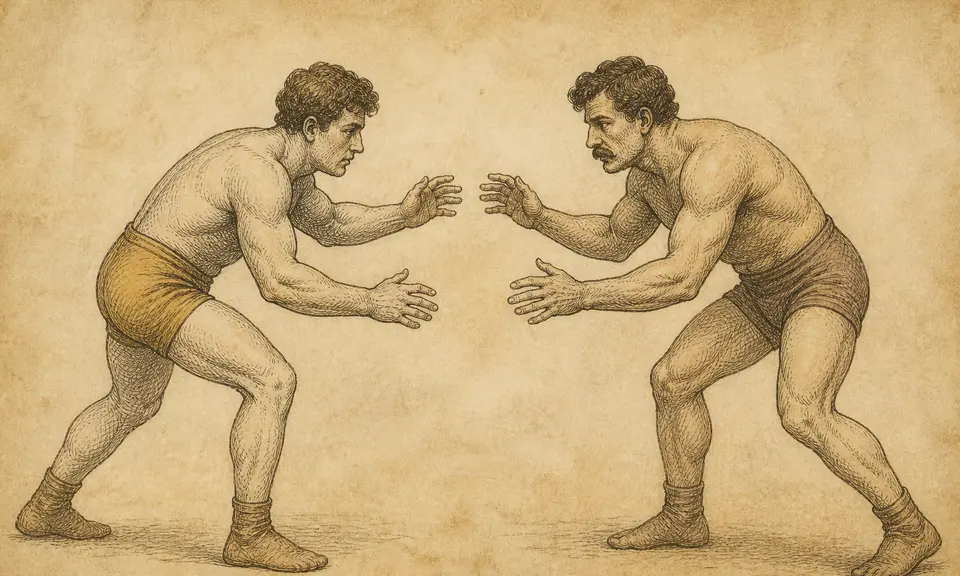
Both books know the same reversal — that the one who fell is the winner — and each makes something different of it: Artemidorus an exception, the Arabic book a rule. For Artemidorus it is better to throw. To wrestle with a man one does not know brings dangers through illnesses, for what the wrestler wants to do to his opponent, that illness too wants to do to the sufferer, namely to give him to the ground: for the one who falls death is in store, and for the one who throws safety. He allows the reversal in one kind of dispute only: in a quarrel over land it is better to fall, for whoever comes to be against the ground, the ground becomes his too. The rest he reads by the opponent: wrestling with a blood relation signifies strife with him, and wrestling with a boy is in no way good, since if he throws the boy he will bury somebody and if the boy throws him he will endure mockery and illness as well, because he was beaten by a softer body. an-Nabulsi puts the reversal first — the man thrown to the ground is the winner in waking, and this holds for two kings wrestling with war in mind and for everyone who has an opponent taking him to court — and then adds the witnesses that overturn it, which is the strangest thing in the reading: new clothes on the winner against worn clothes on the one thrown overturn it, and so does the winner being tall and great of body while the one thrown is small and yellow in colour, because the witness of the dream said so.
This paragraph was generated by a model. It sums up the sources above, comes from none of them and is attributed to no one.
To wrestle with one of one's blood relations or with a friend signifies strife and contention with him.
Passage Book I, 60
Unless they are fighting over land; for in disputes of that kind it is better to fall, unless the one who throws is himself underneath; for whoever comes to be against the ground, the ground becomes his too.
Passage Book I, 60
I know a man who dreamed that he was wrestling and, having made the hold called 'two fingers about one', threw his opponent. It befell him to win by getting hold of writings written by his adversary.
Passage Book I, 60
To wrestle with a man one does not know brings dangers through illnesses; for what the wrestler wants to do to his opponent, that illness too wants to do to the sufferer, that is, to give him to the ground. For the one who falls, then, death is in store, and for the one who throws, safety.
Passage Book I, 60
Further, for a man to wrestle with a boy is in no way good; for if he throws the boy, he will bury someone.
Passage Book I, 60
Then, for the well-to-do, a fight with certain people over land, and for the poor illness, on account of the wrestling.
Passage Book I, 57
And if he is thrown by the boy, besides the wasted effort he will endure mockery and illness as well: mockery because it follows upon it, and illness because he was beaten by a softer body.
Passage Book I, 60
But for a boy it is good to throw a man, for he will obtain great things beyond expectation.
Passage Book I, 60
But it is not good for a boy athlete, for it means that he will not be admitted among the boys.
Passage Book I, 60
And it is always better to be the one who dashes the other down.
Passage Book I, 60
But in the case of men already at strife, whichever of the two gains the victory in the wrestling in the dream, his it is also after …
Passage Book I, 60
A man dreamt that he was wrestling in the men's class at Nemea and winning and being crowned. He happened to have a lawsuit about a field, in which there was a very great marsh. And he won it, indeed, on the count of the marsh, because at Nemea the victors are crowned with wild celery.
Passage Book V
Whoever sees in a dream that a man threw him down loses his money; and the loser in the wrestling, the one who falls to the ground, is the winner in waking. If two kings wrestle and their intent is war, the one thrown is the one who wins; and so it is with everyone who has an opponent contending with him or taking him to court. But the winner in the wrestling may well win in waking too, if there is something in the dream to bear it out — as when a man throws his opponent while wearing new clothes and the one thrown is in worn old clothes. And if they were equal in dress, and the winner was tall of stature or great of body while the one thrown was small in measure and wasted in body and yellow in colour, then he is the loser in waking too, because the witness of the dream said so. And the winner may be the winner without any witness at all, because the dream falls out like for like. If the two wrestlers are of different kinds, the wrestler is in a better state than the one wrestled down, as with a man and a lion. Whoever sees two men wrestling and one throws the other, the one thrown is in a better state than the thrower; and wrestling is a quarrel. Whoever sees that he wrestled and threw his man wins. And if a woman sees the Prophet wrestle her and throw her and sit on her breast, her husband dies and she marries another. Wrestling is a sign of the illness of the man thrown, and perhaps it points to a sick man's recovery — unless he is the winner over a human being, for then it is a sign of his death. And if he wrestles an animal in a dream and kills it, it points to his deliverance from his hardship. And if he became a protected non-Muslim, it points to his overcoming and subduing his enemies.
Section letter ṣad
It in a dream is a quarrel; and if the two kinds differ, the wrestler is in a better state than the one thrown down, as with the man and the beast of prey; and if the wrestling was between two men, the wrestler is the one overcome.
Section letter mim