I know a man of rank in Greece who dreamed that he was taking a nut from someone, and when he woke he happened to be holding that very nut in his hand. Many other evils befell him, and in the end he became a man without honour.
Passage Book I, 73
3 readings from 3 sources.
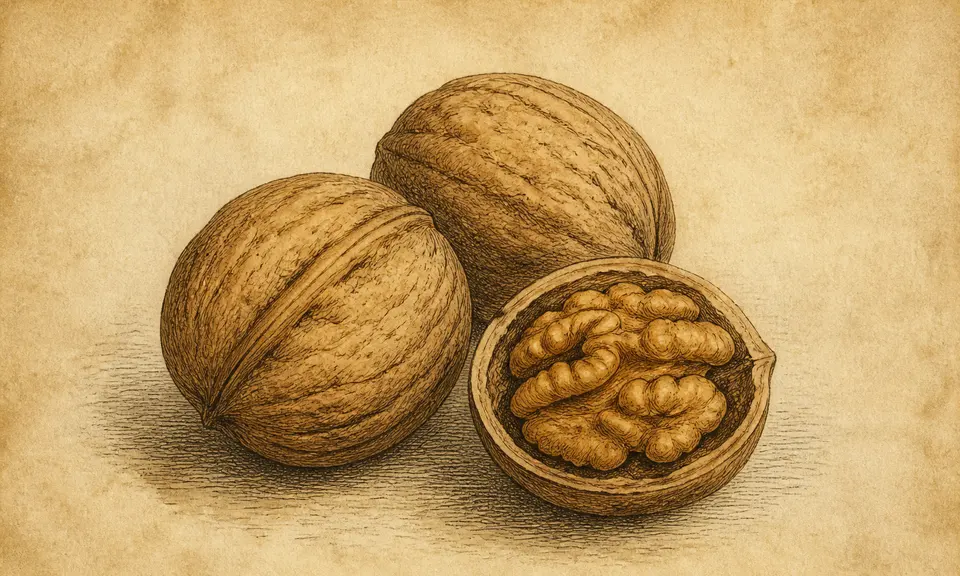
Miller reads the shell: walnuts are an omen of prolific joys, a decayed one cracked open means expectations ending in bitterness, and walnut stain on a young woman's hands means her lover turning to another and her own regret. an-Nabulsi reads the kernel as money hoarded, and then listens to it: if you heard it rattle, it is a quarrel and an uproar. The tree gets a character of its own — a foreign man, stingy, vexatious and hard, with money that grows and is well guarded. Artemidorus has one case only, and it is a warning about the taking: he knew a man of rank in Greece who dreamed that he was taking a nut from somebody, and who woke holding that very nut in his hand. Many other evils befell him, and in the end he became a man without honour.
This paragraph was generated by a model. It sums up the sources above, comes from none of them and is attributed to no one.
I know a man of rank in Greece who dreamed that he was taking a nut from someone, and when he woke he happened to be holding that very nut in his hand. Many other evils befell him, and in the end he became a man without honour.
Passage Book I, 73
In a dream it is hoarded money; and if you heard it rattle, it is a quarrel and an uproar. The walnut tree is a foreign man, stingy, vexatious and hard, a man of money that grows and is well guarded. And whoever sees that he is upon a walnut tree clings to a big foreign man, according to the measure of what I have described; and if he came down from it, what is between him and the companion he clung to was not completed; and if he fell from it and died, then a big man or a king is killed over against him; and if the tree broke, that big man perished and the one who fell from it took possession; and if he had seen that he died when he fell, then he did not die, he was saved. And if he saw that his hands and his feet were broken at that, then he comes to the brink of destruction and a great affliction reaches him, except that he is saved afterwards. And whoever sees that he cut down a walnut tree, a man killed a foreigner. And the walnut, which is a fruit, is money that does not come out except by drudgery and toil, for the walnut is not eaten except after the breaking, and its oil does not come out except by pressing. And if he saw that he picked up walnuts from a garden, then he gets money from the side of a woman; and if it was shelled, then it is provision that suffices; and if he ate the shells of the walnut, then he backbites a miserly man; and if a woman scattered them over him, she burned his clothes. And whoever sees that he plays with walnuts wades into unlawful money, and the shelled of them is provision. And the walnut stands for the righteous and the chiefs and the brethren; and the walnut is read as health of the body and length of travel; and if the dreamer is of the women, then the walnut points to length of life; and the walnut points to the husband, because of the turning round of its letters, and to the passing through of hard affairs; and the broken walnut is money without toil. And the Indian nut points to the speech of the soothsayers; so whoever sees that he ate of it, a people were truthful to him; and whoever sees that he became a soothsayer eats of the Indian nut. And it is said the Indian nut is an astrologer; so whoever sees that he ate it became an astrologer. And the Indian nut is called the narjil; some of them said it is money from the side of a foreign man, and it is said it points to an astrologer. And whoever sees that he eats the Indian nut learns the knowledge of the stars, or follows an astrologer in his opinion. And the narjil, which is the Indian nut, points to burning and to fire, from its name and its nature, and to fire in the bowels, or to the foreigners among the merchants.
Section letter jim
To dream of walnuts, is an omen significant of prolific joys and favors. To dream that you crack a decayed walnut, denotes that your expectations will end in bitterness and regretable collapse. For a young woman to dream that she has walnut stain on her hands, foretells that she will see her lover turn his attention to another, and she will entertain only regrets for her past indiscreet conduct.