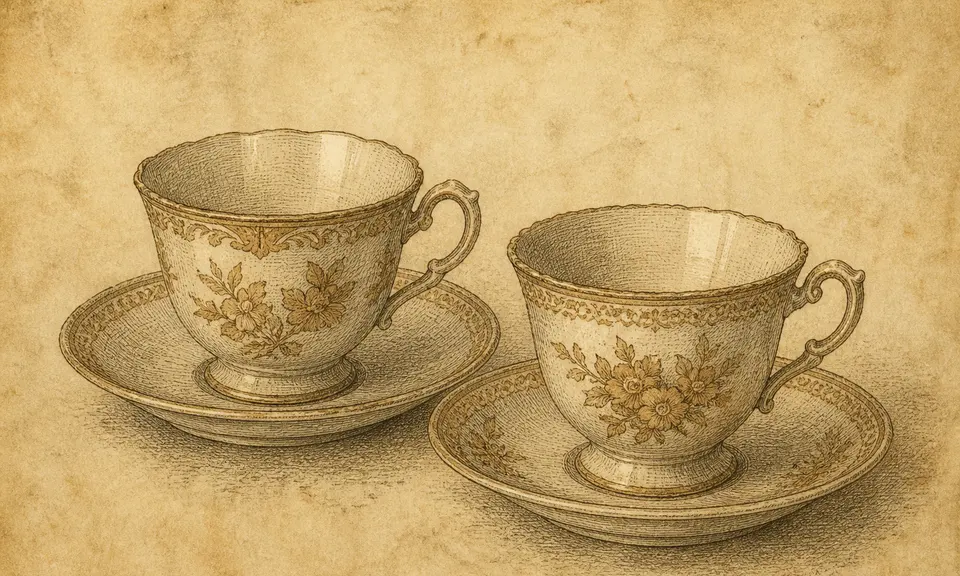
Teacups

2 readings from 2 sources.

The image was generated by a model. It is not a period engraving and comes from none of the sources.

Both readers reach for the same moment — the cup breaking — and read it at very different weights. Miller keeps it social: teacups foretell affairs of enjoyment, a woman who breaks them or sees them broken will have her pleasure marred by a sudden trouble, and wine drunk from one means fortune and pleasure together in the near future. an-Nabulsi makes the cup a woman and a servant, and the full cup a woman with child: spilled water is the child lost, a broken cup the woman dead. Then he separates the two in a single picture — the cup falls and breaks but the water stays in the hand, and the wife dies while her son lives. The material counts too: gold and silver last, glass points to hardship and to hidden things coming out.

This paragraph was generated by a model. It sums up the sources above, comes from none of them and is attributed to no one.

Arabic dream book

It is in a dream a sign of the woman and a sign of the servant. Cups of gold and silver are better than glass, because they last; and glass cups may point to hidden things coming out into the open. A full cup points to a woman with child: if the water is spilled, she loses the child, and if the cup breaks, the woman dies. Whoever sees a cup in his hand, and the cup falls and breaks while the water stays in his hand — his wife bears a boy and dies, and her child remains; and if the cup is unhurt and the water is gone, the child dies and the woman is safe. The cup is a slave girl, and it points to provision. Cups of precious stone are women, and drinking water in them comes from two sides. And glass cups may point to hardship, because they break. Whoever sees that he eats cups falls into great hardship, and whoever's cup breaks, his cupbearer dies.

Section letter qaf

The Perfuming of Mankind in the Interpretation of Dreams

Abd al-Ghani al-Nabulsi

before 1731; first printed Cairo 1858 · Arab-Islamic

carries the ancient tradition after Artemidorus

About this source

An Arabic dream book by the Damascene scholar al-Nabulsi, an alphabetical dictionary of two and a half thousand headwords. It draws on the ancient tradition directly: Artemidorus was translated into Arabic by Hunayn ibn Ishaq in the ninth century. The readings here almost always address the dreamer’s standing, property and faith rather than their feelings.

Rights: public domain

Where the text is from: https://shamela.ws/book/1217

Miller

To dream of teacups, foretells that affairs of enjoyment will be attended by you. For a woman to break or see them broken, omens her pleasure and good fortune will be marred by a sudden trouble. To drink wine from one, foretells fortune and pleasure will be combined in the near future.

Ten Thousand Dreams Interpreted; Or, What's in a Dream

Gustavus Hindman Miller

1901 · American Victorian

carries fragments of the ancient tradition without its system

About this source

An American dream book, the only one here that knows the telephone, the railroad or the elevator. Doctrinally it is the most degraded: it keeps fragments of the ancient tradition without the system that once held them together.

Rights: public domain

Where the text is from: https://www.gutenberg.org/ebooks/926