But tanning is bad for everyone, for the tanner handles dead bodies and is settled away from the city; further, it brings hidden things to light because of the smell. And for physicians it is the hardest of all.
Passage Book I, 52
4 readings from 3 sources.
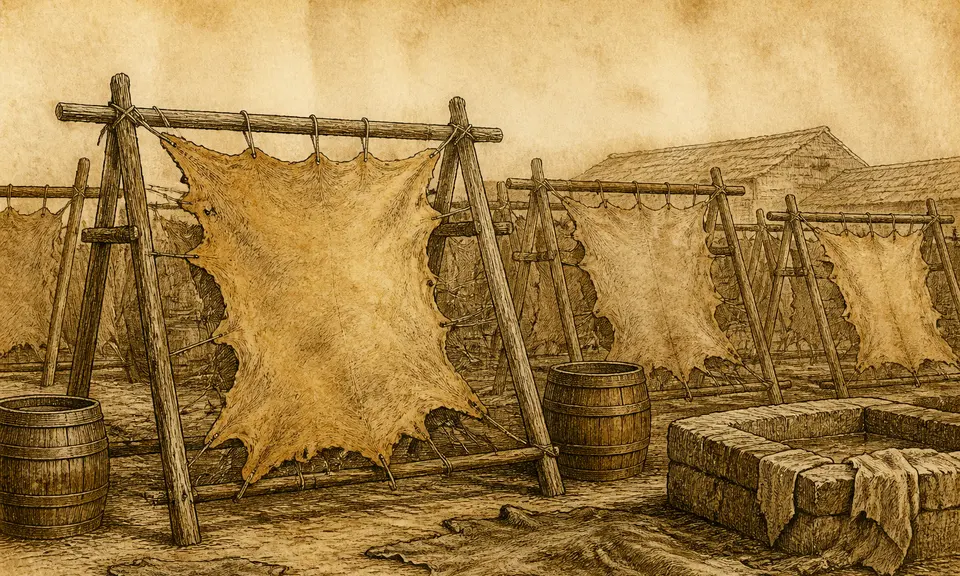
Miller reads the tannery as a health hazard and a trade: it denotes contagion and other illness and loss in trade, being a tanner means work not to one's taste with others depending on one, and buying leather there means success with few friends. an-Nabulsi starts from the same smell — its ruling is the ruling of the slaughterhouse, for the waters and the stench and the flayed hides — and then turns it into a school, since the tannery may be the house of knowledge or the hospice, where souls are schooled and settled on the good. And it may be a woman of much toil who endures being hurt, or one of harsh force and bad character. Another Arabic reading takes the tanner rather than the tannery, and it makes him a healer: he points to the cupper, for the healing there is in cupping, and a physician seen turned into a tanner is a sign of his skill and of how many are cured at his hands — unless the tanning is spoiled and rotten, and then he is ignorant and a cheat. Artemidorus stands against both of the Arabic readings and gives three reasons at once: tanning is bad for everyone, for the tanner handles dead bodies and is settled away from the city, and further it brings hidden things to light because of the smell — and for physicians it is the hardest of all. The same trade is a healer in one book and the worst dream a physician can have in the other.
This paragraph was generated by a model. It sums up the sources above, comes from none of them and is attributed to no one.
But tanning is bad for everyone, for the tanner handles dead bodies and is settled away from the city; further, it brings hidden things to light because of the smell. And for physicians it is the hardest of all.
Passage Book I, 52
In a dream its ruling is the ruling of the slaughterhouse, for the waters and the stench and the flayed hides in it; and the tannery may point to the house of knowledge and the hospice and the like, the places where souls are schooled and settled upon the good and the right. And the tannery may point to the woman of much toil who endures being hurt, or to the bondwoman or the young servant; and it may point to a woman of harsh force and bad character, or to the loathsome woman who does not keep herself from filth; and the tannery may point to money.
Section letter mim
And he is the one who prepares the skins of animals, and he points in a dream to the cupper, for the healing there is in cupping. Whoever sees a physician turned into a tanner of skins — it is a sign of his skill and of how many are cured at his hands; unless he sees that his tanning is spoiled and rotten, and then he is an ignorant man and a cheat. And the tanner, if he points to a matter of this world, escapes destruction; and if he points to a matter of religion, he feeds a poor man in a drought. And the tanner is a man who sets things right, or a physician, or a man who deals with the estates of the dead; and perhaps seeing him points to cares and troubles. And the tanner is a wrongdoing man.
Section letter dal
To dream of a tannery, denotes contagion and other illness. Loss in trade is portended. To dream that you are a tanner, denotes that you will have to engage in work which is not to your taste, but there will be others dependent upon you. To buy leather from a tannery, foretells that you will be successful in your undertakings, but will not make many friends.