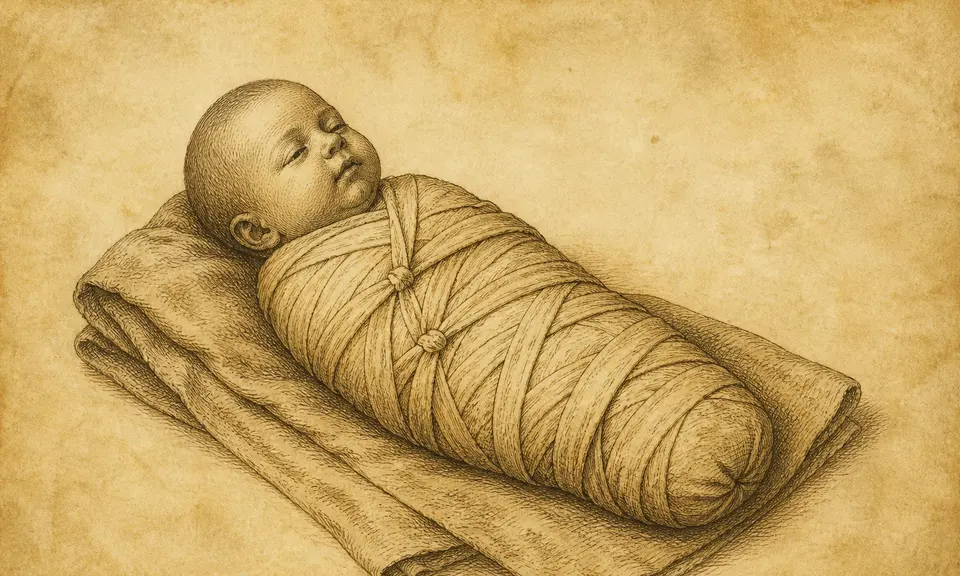
Swaddling band

2 readings from 2 sources.

The image was generated by a model. It is not a period engraving and comes from none of the sources.

Both books read swaddling as a child on the way, and both make it turn on who is dreaming. Artemidorus begins with the man: whoever dreams he is in swaddling clothes like infants and that he takes milk from some woman, known to him or not, will fall sick of a long illness — unless he has a wife with child, for then the reading runs the other way, since the child will be born like him and will be reared in this way. To a woman who sees it, it foretells a little daughter. The Arabic book comes at the same thing more briefly: the seeing of swaddling points to the child for the pregnant woman, and perhaps to the subduing of an enemy — and perhaps it warned the protector of a fracture that befalls, because with it are the oil and the myrtle, and it is counted among the things for binding. So the Greek sets the child against illness and the Arabic against a fracture, and both do it by the same turn: swaddling is a bandage.

This paragraph was generated by a model. It sums up the sources above, comes from none of them and is attributed to no one.

Greek dream book

If a man dreams that he is in swaddling clothes like infants and that he takes milk from some woman, known to him or not, he will fall sick of a long illness — unless he has a wife with child, for then the child, being born like him, will be reared in this way. To a woman who sees it, it foretells that she will have a little daughter.

Passage Book I, 16

Ὀνειροκριτικά (Oneirokritika)

Artemidorus of Daldis; edited by Rudolf Hercher

second century; Hercher’s edition 1864 · Greco-Roman

the source of the ancient tradition itself, which the others draw on

About this source

Five books of second-century Greek prose, not an alphabetical dictionary: the readings sit inside argued chapters and the author says of each one why it reads as it does. It is the source the other European and Arabic dream books draw on, including where they do not name it.

Rights: public domain

Where the text is from: https://archive.org/details/bub_gb_CRwTAAAAQAAJ

Arabic dream book

It in a dream: the seeing of it points to the child for the pregnant woman; and perhaps it points to the subduing of the enemy; and perhaps it warned the protector of a fracture that befalls, because with it are the oil and the myrtle, and it is counted among the things for binding.

Section letter qaf

The Perfuming of Mankind in the Interpretation of Dreams

Abd al-Ghani al-Nabulsi

before 1731; first printed Cairo 1858 · Arab-Islamic

carries the ancient tradition after Artemidorus

About this source

An Arabic dream book by the Damascene scholar al-Nabulsi, an alphabetical dictionary of two and a half thousand headwords. It draws on the ancient tradition directly: Artemidorus was translated into Arabic by Hunayn ibn Ishaq in the ninth century. The readings here almost always address the dreamer’s standing, property and faith rather than their feelings.

Rights: public domain

Where the text is from: https://shamela.ws/book/1217