For he took the crown not by going up but by going down the ladders, and we call advancements 'ascents' and the opposite of them 'descents'.
Passage Book IV
3 readings from 3 sources.
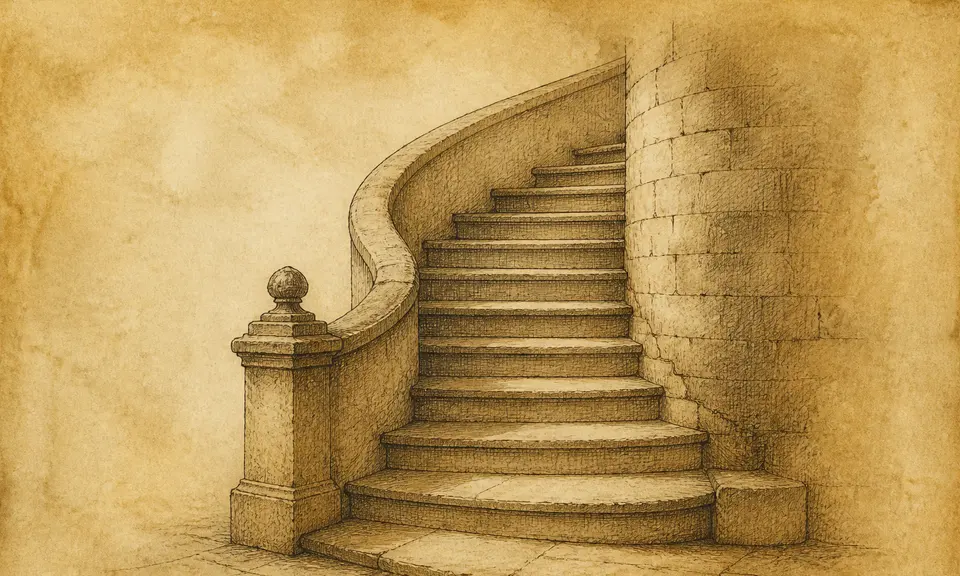
Miller reads the stairs by the direction: going up foretells good fortune and happiness, falling down being the object of hatred and envy, walking down bad luck in one's affairs, broad handsome stairs approaching riches, and sitting on the steps a gradual rise. an-Nabulsi reads the same direction and then measures the climb: the stairs are the causes of elevation, and also the stages of a journey, and also the days of a life that lead to its end — so a sick man who climbs unknown stairs to the top dies, and a man who counts the steps he rose by lives that many years. The material decides what the elevation is worth: clay or mud brick, elevation with religion; stone, with hardness of heart; wood, with hypocrisy; gold, fortune; silver, a slave girl for every step; fired brick, no good at all. And the last line reads the five steps as the five prayers, so a step missing is a prayer missing.
This paragraph was generated by a model. It sums up the sources above, comes from none of them and is attributed to no one.
For he took the crown not by going up but by going down the ladders, and we call advancements 'ascents' and the opposite of them 'descents'.
Passage Book IV
In a dream it points to the causes of height and elevation and fortune in this world and the next, and it points to properties and to being led on step by step; and perhaps it points to the stages of a journey and to the lodgings travellers come down at, one lodging and one stage at a time; and perhaps it points to the days of a life that lead to its end. And the stairs a man knows point to the servant of the house and to its owner's slave and to his scribe. So whoever climbed unknown stairs: if he reached the end of them and was sick, he died; and if he entered the topmost room, he reached a degree in the garden; and if he was held back short of it, it was veiled from him after death. As for coming down the stairs: if he was a traveller, he came home from a journey; and if he was a chief, he came down from his chieftaincy and was removed from his work; and if he was riding, he went on foot; and if he had an ailing wife, she perished and he came down from her. And if he was himself the sick man: if his coming down was to a place he knew, or to his people and his house, or to much chaff or barley or whatever points to the monies of this world and its goods, he recovered from his ailment; and if his coming down was to a place he did not know, or to dead people he had known, it is as was said before. If his falling was into a pit or a buried well, or to a lion that tore him, or to a bird that snatched him, or to a moored ship that set sail with him, or to a mount with a litter upon it, then the stairs are the days of his life and all that he came down to is from his death, when his term was fulfilled. And if he was sound of sickness in waking and was a tyrant or an unbeliever: if what he came down to points to righteousness, like the mosque and plenty and the winds and washing, then he comes safe and repents and comes down from what he is upon and leaves off from it; and if his coming down was to the contrary of that, of what points to grave things, like the great frightening pits and the lion and the snakes and the chasms and the bones, then he is being led on and given rope. And the stairs, if they were of mud brick, he was righteous, and if they were of fired brick, it was disliked. And some of them said: the deeds of good — the first is the prayer, the second the fast, the third the alms-due, the fourth almsgiving, the fifth the pilgrimage, the sixth the striving, the seventh the Qur'an; and every ascent in the deeds of good is when they are of clay or of mud brick, and there is no good in them when they are of fired brick. And ascents of clay are, for the governor, elevation and might with religion, and for trade, profit with religion; and if they were of stones, they are elevation with hardness of heart; and if they were of wood, elevation with hypocrisy and show; of gold, he attains fortune and plenty and good; and if they were of silver, he attains slave girls to the number of every step; and if they were of brass, he attains the goods of this world. And whoever climbed a step gained understanding and sharpness by which he rises. And it is said the step is an ascetic, worshipping man, and whoever came near him had elevation and devotion. And every step, for a governor, is a governorship. And the climbing of stairs is the dangers he takes on, and their hardness or their easiness is according to his climbing in them. And built stairs point to matters made easy; and if the wooden stairs became built, perhaps that points to steadiness in matters and to the covering of what he hopes to have covered over him. And the rising in the stairs is an elevation he attains step by step, little by little. And the degrees are stations in the garden, and whoever rose by stairs and counted them lives years to their number. And the five steps are the five prayers, so whatever happened in them of lack is in the prayers.
Section letter dal
To dream of passing up a stairs, foretells good fortune and much happiness. If you fall down stairs, you will be the object of hatred and envy. To walk down, you will be unlucky in your affairs, and your lovemaking will be unfavorable. To see broad, handsome stairs, foretells approaching riches and honors. To see others going down stairs, denotes that unpleasant conditions will take the place of pleasure. To sit on stair steps, denotes a gradual rise in fortune and delight.