Sieve

4 readings from 2 sources.

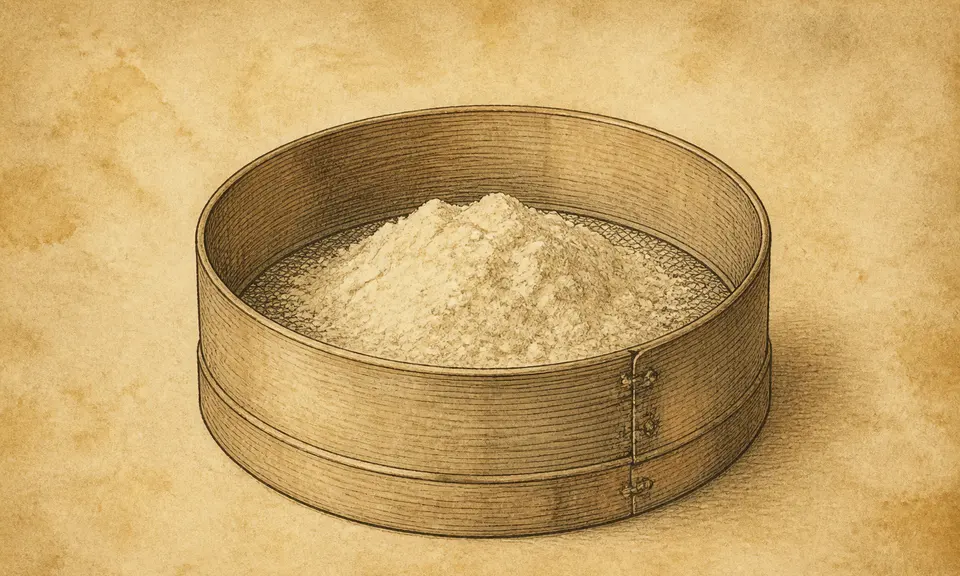
The image was generated by a model. It is not a period engraving and comes from none of the sources.

Miller reads the mesh: a sieve means an annoying transaction, probably at a loss, meshes too small mean a chance to reverse an unfavourable decision, and too large mean losing what was recently gained. an-Nabulsi reads the sorting and reads it both ways. It is guidance after straying and repentance after disobedience, and the judge who divides the true from the false — and then, because the sieve divides things and does not gather them, it is harm and scattering, a man who parts lovers and kin. He ends with two people the tool can stand for, a hairdresser, because it takes out the husks, and a maidservant. Another Arabic reading takes the strainer rather than the sieve and keeps both directions, since it points to the pure essence of religion and of knowledge, and to hinting and singing and the frequenting of places of corruption; its last line is the plainest praise in the motif, that the strainer is a truthful man who speaks the truth and will not be content with filth. A further Arabic reading gives the sieve the whole of its good side and the reason for it: knowledge, telling apart, honour, office, the dividing of the true from the false, the man who tests coins and picks over speech and deeds. And it ends on the one image that turns it: a sieve given in place of a promise means the promise will not be kept, because a sieve holds no water.

This paragraph was generated by a model. It sums up the sources above, comes from none of them and is attributed to no one.

Arabic dream book

Seeing it in a dream points to guidance after straying and to repentance after disobedience; and it may point to the judge who divides the true from the false; and it may point to a man or a woman who carries no evil. The sieve points to harm and to scattering, because it divides things and does not gather them; and it is said it is a man who parts lovers and kin; and it is said it is a hairdresser, because it takes out the husks; and it is said a man through whose hands honourable monies pass; and it points to the maidservant.

Section letter mim

It points in a dream to the pure essence of religion and of knowledge, or to hinting and to singing, or to attending the places of innovation and of corruption. And the strainer is a truthful man who speaks the truth and is not content with filth.

Section letter ra

It points in a dream to knowledge and to telling apart, and to honour and office, and to the dividing of the true from the false. And the sieve is in the place of the man who tests coins, and of the man who picks over speech and deeds and tells one from another, the good of them from the bad, the fine from the coarse. And he is a man of piety in his earning. And the sieve is read as the comb, if we read the hair as the barley, because the comb cleans the dirt out of the hair, and in the same way the sieve takes the chaff off the barley. And whoever was promised a promise, and the one who promised gave him a sieve, breaks his promise and does not hold to it — just as the sieve does not hold water.

Section letter ghayn
The Perfuming of Mankind in the Interpretation of Dreams

Abd al-Ghani al-Nabulsi

before 1731; first printed Cairo 1858 · Arab-Islamic

carries the ancient tradition after Artemidorus

About this source

An Arabic dream book by the Damascene scholar al-Nabulsi, an alphabetical dictionary of two and a half thousand headwords. It draws on the ancient tradition directly: Artemidorus was translated into Arabic by Hunayn ibn Ishaq in the ninth century. The readings here almost always address the dreamer’s standing, property and faith rather than their feelings.

Rights: public domain

Where the text is from: https://shamela.ws/book/1217

Miller

To dream of a sieve, foretells some annoying transaction will soon be made by you, which will probably be to your loss. If the meshes are too small, you will have the chance to reverse a decision unfavorable to yourself. If too large, you will eventually lose what you have recently acquired.

Ten Thousand Dreams Interpreted; Or, What's in a Dream

Gustavus Hindman Miller

1901 · American Victorian

carries fragments of the ancient tradition without its system

About this source

An American dream book, the only one here that knows the telephone, the railroad or the elevator. Doctrinally it is the most degraded: it keeps fragments of the ancient tradition without the system that once held them together.

Rights: public domain

Where the text is from: https://www.gutenberg.org/ebooks/926