Shop

3 readings from 2 sources.

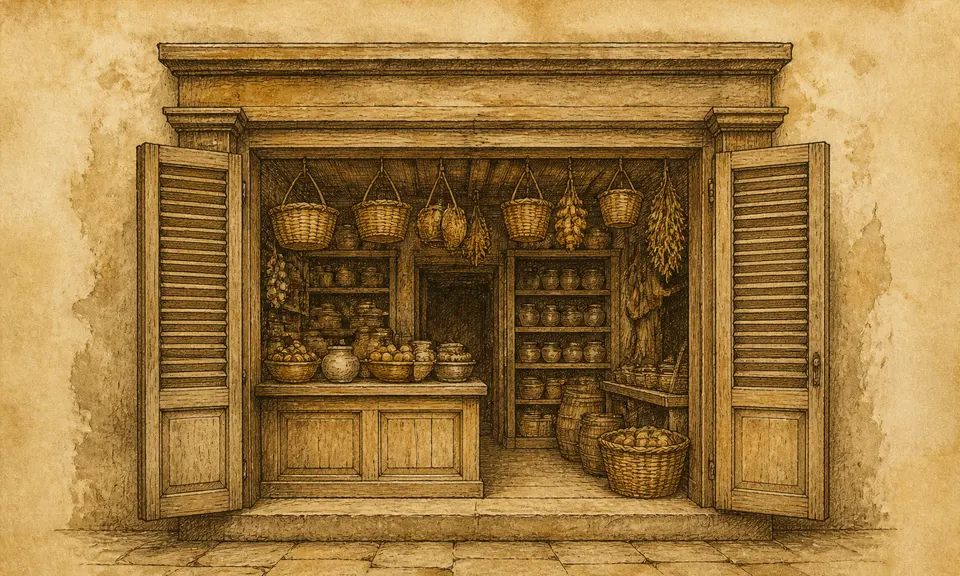
The image was generated by a model. It is not a period engraving and comes from none of the sources.

Miller reads the shop as competition: you will be opposed in every attempt at advancement by scheming and jealous friends. an-Nabulsi reads the same frontage as an affair — the shop is the bench before the house, and whoever sees one at the door of the house sees a friend of the master's wife, or of the dreamer. Both books put somebody unwelcome close to the business; only the Arabic one says which door he is standing at. Another Arabic reading turns the shop into a list of everything a man has: his wife, his child, his death, his life, his money, his standing, his servant, his beast, his secret. From there it reads mechanically — a shop fallen down is a divorce, a death, a loss, a secret out; a shop new and sweet-smelling is a good wife, a child, a recovery, a rise. Whatever happens to the shop goes back on whoever the shop stood for. And the last lines leave the one shop for the street of them: doors shut are trade gone slack, doors blocked up are the traders dead and their name gone, doors opened are trade opened to them.

This paragraph was generated by a model. It sums up the sources above, comes from none of them and is attributed to no one.

Arabic dream book

It is the bench before the house: whoever sees in a dream a shop at the door of the house, it is a friend of the wife of the master of the house, or of the dreamer. And whoever sees that he is sitting on a shop bench comes by office and honour and rank and standing and bounty, if he is fit for it.

Section letter dal

In a dream it is the man's wife and his child and his death and his life and his money and his standing and his slave girl and his beast and his secret. So if his shop fell down in the dream, he divorced his wife, or parted from his child, or died if he was ill, or lost his money, or sold his slave girl, or she died, or his beast perished, or his secret came out. And if he saw his shop new and handsome, or sweet of smell — if he was unmarried he married a good woman, or was granted a child; and if he was ill he was made well of his illness and his life grew long; and perhaps his worth rose and his standing widened, or he bought a handsome slave girl or a fine beast, or his secret was kept for him. And perhaps the shop points to the father and the mother, because they were the cause of his being and of his feeding and of his use. And perhaps it points to his knowledge and his fortune and his voice. So whatever happened to his shop — increase or lessening, newness or falling down or a change of place — goes back upon whoever the shop points to. Whoever sees that he sat in a shop has good of it. Whoever sees that his shop fell down — if his father or his mother or his wife was ill, that one died; and if not, his affair became hard for him and his market went slack. And the shop is a man's living, and his marrying a woman he comes to. Whoever sees that he sweeps out his shop moves away from it. And if he saw the doors of the shops shut, a slackness in their goods reached them and a closing in their trade. And if he saw their doors blocked up, they died and their name went. And if he saw them opened, the doors of trade are opened to them.

Section letter ḥa
The Perfuming of Mankind in the Interpretation of Dreams

Abd al-Ghani al-Nabulsi

before 1731; first printed Cairo 1858 · Arab-Islamic

carries the ancient tradition after Artemidorus

About this source

An Arabic dream book by the Damascene scholar al-Nabulsi, an alphabetical dictionary of two and a half thousand headwords. It draws on the ancient tradition directly: Artemidorus was translated into Arabic by Hunayn ibn Ishaq in the ninth century. The readings here almost always address the dreamer’s standing, property and faith rather than their feelings.

Rights: public domain

Where the text is from: https://shamela.ws/book/1217

Miller

To dream of a shop, denotes that you will be opposed in every attempt you make for advancement by scheming and jealous friends. See Store.

Ten Thousand Dreams Interpreted; Or, What's in a Dream

Gustavus Hindman Miller

1901 · American Victorian

carries fragments of the ancient tradition without its system

About this source

An American dream book, the only one here that knows the telephone, the railroad or the elevator. Doctrinally it is the most degraded: it keeps fragments of the ancient tradition without the system that once held them together.

Rights: public domain

Where the text is from: https://www.gutenberg.org/ebooks/926