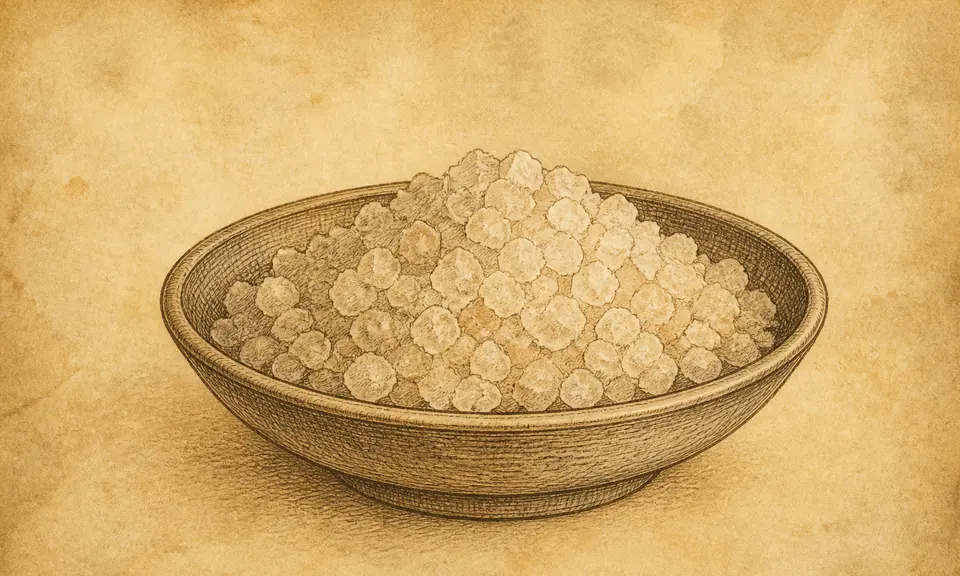
Salt

2 readings from 2 sources.

The image was generated by a model. It is not a period engraving and comes from none of the sources.

The two readings are opposite and both are short. Miller finds nothing good in salt: it is an omen of discordant surroundings, everything goes awry after the dream, quarrels show themselves in the family, salting meat means debts and mortgages, and a young woman who eats it will be deserted for a prettier girl. an-Nabulsi gives it one line: in a dream it is money without toil, and if you saw it among people who are quarrelling, they make peace. The same handful breaks a household in one book and settles a quarrel in the other.

This paragraph was generated by a model. It sums up the sources above, comes from none of them and is attributed to no one.

Arabic dream book

In a dream it is money without toil, and if you saw it among people who are quarrelling, they make peace. And whoever sees that the salt of the people has spoiled — then the plague alights upon that place, or injustice, or famine. And salt is toil and illness, and white salt is renunciation of the world and good and blessing. And whoever ate bread with salt has been content with a small thing out of the world. And the salt-cellar is a comely slave girl, and whoever found salt fell into hardship and illness. And salt is that by which every thing is set right, like the man learned in the custom of the Prophet and in the Qur'an and in the inflection of speech, and like Islam, and the wife, and money, and the child, and lawful provision. And if the one who saw was afraid and saw salt, he was granted safety, or forbearance, because the reverse of milh is hilm. And a man used to read with us in the science of the oneness of God, and then he set about reading a lesson in the science of grammar; then he saw in his sleep that he puts milk upon the fire and salt above it, and he asked me about that, and I said to him: the milk is the science of the oneness of God, and you have brought salt into it, and that is the science of grammar, as they have said: put grammar into speech as salt into food. And the salty thing points to the healing medicines among the drugs. And perhaps the sight of it points to fellowship and love and the gathering together upon what is hateful, and to the eating of doubtful things. And salted fish is glad news, and salted olives are the breaking of a covenant.

Section letter mim

The Perfuming of Mankind in the Interpretation of Dreams

Abd al-Ghani al-Nabulsi

before 1731; first printed Cairo 1858 · Arab-Islamic

carries the ancient tradition after Artemidorus

About this source

An Arabic dream book by the Damascene scholar al-Nabulsi, an alphabetical dictionary of two and a half thousand headwords. It draws on the ancient tradition directly: Artemidorus was translated into Arabic by Hunayn ibn Ishaq in the ninth century. The readings here almost always address the dreamer’s standing, property and faith rather than their feelings.

Rights: public domain

Where the text is from: https://shamela.ws/book/1217

Miller

Salt is an omen of discordant surroundings when seen in dreams. You will usually find after dreaming of salt that everything goes awry, and quarrels and dissatisfaction show themselves in the family circle. To salt meat, portends that debts and mortgages will harass you. For a young woman to eat salt, she will be deserted by her lover for a more beautiful and attractive girl, thus causing her deep chagrin.

Ten Thousand Dreams Interpreted; Or, What's in a Dream

Gustavus Hindman Miller

1901 · American Victorian

carries fragments of the ancient tradition without its system

About this source

An American dream book, the only one here that knows the telephone, the railroad or the elevator. Doctrinally it is the most degraded: it keeps fragments of the ancient tradition without the system that once held them together.

Rights: public domain

Where the text is from: https://www.gutenberg.org/ebooks/926