Preacher

3 readings from 2 sources.

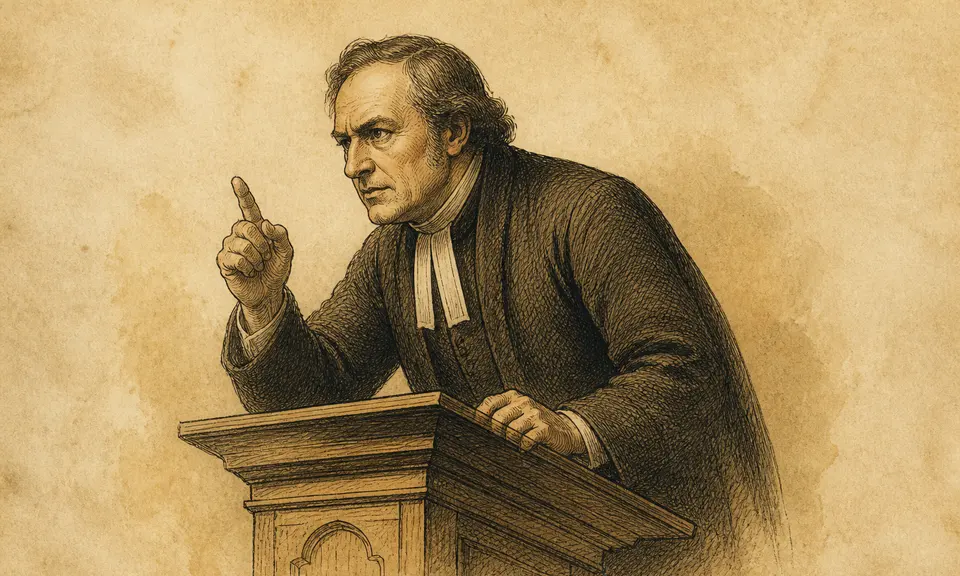
The image was generated by a model. It is not a period engraving and comes from none of the sources.

Miller writes a whole paragraph against the man: a preacher means one's ways are not above reproach, being one means losses in business, hearing preaching misfortune, arguing with him a contest lost, and a long-haired preacher disputes with overbearing and egotistical people. an-Nabulsi reads the visit: the preacher points to weeping and sorrow and cares one after another, and if he came in to a sick man, that man dies. Then he widens it to whatever a man is admonished by — the Qur'an, the tradition, an elder — and ends with the people who are an admonition in themselves. Another Arabic reading reverses Miller's and is the fullest reading of the man among them. Seeing a preacher is cleanness, humility, repentance, long life; being one, for a man whom office suits, is the office itself, and white robes in place of black are a rise. It then hangs the whole reading on one word, because the Arabic for preaching is also the Arabic for asking in marriage: an unmarried woman who sees him marries a suitor, an unmarried man goes asking. And it ends where Miller never goes — a governor whose sermon is cut off before the end loses his rule by that alone.

This paragraph was generated by a model. It sums up the sources above, comes from none of them and is attributed to no one.

Arabic dream book

In a dream he points to weeping and sorrow and cares one after another; and if the preacher came in to a sick man, that man dies. The preacher points to whatever a man is admonished by, of the Qur'an or the tradition or an elder; and he may point to the man who is himself an admonition, like the leper and the man with the whitening disease, or the like.

Section letter waw

Seeing him in a dream points to cleanness and to humility and to turning back from sins and to weeping, and to a high standing and a long life and a tie with the commanders of the faithful. And the preacher points to bidding what is right and forbidding what is wrong, and he points to joys and to the gathering at the season. So if an unmarried woman saw him, she married a suitor; and so too, if the unmarried man saw him, it pointed to his seeking to ask for a woman himself — for the one word covers the preaching and the asking. And if he saw that he became a preacher, and he was one whom offices suit, he took an office that suits him according to his worth; and if he kept, in the dream, to the conditions of preaching, he was helped in what he takes charge of. And if he put on white in place of black, his worth rose and his provision flowed. And if he put on black and did not preach, or was sitting down in the dream, he masters those of his own standing, or a blight comes down on him by which he is disgraced. Whoever sees that he preaches at the season of the pilgrimage and is not fit for the preaching, and there is none of his household fit for it, then it goes back to his namesake, or to his like among people; or he comes by some of the trials; or his name is spread abroad for piety. Whoever sees that he did the preaching and the prayer well and finished them with the people, and they were listening to his preaching, becomes a governor who is obeyed; and if he did not finish them, his succession was not completed and he was removed. And if one who is not a Muslim sees that he preaches, he becomes a Muslim or dies soon. And if a woman saw that she preaches and recites the admonitions, she comes by strength; and if her speech in the preaching was other than wisdom and admonition, she is disgraced and becomes known for what is not approved of in the doings of women. And if the governor saw that his preaching was cut off and he did not finish it, his rule passed away by that. And if a woman saw that she asks in marriage, she marries a good man; and if she preached on the Friday as the preacher preaches, then her husband divorces her and she brings a child of adultery.

Section letter kha
The Perfuming of Mankind in the Interpretation of Dreams

Abd al-Ghani al-Nabulsi

before 1731; first printed Cairo 1858 · Arab-Islamic

carries the ancient tradition after Artemidorus

About this source

An Arabic dream book by the Damascene scholar al-Nabulsi, an alphabetical dictionary of two and a half thousand headwords. It draws on the ancient tradition directly: Artemidorus was translated into Arabic by Hunayn ibn Ishaq in the ninth century. The readings here almost always address the dreamer’s standing, property and faith rather than their feelings.

Rights: public domain

Where the text is from: https://shamela.ws/book/1217

Miller

To dream of a preacher, denotes that your ways are not above reproach, and your affairs will not move evenly. To dream that you are a preacher, foretells for you losses in business, and distasteful amusements will jar upon you. To hear preaching, implies that you will undergo misfortune. To argue with a preacher, you will lose in some contest. To see one walk away from you, denotes that your affairs will move with new energy. If he looks sorrowful, reproaches will fall heavily upon you. To see a long-haired preacher, denotes that you are shortly to have disputes with overbearing and egotistical people.

Ten Thousand Dreams Interpreted; Or, What's in a Dream

Gustavus Hindman Miller

1901 · American Victorian

carries fragments of the ancient tradition without its system

About this source

An American dream book, the only one here that knows the telephone, the railroad or the elevator. Doctrinally it is the most degraded: it keeps fragments of the ancient tradition without the system that once held them together.

Rights: public domain

Where the text is from: https://www.gutenberg.org/ebooks/926