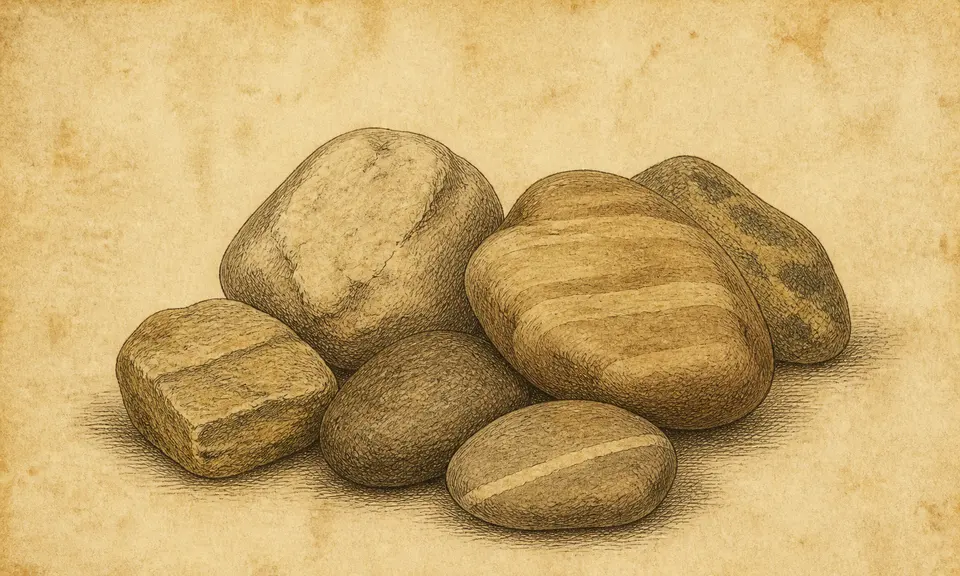
Seeing them in a dream points to men and women and to the small among people, and to counted coins, because they are of the earth; and to memorizing and reckoning up what a student has gathered of knowledge or of poetry; and to the pilgrimage and the casting of the pebbles; and to hardness and severity; and to abuse and slander. So whoever saw a bird come down from the sky and pick up a pebble and fly off with it — if that was in a mosque, a righteous man perished from it, or one of the righteous among people; and if the dreamer was sick and was of the people of good, or of those who also pray in it, and none of those who pray in it shared his illness, then the dreamer is dead. And if its picking up of the pebble was from a church, the reckoning in the sick man's ruin was like what we set out before. And if it picked it up from his house or from an unknown place, then a child of the dreamer perishes, or another. And as for the one who picked up a number of pebbles and tied them in his garment or swallowed them into his belly — if his picking them up was from a mosque or the house of a learned man or a circle of remembrance, he took in of knowledge and of the Quran and profited from the remembrance and the exposition in the measure of what he picked up of the pebbles. And if his picking up was from the markets or from the fields and the roots of the trees, then they are benefits of this world and dirhams that come together for him by reason of the fruits, or of the stones, or of begging and alms, for each man according to his resolve and his habit in waking. And if it was behind the trees, then they are gifts from the ruler if he serves him, or benefits from the sea if he trades in it, or knowledge he earns from a learned man if that is what he seeks, or a gift or a benefaction from a rich wife, if he has a child; and if he has no child, he is granted a child from a wife. And as for the one who threw them into a sea, his money went into it. And if he threw them into a well, he laid out money upon a marriage or the buying of a servant. And if he threw them into a storage pit or into one of the vessels of food or into the sea store, he bought with what he had, or in the measure of what he threw, a merchandise that is known from the place into which he threw what he had with him. And if he pelted with them an animal, like the lion and the leopard and the ape and the locust and the crow and their like — if that was in the days of the pilgrimage, he will cast the pebbles at the pillars in the time to come, because the origin of the casting is that Gabriel, peace be upon him, ordered Adam, peace be upon him, to pelt Satan with them when he came in his way, and so it became a custom. And if that was not in the days of the pilgrimage, the pebble was his prayer against an enemy or a depraved man, or an abuse, or a testimony he bears against him. And if he pelted with them other than these kinds, like doves and the Muslims among people, the man was an abuser, a backbiter, one who speaks against the righteous among people and against chaste women. And the pebbles are the learned among the people; and it is said repentance for the disobedient and guidance for the unbeliever. And sometimes the pebbles point to the testimony, because they gave glory in the palm of the Prophet, God bless him and give him peace. And sometimes the pebble is taken as the illness of it, like gravel; and it points to divining with them; and walking in them points to evil and quarrel. And sometimes it points to death, because it is carried onto the graves. And sometimes it points, for the people of a livelihood, to what they weigh or measure with, or to what is made of it, and to other things. And the pebbles are speech with hardness in it, and much of it is a work that takes a man up. And whoever saw that there is a pebble in his ears and his ear spat it out and cast it away — then he hears a hard word and his ear spits it right out.
Section letter ḥa