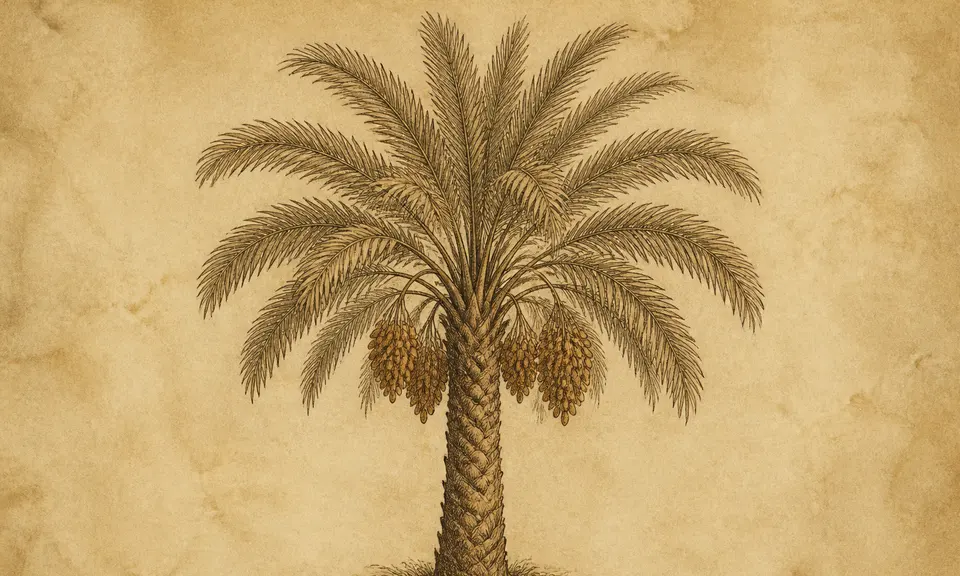
Palm tree

2 readings from 2 sources.

The image was generated by a model. It is not a period engraving and comes from none of the sources.

Miller reads the palms as a view: palm trees are messages of hopeful situations and happiness of a high order, an avenue of them means a cheerful home and a faithful husband for a young woman, and withered palms an unexpected sorrow. an-Nabulsi reads the tree as a man and then counts them: the palm is a learned man or a child, and cutting it down is his death; it is read as an Arab of good birth, high and useful to people; whoever owns many palms is set over men in that measure. A withered palm is a hypocrite — and palms torn up mean a plague on that place, or a punishment from the ruler.

This paragraph was generated by a model. It sums up the sources above, comes from none of them and is attributed to no one.

Arabic dream book

In a dream it is a learned man or a child, and cutting it down is his death. The palm is read as an Arab man of good birth, high and useful to people. Whoever owned many palms is set over men in that measure; if he was a merchant his trade increased, and if he was of the market people he came by earnings. A withered palm is a hypocrite; and if the palms were torn up, a plague falls on that place, and it may be a punishment from the ruler. And whoever sees his palm tree cut — then the matter he is upon is a hateful journey or a dispute. And the palm tree is a man's paternal aunt, and the palms are women of the Arabs. And whoever sees that a date stone became a palm tree — then a child becomes a learned man, or a man of low standing becomes high. And it is said the palms point to length of life and to children. And the palm tree is a wife, or a house, or land, or a kingdom, or a year, or clothing, or money, or a child, or a father, or a learned man. And if he saw that he cut a palm tree down — then the matter he is in, of a dispute or an office or a journey or a hateful thing, is cut off.

Section letter nun

The Perfuming of Mankind in the Interpretation of Dreams

Abd al-Ghani al-Nabulsi

before 1731; first printed Cairo 1858 · Arab-Islamic

carries the ancient tradition after Artemidorus

About this source

An Arabic dream book by the Damascene scholar al-Nabulsi, an alphabetical dictionary of two and a half thousand headwords. It draws on the ancient tradition directly: Artemidorus was translated into Arabic by Hunayn ibn Ishaq in the ninth century. The readings here almost always address the dreamer’s standing, property and faith rather than their feelings.

Rights: public domain

Where the text is from: https://shamela.ws/book/1217

Miller

Palm trees seen in your dreams, are messages of hopeful situations and happiness of a high order. For a young woman to pass down an avenue of palms, omens a cheerful home and a faithful husband. If the palms are withered, some unexpected sorrowful event will disturb her serenity.

Ten Thousand Dreams Interpreted; Or, What's in a Dream

Gustavus Hindman Miller

1901 · American Victorian

carries fragments of the ancient tradition without its system

About this source

An American dream book, the only one here that knows the telephone, the railroad or the elevator. Doctrinally it is the most degraded: it keeps fragments of the ancient tradition without the system that once held them together.

Rights: public domain

Where the text is from: https://www.gutenberg.org/ebooks/926